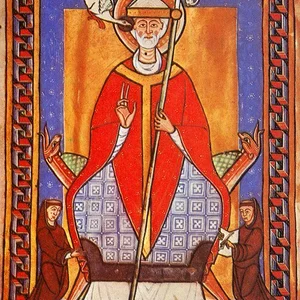

Pope from 590 to 604, Gregory I is one of the greatest pontiffs of Late Antiquity and the early Middle Ages. A reformer of the Church, he organized the evangelization mission to England and left a remarkable theological and liturgical legacy.
Gregory I(540 — 604)
Gregory I
9 min read
Frequently asked questions
Famous Quotes
« Serve Dei, serve servorum Dei. (The servant of God is the servant of the servants of God.)»
Key Facts
- Born around 540 in Rome to an aristocratic family, he became Prefect of Rome before turning to monastic life
- Elected pope in 590, in the midst of a plague epidemic and Lombard invasions threatening Rome
- Sent the monk Augustine of Canterbury in 596 to evangelize the Anglo-Saxons of England
- Reformed the Roman liturgy; Gregorian chant is traditionally attributed to him
- Died in 604, leaving an extensive correspondence (more than 800 letters) and major theological works, including the Moralia in Job
Works & Achievements
A handbook for the ideal bishop, written at the time of his election as pope. Translated into Greek during his lifetime and into Old English by King Alfred the Great, this text served as a guide for the Western episcopate throughout the Middle Ages.
A vast commentary in 35 books on the Book of Job, combining literal, allegorical, and moral exegesis. A masterpiece of Latin patristic theology, it was one of the most copied and widely read texts of the Middle Ages.
A collection of lives of Italian saints in four books, including the famous biography of Saint Benedict of Nursia (Book II). These accounts of miracles helped spread the Benedictine monastic model throughout the Western world.
Forty homilies delivered to the people of Rome on passages from the Gospels. These accessible texts showcase Gregory's gifts as a preacher and his determination to reach all the faithful.
More than 850 letters to correspondents from across the world — bishops, kings, emperors, abbots — spanning fourteen years of his pontificate. An invaluable historical source on the Church and politics at the close of the 6th century.
Gregory sent the monk Augustine with forty companions to evangelize the Anglo-Saxons. The mission led to the baptism of King Ethelbert of Kent and founded the Church of England, of which Canterbury remains the primatial see.
Gregory unified and organized the Roman liturgy, including sacred music. 'Gregorian chant,' codified and developed after his death within the tradition he had established, shaped Western Church music all the way through to the Renaissance.
Anecdotes
Before becoming pope, Gregory noticed on the slave market in Rome some fair-haired, blue-eyed young boys. Upon learning they were Angles (Angli), he is said to have replied: 'Non Angli, sed Angeli' — 'Not Angles, but Angels.' This encounter reportedly inspired him to organize a missionary expedition to England, entrusted to his monk Augustine in 596.
Gregory came from a very wealthy Roman family and could have pursued a distinguished political career. He served as Prefect of Rome around 573. But he sold all his possessions, founded six monasteries in Sicily and one in Rome, and entered religious life himself — voluntarily renouncing wealth and power for an austere monastic existence.
Elected pope in 590 in the midst of a plague epidemic, Gregory organized a penitential procession through Rome to pray for an end to the outbreak. According to legend, he saw the Archangel Michael sheathing his sword above Hadrian's Mausoleum — giving rise to the name 'Castel Sant'Angelo' that the monument would later bear.
Gregory suffered from serious health problems throughout his life — gout and chronic digestive ailments — which he attributed to the excessive monastic asceticism he had practiced before his pontificate. He governed the Church from his bed for long stretches, yet continued to dictate letters and sermons with remarkable energy. More than 800 of his letters survive.
Gregory profoundly reformed the liturgy and sacred chant. 'Gregorian chant,' though he did not invent it from scratch, is traditionally attributed to him: he is said to have compiled and organized the repertoire of liturgical melodies into an antiphonary, laying the foundations of Western sacred chant for centuries to come.
Primary Sources
Gregory to Augustine, Bishop of the English: 'The temples of the idols among that people should not be destroyed, but only the idols themselves... for if those temples are well built, it is necessary to convert them into places where the true God is worshipped.'
Quid est enim quod in hac vita arripit homo, quando ad mortem festinat? — 'What does a man grasp in this life, when he hastens toward death?' For all things that pass away are as though they had never been.
The art of guiding souls is the art of arts. He who governs others must first govern himself, lest, in tending to the wounds of others, he neglect his own.
There arose in the province of Nursia a man of great holiness, by name Benedict. From his earliest years he had the heart of an old man, and living a life beyond his years, he gave not his soul over to pleasure.
See, my dearly beloved, how this woman seeks the one she loves: she weeps before the tomb, she stoops to look inside, and she does not leave even after seeing that the tomb is empty.
Key Places
Gregory's birthplace and the seat of his pontificate. From there he administered the Church, negotiated with the Lombards, and organized relief for starving populations using the patrimony of Saint Peter.
Founded by Gregory in his own family home around 575, this Benedictine monastery was his spiritual refuge. It was from here that Augustine and his companions departed for England in 596.
Capital of the Byzantine Empire, where Gregory resided as papal legate from 579 to 585. He observed imperial power there and preached, but the experience convinced him of the urgency of an autonomous Roman Church.
The city where the mission sent by Gregory in 596 established itself. Augustine became its first archbishop, founding a religious institution that shaped English Christianity for centuries.
Birthplace of Saint Benedict, whose biography Gregory wrote in his Dialogues. The Benedictine Rule, which Gregory deeply admired, inspired his entire ecclesiology and his vision of monastic life.
Liens externes & ressources
Références
Œuvres
Regula Pastoralis (Règle pastorale)
590
Moralia in Job
578-595
Dialogues
593-594
Homiliae in Evangelia (Homélies sur les Évangiles)
590-592
Registrum Epistularum (Registre des Lettres)
590-604
Mission d'Augustin en Angleterre
596-601
Réforme liturgique et chant grégorien
590-604