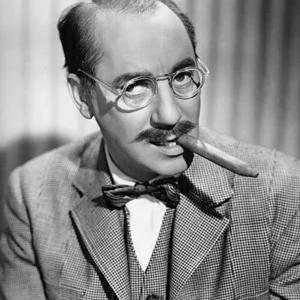

American comedian born in 1890, iconic figure of the Marx Brothers. Star of vaudeville, film, and television, he is famous for his absurdist humor, sharp one-liners, and his iconic painted mustache character.
Groucho Marx(1890 — 1977)
Groucho Marx
États-Unis
9 min read
Frequently asked questions
Famous Quotes
« I refuse to join any club that would have me as a member.»
« Those are my principles, and if you don't like them… well, I have others.»
Key Facts
- Born October 2, 1890 in New York under the name Julius Henry Marx
- The Marx Brothers got their start in vaudeville in the 1910s
- Major box-office success with Duck Soup (1933) and A Night at the Opera (1935)
- Host of the television game show You Bet Your Life from 1950 to 1961
- Died August 19, 1977 in Los Angeles
Works & Achievements
Considered the absolute masterpiece of the Marx Brothers and a pinnacle of slapstick comedy worldwide. A fierce satire of militarism and nationalism, the film was banned by Mussolini in Italy and is today part of many film studies curricula.
The first film produced by MGM, it became the Marx Brothers' greatest commercial success. The overcrowded stateroom scene is regularly cited among the most brilliantly comic sequences in cinema history.
A film adaptation of their Broadway revue, in which Groucho plays Captain Spaulding, a boastful explorer. The film contains some of his most quoted lines and was one of their first major successes in the sound era.
A game show hosted by Groucho for fourteen years, first on radio then on television. His gift for verbal improvisation and spontaneous exchanges with contestants made it one of the first great American television entertainment shows.
Groucho Marx's memoirs tracing his childhood in New York, his vaudeville years, and his Hollywood career. A valuable historical source on the American entertainment world of the first half of the twentieth century, written with humor and self-deprecation.
A collection of Groucho's correspondence with friends, celebrities, and strangers, including T.S. Eliot. The book reveals the literary and intellectual side of the comedian, a passionate reader and master of the written pun.
Anecdotes
His nickname “Groucho” comes, according to family tradition, from a “grouch bag” — a small pouch worn around the neck by traveling vaudeville performers to stash their savings. Julius Marx was known for keeping his on him at all times during tours, and his brothers reportedly gave him the nickname long before he became famous.
The British poet T.S. Eliot, Nobel Prize winner in Literature, was a passionate admirer of the Marx Brothers. From 1961 onward, he and Groucho maintained a regular correspondence, and the two met for dinner in London in June 1964. The scene was surreal: Eliot wanted to talk about the Marx Brothers' films, while an intimidated Groucho wanted to discuss his host's poetry.
One of his most famous quips was born from a real event: having applied for membership at New York's Friars Club, Groucho eventually sent a resignation letter declaring that he would not want to belong to any club that would accept someone like him as a member. The line, recounted in his autobiography *Groucho and Me* (1959), became one of the most quoted sayings of the twentieth century.
For his show *You Bet Your Life* (1950–1961), Groucho improvised so freely that producers sometimes recorded several hours of footage to end up with just thirty minutes of broadcast material. In 1961, NBC deliberately destroyed hundreds of original reels, deeming them to have no commercial value — a loss now regarded as a major disaster for America's audiovisual heritage.
Despite his image as a harmless clown, Groucho was monitored by the FBI for several years during the McCarthy era. J. Edgar Hoover suspected that his subversive humor and political satires — most notably *Duck Soup*, which was banned by Mussolini in Italy — concealed communist sympathies. A file running to several dozen pages was compiled without ever uncovering anything incriminating.
Primary Sources
I don't care to belong to any club that will have me as a member. This is my resignation from the Friars Club.
Dear Groucho, I have your photograph on my mantelpiece and I have been bragging about your proposed visit to London to such an extent that I can now only justify it by producing you in the flesh.
A man is only as old as the woman he feels. I have never found this to be true in practice, but it looks well in print.
Subject is known for subversive humor in films and radio programs. His political affiliations and associations are under review.
Key Places
The neighborhood where Julius Henry Marx was born, then populated by German and Ashkenazi Jewish immigrants. It was in this working-class environment that the Marx Brothers grew up and developed their sense of humor, shaped by street life and the vaudeville shows of the area.
The studio where the Marx Brothers made their first five talking pictures between 1929 and 1933 (*The Cocoanuts*, *Animal Crackers*, *Monkey Business*, *Horse Feathers*, *Duck Soup*). It was at Paramount that their absurdist, subversive comic style fully came into its own.
After leaving Paramount, the Marx Brothers joined MGM for their most commercially successful films, including *A Night at the Opera* (1935). MGM imposed stricter narrative constraints, steering their humor toward a broader audience.
A leisure club frequented by Jewish Hollywood celebrities at a time when other country clubs were closed to them. Groucho played golf there for decades, and it is said to be where his famous quip about clubs that would accept him as a member took its definitive form.
An upscale residential neighborhood in Beverly Hills where Groucho Marx spent his final decades. It was there that he welcomed admirers and celebrities — including Woody Allen and Alice Cooper — and where he died on August 19, 1977.
Typical Objects

An iconic stage prop for Groucho, the cigar was both a comic tool and a central element of his persona. He would hold it, point with it, and chew on it during performances, but almost never light it — he used it like a conductor's baton.

A mustache drawn in stage makeup (greasepaint) on his upper lip, rather than a real false mustache. This cheaper and more expressive technique became his absolute trademark, to the point that he continued wearing it long after his earliest films.
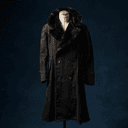
The long, fitted coat worn by Groucho's stage character, inherited from vaudeville and burlesque traditions. This deliberately old-fashioned and slightly ridiculous outfit amplified the caricatural nature of his persona and set him apart visually from his brothers.

A large standing condenser microphone, symbol of radio and television broadcasts in the 1940s and 1950s. Groucho used one for fourteen years hosting *You Bet Your Life*, transforming verbal improvisation into the art of televised entertainment.

Professional motion picture camera used in Hollywood studios during the 1930s and 1940s. It was in front of these cameras — first at Paramount, then at MGM — that the Marx Brothers filmed their most celebrated works.

Groucho was a prolific letter writer who personally answered his correspondence on a typewriter. His letters — most notably his exchange with T.S. Eliot — reveal a rich intellectual life behind the image of the clown.
School Curriculum
Vocabulary & Tags
Key Vocabulary
Tags
Daily Life
Morning
During his Hollywood golden years (1930s–1950s), Groucho woke early — a habit carried over from vaudeville tours when trains departed at dawn. He read several daily newspapers and personally typed his own replies at the typewriter; he was a prolific letter-writer who never delegated his correspondence.
Afternoon
Filming afternoons were filled with rehearsals, lively arguments with screenwriters whose lines he freely rewrote, and makeup sessions to paint on his greasepaint mustache. Off set, he regularly played tennis or golf at the Hillcrest Country Club in Beverly Hills, his club of choice.
Evening
An avid bridge and poker player, Groucho often entertained intellectual friends — writers and musicians alike. A passionate reader of English literature — Dickens, Mark Twain, G.B. Shaw — he knew the Gilbert and Sullivan operettas by heart and would readily sing them for his guests.
Food
Raised in a modest immigrant family, Groucho kept simple tastes throughout his life: Ashkenazi staples (pastrami, matzo ball soup) and classic American studio fare (sandwiches, black coffee). Contrary to his image, he did not actually smoke his cigars — he used them purely as a stage prop.
Clothing
In everyday life, Groucho dressed simply and comfortably, far from his stage costume. He favored relaxed Californian attire — dress trousers, open shirt — and shed the frock coat, painted mustache, and oversized glasses the moment filming wrapped.
Housing
Groucho spent most of his adult life in Beverly Hills, first in several family homes and later in a house in Trousdale Estates. Unlike many Hollywood stars, he made no effort to flaunt an extravagant lifestyle, preferring a comfortable home to a mansion.
Historical Timeline
Period Vocabulary
Liens externes & ressources
Références
Œuvres
You Bet Your Life (émission radio puis télévision NBC)
1947-1961
Groucho and Me (autobiographie)
1959
The Groucho Letters
1967