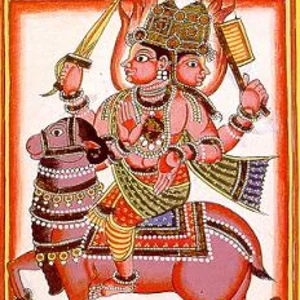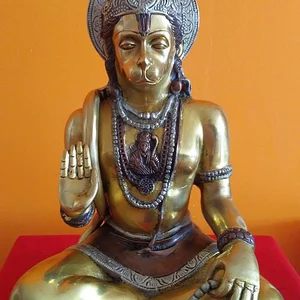

A Hindu deity in the form of a monkey, Hanuman is the devoted servant of the god Rama in the epic Ramayana. A symbol of devotion, strength, and courage, he is one of the most venerated figures in Hinduism.
Hanuman
Hanuman
8 min read
Frequently asked questions
Key Facts
- Hanuman is a central figure in the Ramayana, the Sanskrit epic attributed to the sage Valmiki (around the 5th–2nd century BCE)
- He helps Rama rescue his wife Sita, who has been abducted by the demon Ravana
- He can fly, change his size, and possesses superhuman strength
- His absolute devotion to Rama makes him the embodiment of bhakti (devotion) in Hinduism
- He remains one of the most widely worshipped deities in India to this day
Works & Achievements
Hanuman performs his legendary leap across the ocean to locate Sita, held captive in the Ashoka garden. He delivers Rama's ring to her and announces that her rescue is near.
Captured by Ravana, who orders his tail set on fire, Hanuman turns this torment against his captors by setting the entire city of Lanka ablaze. This act marks the beginning of the demon kingdom's downfall.
Hanuman lifts an entire mountain from the Himalayas to bring back the miraculous Sanjeevani herb and save Lakshmana. This colossal feat has become the ultimate symbol of boundless devotion.
Hanuman leads the Vanara armies in constructing a bridge of floating stones to cross the ocean and attack Lanka. This bridge is identified in tradition with the natural sandbar between India and Sri Lanka.
Hanuman fights alongside Rama in the final battle against Ravana and his demon army. His strength and military strategy prove decisive in securing victory for the side of the gods.
Tulsidas composes a hymn of 40 couplets summarizing Hanuman's great deeds. Recited daily by millions of Hindus, it is one of the most widely read religious texts in the world.
Anecdotes
As a child, Hanuman mistook the Sun for a ripe fruit and leaped toward it to take a bite. Terrified by this attack, Indra, god of lightning, struck him with his thunderbolt and shattered his jaw. This is how his name came to literally mean "broken jaw" in Sanskrit.
To find Sita, held captive by the demon Ravana on the island of Lanka, Hanuman made a tremendous leap across the ocean. The texts of the Ramayana describe this jump as a display of his immense divine power — one that set the waves in motion and shook the entire sky.
Captured by Ravana's soldiers, who set his tail ablaze as punishment, Hanuman turned this torment against his enemies and burned the entire city of Lanka to the ground. He then escaped without a single burn, protected by his father Vayu, god of the wind.
When Lakshmana, Rama's brother, was gravely wounded in battle, only the Sanjeevani herb could save him. Unable to identify it in the darkness, Hanuman made the spectacular decision to lift the entire Himalayan mountain and carry it to the battlefield.
One day, sages asked Hanuman to prove his devotion to Rama. He opened his own chest with his bare hands, revealing in his heart the image of Rama and Sita entwined together. This episode has become one of the most powerful symbols of bhakti — total devotion — in Hinduism.
Primary Sources
Then Hanuman, son of the wind, standing atop Mount Mahendra, resembling a mountain himself, gathered his strength and leapt with prodigious force across the salt waters to reach Lanka.
Seeing Lakshmana lying lifeless, Hanuman flew to the Himalayas. Unable to identify the Sanjeevani herb in the darkness, he lifted the entire mountain and carried it back in his mighty arms.
O Hanuman, ocean of wisdom and virtue, I sing your praises. Son of Vayu, you illuminate the three worlds with your glory. You carry Rama in your heart at every moment.
When he caught sight of Mother Janaki in the Ashoka grove, Hanuman rejoiced in his heart, for his lord Rama's mission was on course. He then placed Rama's ring at her feet.
Bhima came upon an old monkey lying across the path, its tail blocking the way. Unable to move it despite all his strength, Bhima recognized in him Hanuman, his divine brother, son of Vayu.
Key Places
The mythical citadel of the demon king Ravana, traditionally identified with Sri Lanka. It is here that Hanuman performs his most celebrated feats: finding Sita, setting the city ablaze, and taking part in the final battle against the demon king.
The subterranean city of the divine monkey people, identified with the Hampi region in Karnataka. It is here that Hanuman first meets Rama, and where the monkey king Sugriva rules over the Vanara people.
Rama's royal city on the banks of the Sarayu River, capital of the kingdom of Kosala. After the victory over Ravana, Hanuman dwells here as Rama's devoted servant; a towering statue of Hanuman is venerated in the city.
A Himalayan peak from which Hanuman uproots the Sanjeevani herb to save Lakshmana. This summit is identified in various local traditions with pilgrimage sites in Uttarakhand, in northern India.
A sacred island in southern India, the mythical launching point of the bridge built by the Vanaras to reach Lanka. Hanuman played a key role in the construction of Ram Setu alongside his army of divine monkeys.
Typical Objects

A heavy ritual metal weapon that Hanuman holds in his classical iconography, symbolizing his superhuman strength. It represents his ability to fight the forces of evil as a divine warrior in service of dharma.

Rama gives his personal ring to Hanuman as a token of recognition for Sita. Hanuman places it at Sita's feet during their secret meeting in the gardens of Lanka, proving that he is indeed his lord's messenger.

An entire Himalayan mountain that Hanuman lifts and carries to save the gravely wounded Lakshmana. This colossal act has become the symbol of boundless devotion and miraculous strength placed in the service of good.

A miraculous medicinal plant capable of reviving warriors killed or wounded on the battlefield. Hanuman searches for it in the Himalayas — an episode that illustrates his absolute loyalty to Rama and those dear to him.

Upon his capture in Lanka, Ravana's soldiers set his tail on fire as punishment. Hanuman turns this weapon against them and burns the entire city, demonstrating that the demons' schemes always backfire on them.

In the Mahabharata, Hanuman adorns the flag of Arjuna's chariot, granting him divine protection during the Battle of Kurukshetra. This detail symbolizes the spiritual continuity between the two great Hindu epics.
School Curriculum
Vocabulary & Tags
Key Vocabulary
Daily Life
Morning
Hanuman begins each dawn with meditation and the recitation of Rama's sacred names (japa), turning his gaze toward the rising sun in homage to his father Vayu. He then dedicates his morning to martial training, maintaining his prowess as the invincible warrior in service of his divine master.
Afternoon
In the afternoon, Hanuman carries out the missions Rama entrusts to him: espionage, scouting new territories, or diplomacy with other kings. As a faithful messenger, he travels at supernatural speed using his power of flight, crossing forests, mountains, and oceans in an instant.
Evening
In the evening, Hanuman retreats to the sacred space dedicated to Rama and Sita to recite hymns and watch over his lord's sleep. For Hindu devotees, Hanuman never truly sleeps: he remains in a state of constant vigilance, the eternal guardian and protector of the faithful.
Food
Hanuman is vegetarian, as are all great Vaishnava devotees, subsisting mainly on fruits, roots, nuts, and leaves — the symbolic diet of forest dwellers and ascetics in the Indian tradition. His favorite fruits are figs, mangoes, and the fruits of the tropical forests.
Clothing
Hanuman wears a saffron or red dhoti tied at the waist, the color of devotion and renunciation in Hinduism. He is adorned with golden ornaments — bracelets, a necklace, and a belt — and crowned with a royal headdress symbolizing his status as a prince among the Vanaras, his body naturally covered in reddish-orange fur.
Housing
Hanuman lives in nature and sacred forests, in caves and on mountain peaks — places of meditation and spiritual power. In Kishkindha, he resides in the Vanara city carved into the rock, but his true home is wherever Rama is.
Historical Timeline
Period Vocabulary
Visual Style
Iconographie classique hindoue inspirée des miniatures Rajput et Mughal : Hanoumân en divinité-singe safranée et dorée, couronné, brandissant sa masse et une montagne himalayenne, dans un décor de forêt et d'océan cosmique.
Sound Ambience
Ambiance sonore mêlant la forêt tropicale indienne, les chants védiques, le fracas des batailles épiques du Râmâyana et le souffle divin du vent, père d'Hanoumân.
Liens externes & ressources
Références
Œuvres
Traversée de l'océan et découverte de Sita à Lanka
Treta Yuga (temps mythologique)
Incendie de Lanka
Treta Yuga (temps mythologique)
Transport de la montagne Dunagiri
Treta Yuga (temps mythologique)
Construction du pont vers Lanka (Ram Setu)
Treta Yuga (temps mythologique)
Combat lors de la bataille finale contre Ravana
Treta Yuga (temps mythologique)
Hanuman Chalisa (hymne composé en son honneur par Tulsidas)
1574 apr. J.-C.