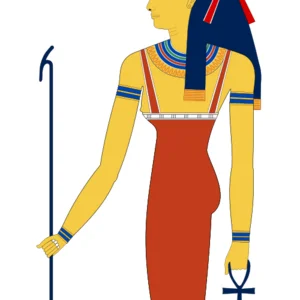

An Egyptian goddess venerated since the Old Kingdom (c. 2700 BCE), Hathor is associated with love, music, joy, femininity, and the sky. Depicted as a cow or as a woman with bovine horns bearing the solar disk, she is one of the most popular deities in the Egyptian pantheon.
Frequently asked questions
Key Facts
- Attested in the Pyramid Texts as early as c. 2400 BCE, she is one of the oldest known Egyptian goddesses
- Her great temple at Dendera, preserved nearly intact, dates mainly from the Ptolemaic period (c. 54 BCE) but stands on the foundations of much older sanctuaries
- She is depicted as a cow, as a woman with a cow's head, or as a woman wearing a solar disk between two bovine horns
- Associated with the god Ra as his daughter or his eye, she can take on a destructive aspect under the name Sekhmet
- Her cult was celebrated through musical festivals and ritual processions; the sistrum (a percussion instrument) was sacred to her
Works & Achievements
A masterpiece of Egyptian religious architecture, this temple is entirely dedicated to Hathor and preserves exceptional reliefs and inscriptions. Its astronomical ceiling featuring the circular zodiac is one of the most valuable scientific documents of the ancient world.
Built by Ramesses II to honor Hathor and Queen Nefertari, this small monolithic temple carved directly into the rock is a unique testament to royal devotion to the goddess.
A foundational narrative codifying Hathor's duality — goddess of love and destructive force. This myth is inscribed in the tomb of Seti I at Abydos and remains one of the most complete Egyptian mythological texts in existence.
A corpus of liturgical hymns carved into the Temple of Philae, celebrating Hathor as a universal goddess. These texts are a valuable source for understanding late Egyptian theology.
A circular bas-relief depicting the celestial vault with constellations and planets, created in the sanctuary of Hathor. It is now housed in the Louvre Museum in Paris.
Anecdotes
Hathor was nicknamed 'the Lady of the Sycamore' because Egyptians believed she hid within sycamore fig trees to offer food and fresh water to the souls of the dead. Depictions show her emerging from a tree trunk, extending fruits and water jars to mummies.
According to the myth of 'The Destruction of Mankind,' the aging sun god Ra, mocked and disrespected by humanity, sent Hathor in her destructive form — the Eye of Ra — to punish humankind. Transformed into Sekhmet the lioness, she unleashed such slaughter that Ra himself had to resort to trickery to stop her: he had beer dyed red to resemble blood, and Hathor, drinking it in a frenzy, fell into a drunken sleep and grew calm.
The Temple of Hathor at Dendera, built during the Greco-Roman period, features a circular zodiac on its ceiling — one of the oldest known astronomical star maps. This zodiac, now housed in the Louvre, reflects the deep connection between Hathor, the sky, and the stars.
Hathor's priestesses played the sistrum, a metal percussion instrument whose sound was believed to drive away evil spirits and delight the goddess. Its metallic rattle marked festivals, processions, and funerary rituals throughout ancient Egypt.
Hathor was also venerated as the protector of miners and quarry workers. In the Sinai Peninsula at Serabit el-Khadim, Egyptian workers who mined turquoise dedicated a rock-cut temple to her and gave her the title 'Lady of Turquoise.'
Primary Sources
Hail to you, Hathor, Lady of the West! You give bread, beer, and all good things to the soul of the deceased, for you are the mistress of joy and music.
And Ra said: 'Bring beer dyed red as blood.' And Hathor drank, and her heart was gladdened, and she no longer recognized mankind.
You are the lady of the sky, the mistress of the two lands, the face of the solar disk, the eye of Ra who has no equal. The gods praise you and men worship you.
To Hathor, Lady of Turquoise, may the king offer her incense and wine so that she may protect the miners and grant them her favor.
I belong to her as Hathor belongs to the sun god. Her love is my sun, her presence is my music, and when she smiles at me, the festival of Hathor begins.
Key Places
The main sanctuary of Hathor, built during the Ptolemaic period. It is one of the best-preserved Egyptian temples and houses the famous circular zodiac, now held at the Louvre.
A rock-cut temple dedicated to Hathor, 'Lady of Turquoise', built by Egyptian miners who extracted turquoise in this region. One of the oldest sites of Hathor worship outside the Nile Valley.
The small temple of Abu Simbel, dedicated to Hathor and Queen Nefertari by Ramesses II, represents one of the finest expressions of Hathoric worship during the New Kingdom.
A major religious center where the 'Beautiful Festival of the Valley' honored Hathor each year, bringing the community together to celebrate rebirth and the bond between the living and the dead.
Capital of the Old Kingdom where Hathor was venerated from the earliest times as protector of the king and goddess of the sky, alongside Ptah and Sokar.
Typical Objects

A percussion instrument made of metal or wood, shaken during rituals honoring Hathor. Its sound was believed to drive away evil spirits and delight the goddess of music and joy.

A heavy beaded necklace with a counterweight, one of Hathor's most distinctive attributes. It was rattled like a sistrum during ceremonies and symbolized fertility, protection, and renewal.

Hathor's iconic headdress, depicting the sun held between her cow horns. This symbol reflects her role as mother of the sun and goddess of the sky.

An offering object frequently dedicated to Hathor, whose handle was often carved in the shape of the goddess's face. It symbolized beauty, femininity, and reflected sunlight.

A gemstone closely associated with Hathor, who was known as the 'Lady of Turquoise.' Miners in the Sinai would offer her this blue-green stone in hopes of her protection deep within the mines.

Hathor's sacred tree, beneath which she was believed to appear in order to offer water, bread, and fruit to the dead. Her temples were often surrounded by these sacred fig trees.
School Curriculum
Vocabulary & Tags
Key Vocabulary
Daily Life
Morning
In the temples of Hathor, at dawn, the priestesses opened the sanctuary doors while singing to 'awaken' the goddess. They washed and dressed the divine statue, offering food and incense to recharge her divine energy for the day ahead.
Afternoon
Worshippers came to leave votive offerings — bronze mirrors, sistrums, cow figurines — and offered prayers for fertility, love, or protection during childbirth. The priestesses played the sistrum and menat during daytime rituals to maintain cosmic harmony.
Evening
At nightfall, the priestesses sang hymns to accompany the setting sun, a symbol of Ra's nocturnal journey through the womb of Hathor. Oil lamps and incense burned throughout the night in the inner sanctuary.
Food
Food offerings placed before Hathor included bread, beer, dates, figs, roasted poultry, and milk. Beer held particular symbolic significance, rooted in the myth in which Ra used it to calm the goddess's wrath.
Clothing
Hathor's priestesses wore a long white linen robe, a large menat collar made of faience and carnelian beads, and sometimes a black wig adorned with a miniature bovine headdress. High-ranking officiants wore falcon feathers and golden sun discs.
Housing
The 'domain of Hathor' (the temple) was a vast complex with a sacred lake, sycamore gardens, workshops for crafting sistrums, and living quarters for the priests and priestesses. The central naos — dark and fragrant with incense — housed the sacred statue, inaccessible to the general public.
Historical Timeline
Period Vocabulary
Visual Style
Le style visuel d'Hathor s'inscrit dans la tradition égyptienne classique : aplats de couleurs chaudes (or, ocre, turquoise), silhouette hiératique et coiffure bovine caractéristique ornée du disque solaire.
Sound Ambience
L'ambiance sonore des temples d'Hathor mêle le tintement métallique des sistres, les chants des prêtresses et le souffle chaud du désert, créant une atmosphère à la fois festive et sacrée.
Liens externes & ressources
Références
Œuvres
Temple d'Hathor à Dendéra
Ier siècle av. J.-C. (époque ptolémaïque)
Chapelle hathorique d'Abou Simbel
vers 1255 av. J.-C.
Le Mythe de la Destruction de l'Humanité
vers 1350 av. J.-C.
Hymnes à Hathor du temple de Philae
IIIe-Ier siècle av. J.-C.
Zodiaque circulaire de Dendéra
vers 50 av. J.-C.