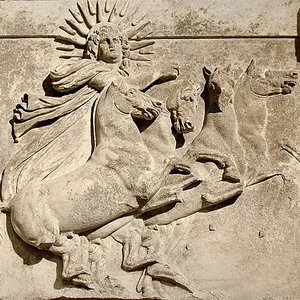

Helios is the sun god of Greek mythology, son of the Titan Hyperion and Theia. Each day, he crosses the sky in his fiery chariot pulled by four spirited horses, bringing light to mortals and gods alike.
Helios
Helios
10 min read
Frequently asked questions
Key Facts
- Son of the Titan Hyperion and Theia, brother of Selene (the Moon) and Eos (the Dawn)
- Each day he drives his solar chariot from east to west across the sky
- His son Phaethon tried to drive the chariot and nearly set the Earth ablaze — Zeus had to strike him down with a thunderbolt
- He revealed to Hephaestus the affair between Ares and Aphrodite, thanks to his all-seeing vision
- The Colossus of Rhodes, one of the Seven Wonders of the Ancient World, was dedicated to him
Works & Achievements
Each day, Helios completes his crossing of the sky from east to west, bringing light and warmth to the world of mortals and gods alike. This cosmic task is his fundamental work and the guarantee of the natural order of the world.
Seeing all from his chariot, Helios is invoked as the supreme witness of the most solemn oaths. The gods themselves call upon him to bear witness to their pledges, granting him a unique moral authority within the Greek pantheon.
It is Helios who, having seen everything from his chariot, reveals to Hephaestus the affair between his wife Aphrodite and Ares. This act illustrates his role as an impartial witness and his participation in divine justice among the Olympians.
Father of Circe and Aeëtes (and grandfather of Medea), Helios passes on to his descendants a magical power linked to fire and light. This solar lineage leaves its mark on numerous Greek and Latin mythological tales.
Although a human creation, the giant statue of Helios erected by the Rhodians testifies to the importance of his cult. Standing roughly 30 meters tall in bronze and counted among the Seven Wonders of the Ancient World, it remained an architectural landmark for centuries.
Anecdotes
Helios is one of the few gods who sees and hears everything from his chariot as he crosses the sky each day. According to legend, he was the first to inform Hephaestus that his wife Aphrodite was being unfaithful to him with Ares. This role as the all-seeing witness made him a guarantor of oaths: swearing by Helios was the most solemn formula in the Greek world.
The myth of Phaethon is one of the most dramatic stories in Greek mythology. Son of Helios, Phaethon demanded to drive the solar chariot to prove his divine origin. But the four fiery horses veered out of control, scorching the Earth; Zeus had to strike him down with a thunderbolt to end the disaster. The Greeks used this story to explain the formation of African deserts and the dark complexion of southern peoples.
In Homer's Odyssey, the island of Thrinacia is home to the sacred herds of Helios: seven hundred immortal cattle and sheep. Hermes had warned Odysseus never to touch them. Driven by hunger, his companions disobeyed and slaughtered several animals. Helios threatened Zeus that he would never shine upon the world again if he was not avenged; all those responsible perished in a shipwreck.
The island of Rhodes was regarded by the Greeks as the earthly domain of Helios. According to Pindar, when Zeus was dividing the lands among the gods, Helios was away driving his chariot; to make it up to him, Zeus raised a new island from the sea. The Rhodians worshipped him fervently and erected in his honor the Colossus of Rhodes, a giant statue roughly 30 meters tall and one of the Seven Wonders of the Ancient World.
Each night, after setting the sun in the west, Helios crossed the cosmic Ocean from west to east in an enormous golden cup to return to his starting point before dawn. The hero Heracles borrowed this cup to cross the Ocean during one of his labors, according to the poet Stesichorus; Helios's patience in the face of such boldness was taken as proof of his goodwill toward great heroes.
Primary Sources
Sing, O Muse, of great Helios, son of divine Hyperion, whom divine Euryphaessa, beautiful among the Immortals, bore to her brother Hyperion. He shines upon mortals and upon the Immortals from his divine head, his terrible eyes gleaming beneath a golden helmet.
Hyperion united in love with Euryphaessa, his sister, who bore him rosy-armed Eos, fair-tressed Selene, and tireless Helios, like unto the immortal gods, who shines upon mortal men and upon the deathless gods.
Helios Hyperionides cried out to them: 'Father Zeus and you blessed, everlasting gods, take vengeance on the companions of Odysseus, son of Laertes, who have slaughtered my cattle in which I took such joy as I journeyed up toward the starry sky and turned once more down toward the earth.'
It came to pass that when Zeus and the Immortals were dividing the earth among themselves, Rhodes was not yet visible on the surface of the briny sea. The island was then allotted to Helios, the god who watches over mortals, and he received it as his rightful domain among the nations of the earth.
The Sun, the father, hid his radiant face in grief, and it is said that day passed without sunlight — the burning of the world itself gave light. Then Jupiter, from the summit of his highest citadel, called the gods to witness and hurled his thunderbolt at the charioteer.
Key Places
Greek island in the Aegean Sea, sacred to Helios since antiquity. According to Pindar, Zeus gave it to the god as compensation for his absence during the division of lands among the gods. The Colossus of Rhodes, a giant statue of Helios, was erected there around 280 BC.
Mythical dwelling of Helios at the eastern gates of the world, where Ocean meets the sky. Ovid describes it adorned with golden columns, ivory roofs, and silver doors engraved with images of the cosmos; it is from here that the solar chariot sets out each morning.
Mythical island where the seven hundred immortal cattle and sheep of Helios graze, tended by his daughters Phaethusa and Lampetia. Homer places here the sacrilege committed by the companions of Odysseus, which led to their shipwreck and death.
Sacred mountain and home of the gods, where Helios reports his observations to Zeus each evening. His celestial omniscience grants him the role of official witness before the divine council and the great decisions of Olympus.
Mythical river flowing at the extreme edge of the known world, which Helios crosses each night in his golden cup to return from west to east. It marks the boundary between the world of the living, the world of the dead, and the domain of the primordial gods.
Typical Objects

A chariot of gold and fire that Helios drives each day from east to west across the vault of the sky. It is his most iconic attribute, a symbol of the sun's regular course and of the cosmic order he upholds.

Harnessed to Helios's chariot, his four horses are named, depending on the source, Pyrois (the Fiery), Eous (the Dawn-bringer), Aethon (the Blazing), and Phlegon (the Burning). They embody the phases and ardor of the sun, and their uncontrollable spirit caused the fall of Phaethon.

A halo or crown of radiant light surrounding Helios's head, representing the sun's rays. It is his most recognizable iconographic attribute in ancient sculpture and pottery, later echoed in depictions of the Colossus of Rhodes.

An enormous golden cup in which Helios sails each night across the waters of Ocean to travel back from west to east before dawn. This object appears in several poetic accounts, notably in Stesichorus and Mimnermus, and symbolizes the perpetual cycle of time.

A driver's whip that Helios wields to guide his spirited horses across the sky. It symbolizes divine mastery over time and light, and serves as a reminder that even the most powerful forces of nature obey a higher order.

Helios is often depicted wearing a mantle or peplos of purple and gold billowing in the wind of his celestial ride, evoking the hues of the sky at dawn and sunset. This royal garment underscores his dignity as one of the oldest gods in the Greek pantheon.
School Curriculum
Vocabulary & Tags
Key Vocabulary
Daily Life
Morning
Each morning, Helios awakens in his eastern palace with its gates of gold and ivory, at the edge of the world. His sister Eos (the Dawn) opens the gates of heaven before him, spreading the rosy light of dawn across the earth. Helios then mounts his blazing chariot, seizes the reins of his four divine horses, and launches himself toward the zenith in an explosion of golden light.
Afternoon
At the height of his journey, Helios is at the peak of his power: his light bathes the entire visible world, from the oceans to the highest mountains. From above, he watches everything that takes place among gods and mortals, letting nothing escape his gaze. Men, aware of his all-seeing eye, are careful to avoid wrongdoing in the full light of day.
Evening
As the day draws to a close, Helios guides his weary horses toward the western horizon and descends into the waters of Oceanus. He then boards his golden cup for the long night crossing that will carry him back to the east before dawn. His sister Selene (the Moon) takes his place in the sky to guide travelers and sailors through the night.
Food
As an immortal god, Helios feeds on ambrosia and drinks nectar — the food and drink of the Olympian gods that confer immortality. His sacred herds on Thrinacia — seven hundred immortal cattle and sheep — are not meant for his consumption, but are symbols of his divine power and the solar fertility he spreads across the world.
Clothing
Helios is depicted wearing a purple cloak embroidered with gold, billowing in the wind of his celestial ride. He wears a radiant crown or a helmet adorned with shining rays spreading out around his head. His body gives off a light so intense that mortals cannot look upon him directly without being blinded, according to mythological tradition.
Housing
The home of Helios is a magnificent palace located at the eastern edge of the world, where the cosmic Ocean meets the sky. Ovid describes it in the Metamorphoses as adorned with columns of solid gold, roofs of polished ivory, and silver doors engraved with images of the heavens, the earth, and the sea. At night, Helios rests in his golden cup as it sails along Oceanus, between the setting and the rising of the sun.
Historical Timeline
Period Vocabulary
Visual Style
Style grec antique classique et hellénistique : Hélios rayonnant en jeune dieu couronné de lumière, debout sur son char d'or tiré par quatre chevaux de feu, sur fond de ciel aux teintes d'ambre et d'azur égéen.
Sound Ambience
Ambiance sonore du char solaire d'Hélios : flammes crépitantes, sabots fougueux des chevaux divins et vents célestes entrecoupés du murmure de l'Océan cosmique à l'aurore et au crépuscule.
Liens externes & ressources
Références
Œuvres
La course céleste quotidienne
Éternelle (mythologique)
Garant des serments divins
Mythologique
Révélation de l'adultère d'Arès et Aphrodite
Mythologique (Odyssée, chant VIII)
Transmission du pouvoir solaire à sa descendance
Mythologique
Le Colosse de Rhodes
~280 av. J.-C.