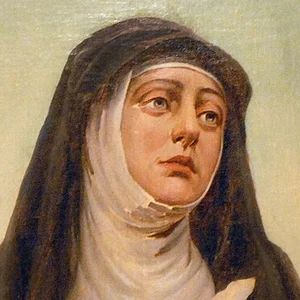

A French intellectual of the 12th century, Héloïse is celebrated for her passionate correspondence with the philosopher Peter Abelard, whose student and secret wife she became. Later abbess of the Paraclete, she was one of the most learned women of her time.
Héloïse d'Argenteuil(1101 — 1164)
Héloïse d'Argenteuil
France
7 min read
Frequently asked questions
Famous Quotes
« I preferred love to marriage, freedom to constraint.»
« I sought in you only yourself, not what you had.»
Key Facts
- Around 1090: likely born in Paris or the Île-de-France region
- Around 1115–1116: relationship and secret marriage with Peter Abelard, her tutor
- Around 1118: entered the convent of Saint-Argenteuil following Abelard's mutilation
- 1129: founding of the Paraclete, of which she became abbess
- 1164: death and burial at the Paraclete, alongside Abelard
Works & Achievements
A collection of letters exchanged between Heloise and Abelard following his Historia Calamitatum, offering an exceptional account of love, monastic vocation, and the condition of women in the Middle Ages. These letters are considered among the finest examples of medieval Latin prose.
A collection of forty-two theological and philosophical questions addressed to Abelard, revealing the depth of Heloise's scriptural knowledge and dialectical skill. This text stands as direct evidence of her intellectual contribution to the scholastic movement.
Heloise asked Abelard to compose hymns for the Paraclete, playing an active role in shaping the liturgical repertoire of her abbey. Her involvement in this musical and poetic work reflects her role as a demanding spiritual leader.
A text in which Heloise argues for a monastic rule adapted specifically for women, grounded in reason rather than male tradition. This pioneering document anticipates ideas that would not be revisited until the nineteenth and twentieth centuries.
Anecdotes
Héloïse was so renowned for her scholarship that Abélard himself, then at the height of his fame in Paris, sought her out. He convinced her uncle Fulbert to take him in as a lodger in exchange for giving her private lessons — a ruse that quickly became a secret love affair. Their story would permanently transform both their lives.
When Héloïse became pregnant, Abélard proposed marriage. She refused at first, arguing forcefully that a wife would be an obstacle to the philosophical career of a man of genius. She wrote to him that the title of friend or mistress suited her better than that of wife — a surprisingly modern position for a woman of the twelfth century.
Uncle Fulbert's revenge, after the secret marriage came to light, was brutal: he hired men to castrate Abélard in his room in the dead of night. The scandal shook all of Paris and drove the two lovers to take religious vows — he at Saint-Denis, she at Argenteuil — without having consulted each other.
Decades after their separation, Héloïse wrote Abélard a letter of striking candor, confessing that she still thought of him with passion and that her prayers were disturbed by memories of him. This confession, written by a respected abbess, reveals a rare and unflinching clarity about her own feelings.
Héloïse ran the Paraclete monastery — founded by Abélard and given to her nuns — with firm authority. She persuaded Abélard to draft a monastic rule specifically adapted for women, challenging the Rule of Saint Benedict as too physically demanding for nuns. Her approach reveals an original way of thinking about the place of women in the Church.
Primary Sources
Considering what easy access to a young girl the house of her uncle offered me, and the comforts suited to a poor philosopher, I resolved to ask to share her lodgings.
You know, my beloved — and the whole world knows — how much I have lost in you, and in what a wretched manner a public betrayal tore you from me, while at the same time robbing me of myself.
God knows I never sought anything in you but yourself. I wanted you alone, not what was yours. I expected neither marriage nor dowry.
We cannot impose upon women the same bodily burdens as upon men. Nature itself exempts them by reason of the weakness of their sex.
Heloise submits to Abelard forty-two questions of exegesis and theology, demonstrating her mastery of Scripture and scholastic dialectic.
Key Places
The site where Héloïse and Abélard met, in the house of her uncle Fulbert near the cathedral of Notre-Dame. Paris was then the intellectual capital of the Christian West, a crossroads of the great scholastic schools.
The Benedictine monastery where Héloïse was educated in her childhood and where she took the veil in 1119. There she acquired her remarkable training in Latin, Greek, and Hebrew before being expelled in 1129.
A monastery founded by Abélard in Champagne and given to Héloïse in 1129, which she led as abbess until her death in 1164. The Paraclete became a renowned intellectual and spiritual center, and housed the remains of both lovers.
A great center of medieval learning where Abélard taught and which drew thousands of students from across Europe. It was within this vibrant intellectual atmosphere that Héloïse received an exceptional education for a woman of her time.
Typical Objects

Essential writing instruments of the twelfth century, with which Héloïse wrote her famous letters to Abelard. The quill was trimmed to a point by the scribe herself, and sheepskin parchment was a precious material that was carefully reused.
A prayer book containing all one hundred and fifty psalms, central to daily monastic liturgy. Héloïse and her nuns recited the entire psalter each week during the canonical hours.

A wax matrix bearing the abbess's emblem, used to authenticate the official acts of the Paraclete. As abbess, Héloïse used this seal to sign the monastery's charters, agreements, and administrative correspondence.
A manual of monastic life written in the sixth century, which the nuns of the Paraclete were required to follow. Héloïse challenged certain aspects of it in her letters, calling for a rule specifically adapted to women.
📷 Domaine public · Wikimedia Commons ↗
Erasable writing surfaces used for drafts, provisional correspondence, and teaching. Héloïse likely used them for her intellectual work before transcribing the final version onto parchment.

The mark of religious consecration, worn by the Benedictine nuns of the Paraclete. Héloïse received it when she took the veil at the convent of Argenteuil — a commitment she describes in her letters as one she endured rather than freely chose.
School Curriculum
Vocabulary & Tags
Key Vocabulary
Daily Life
Morning
Heloise rose before dawn for the Matins office, around 2 a.m., then again for Lauds at daybreak. After communal prayer in the abbey church, she led a morning chapter meeting with her nuns to discuss the Rule and monastery affairs.
Afternoon
Afternoons were devoted to abbey administration — managing lands, drafting charters, receiving visitors — as well as reading and intellectual correspondence. Heloise also oversaw the work of the scriptorium and the instruction of young novices.
Evening
After Vespers and Compline, Heloise withdrew to her cell for private reading and writing by candlelight. She often spent her evenings meditating on biblical and philosophical texts, keeping up her correspondence with Abelard and other scholars.
Food
In accordance with the Benedictine Rule, the nuns followed a plain diet: bread, garden vegetables, legumes, and fish on fast days. Meat was reserved for the sick, and the liturgical rhythm of fasting shaped mealtimes throughout the year.
Clothing
Heloise wore the black Benedictine habit — a wool tunic, scapular, and cloak — along with the white wimple framing the face and the black veil worn by professed nuns. In winter, an additional wool pellisse provided protection against the cold of the stone buildings.
Housing
Heloise lived in the abbatial cell of the Paraclete, a modest room slightly larger than those of the other nuns, furnished with a plank bed, a straw mattress, a chest for books, and a writing desk. The Paraclete monastery comprised a church, a cloister, a refectory, and a scriptorium built in cut stone.
Historical Timeline
Period Vocabulary
Visual Style
Le style visuel évoque les enluminures romanes du XIIe siècle : palette profonde et austère, architecture de pierre froide, figures gracieuses aux drapés stylisés sur fond de parchemin et d'or.
Sound Ambience
L'atmosphère sonore du Paraclet mêle le chant grégorien des offices quotidiens, le silence studieux du scriptorium et les bruits discrets d'une communauté monastique féminine au cœur de la Champagne médiévale.
Liens externes & ressources
Références
Œuvres
Correspondance avec Abélard (Lettres I à VI)
vers 1133-1138
Problemata Heloissae
vers 1135-1140
Hymnes et séquences liturgiques
vers 1130-1150
Lettre sur l'institution des moniales (Lettre VI)
vers 1135