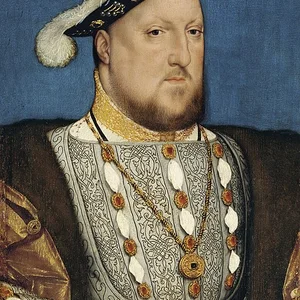

King of England and Ireland from 1509 to 1547, Henry VIII is famous for breaking with the Catholic Church and founding the Church of England in order to annul his marriage. He married six wives and had two of them executed, leaving a lasting mark on England's political and religious history.
Henry VIII(1491 — 1547)
Henry VIII
royaume d'Angleterre
8 min read
Frequently asked questions
Key Facts
- 1509: Crowned at the age of 17, he succeeded his father Henry VII
- 1533–1534: Break with Rome and establishment of the Church of England (Act of Supremacy)
- 1536–1541: Dissolution of the monasteries and seizure of their assets
- He married six wives: Catherine of Aragon, Anne Boleyn, Jane Seymour, Anne of Cleves, Catherine Howard, Catherine Parr
- An amateur composer, he is particularly associated with the song "Pastime with Good Company"
Works & Achievements
A song composed by Henry VIII himself, celebrating the pleasures of youth — hunting, music, and dancing. It showcases the king's genuine musical talents and embodies the Renaissance courtly ideal.
A work written by Henry VIII in defense of the seven Catholic sacraments against Luther. It earned him the title of 'Defender of the Faith' granted by the Pope — a title still borne by British monarchs to this day.
An act passed by the English Parliament making the king the Supreme Head of the Church of England. This founding legislation of Anglicanism had lasting repercussions on European religious and political history.
A sweeping program of closure and seizure of Catholic monastic houses across England. It radically transformed the kingdom's religious, social, and economic landscape, and greatly enriched the Crown.
The first official Bible in the English language, commissioned by Henry VIII and placed in every Anglican parish church. It democratized access to Scripture and deepened the cultural break with Latin Catholicism.
Henry VIII dramatically expanded the English fleet, commissioning warships such as the Mary Rose and the Henri Grace à Dieu. In doing so, he laid the foundations for Britain's future naval power.
Anecdotes
Henri VIII was a man of remarkable culture: he spoke several languages, played the lute and flute, and composed his own musical pieces, including the famous song 'Pastime with Good Company'. Far from the brutal tyrant history often remembers, he was first celebrated as a humanist and scholarly king upon his accession in 1509.
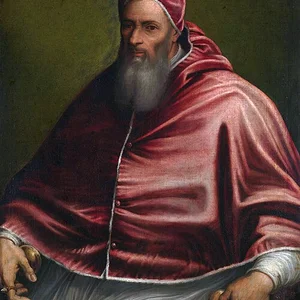
In 1521, Pope Leo X awarded Henry VIII the title of 'Defender of the Faith' as a reward for a treatise he had written against the ideas of Martin Luther. Ironically, it was this same Henry VIII who broke with Rome fifteen years later to found the Church of England — a spectacular historical reversal.
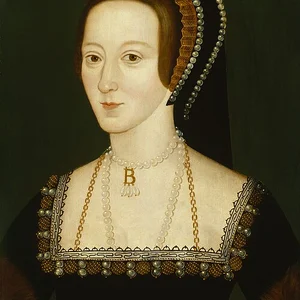
Henry VIII had two of his six wives executed: Anne Boleyn in 1536 and Catherine Howard in 1542, both accused of adultery and treason. To remember their fates, an English rhyme sums up the destinies of the six queens: 'Divorced, beheaded, died, divorced, beheaded, survived.'
By the end of his life, Henry VIII suffered from severe obesity and leg ulcers, and had to be carried around using mechanical chairs. His imposing figure, immortalised in portraits by Hans Holbein the Younger, became the iconic image of the Tudor king — far removed from the handsome young athlete he had been in his twenties.
The dissolution of the monasteries between 1536 and 1541 allowed Henry VIII to seize immense wealth belonging to the Catholic Church. Hundreds of abbeys were destroyed or sold, their lands redistributed to the nobility, permanently transforming the religious and economic landscape of England.
Primary Sources
Henry VIII refutes Luther's theses on the sacraments and defends the authority of the Pope: 'What serpent of a heretic ever dared to bark against the vicar of Christ?'
Parliament declares: 'The King, our sovereign lord, his heirs and successors, shall be taken, accepted, and reputed as the only supreme head on earth of the Church of England.'
In one of these letters preserved in the Vatican Library, Henry writes: 'I am struck with wonder at receiving no news from you [...] I hope it is not by your own will.'
The text justifies the dissolution by the 'manifest sin, vicious, carnal, and abominable living' practised in the smaller monasteries, legitimising the confiscation of their assets.
Henry VIII settles the succession to the throne in favour of his son Edward, then his daughters Mary and Elizabeth, and sets out his provisions for masses and prayers for the good of his soul.
Key Places
Henry VIII's birthplace in 1491, Greenwich was one of his favourite palaces. It was here that he signed many royal decrees and where his daughters Mary and Elizabeth were born.
A royal fortress and state prison, the Tower of London was the site of imprisonment and execution of Anne Boleyn, Thomas More, Thomas Cromwell, and many other victims of Henry VIII's reign.
A magnificent residence originally built by Cardinal Wolsey, then seized by Henry VIII in 1529. This Tudor palace remains one of the finest architectural examples of the English Renaissance.
The seat of the Primate of All England, Canterbury was at the heart of the break with Rome. Thomas Cranmer, the first Anglican Archbishop of Canterbury, confirmed the royal supremacy over the Church there.
The site of Henry VIII's coronation in 1509 and a symbol of the English monarchy. Though spared during the dissolution of the monasteries, Westminster embodies the tension between royal power and religious authority.
The iconic royal residence where Henry VIII was finally laid to rest in 1547, alongside his third wife Jane Seymour — the only one who gave him a male heir.
Typical Objects

Henry VIII was an accomplished lutenist and amateur composer. The lute, the instrument of choice among Renaissance humanists, symbolized the refined culture he cultivated at his court.

The monumental portraits of Henry VIII by Hans Holbein the Younger — depicting him face-on, legs apart, with an imperious gaze — served as tools of royal propaganda and defined the very image of absolute power.

These royal regalia, used at the coronation and official ceremonies, embodied Henry VIII's dual authority as temporal king and, after 1534, Supreme Head of the Church of England.

Henry VIII had a passion for jousting and tournaments. His custom-made suits of armour, preserved in the Tower of London, bear witness to his imposing physique and his love of chivalric martial arts.

In 1539, Henry VIII authorised the publication of the Great Bible in English — the first official Bible intended to be placed in every Anglican church — a powerful symbol of the break from Rome's Latin tradition.

The Great Seal of England, affixed to official documents such as the Act of Supremacy, was the legal symbol of the king's absolute authority over his subjects and over the Church.

Henry VIII's court was renowned for its splendour: gold and silver plate, lavish banquets, and precious objects seized from dissolved monasteries adorned the royal tables.
School Curriculum
Vocabulary & Tags
Key Vocabulary
Tags
Daily Life
Morning
Henry VIII rose early, around six o'clock, and attended daily Mass in his private chapel, surrounded by his chaplains. The royal morning routine was a highly codified ritual involving a dozen gentlemen of the chamber who dressed him and helped him prepare according to strict protocol.
Afternoon
Afternoons were often devoted to physical activities: hunting in the royal forests, jousting, real tennis, or archery. Henry VIII also held audiences, signed state documents, and received ambassadors and advisors in his council chamber.
Evening
Evenings at Henry VIII's court were renowned for their splendor: endless banquets featuring dozens of courses, dance performances, plays, and musical concerts. The king enjoyed taking part in masquerades (masked balls) and would sometimes play the lute himself for his guests.
Food
The royal table was extraordinarily lavish: roasted meats (venison, wild boar, beef), poultry, fish, meat pies, candied fruits, and French and Rhenish wines. It is estimated that the court consumed hundreds of kilograms of meat daily — a diet that contributed to Henry's obesity in the later years of his life.
Clothing
Henry VIII wore doublets of crimson velvet or cloth of gold, puffed breeches, a short mantle with a fur collar, and the famous flat Tudor bonnet adorned with a feather. His garments were embroidered with gold thread and encrusted with pearls and precious stones, reflecting his determination to impress through sheer magnificence.
Housing
Henry VIII resided in numerous palaces: Whitehall (the largest in Europe at the time), Hampton Court, Greenwich, and Windsor. These residences featured grand reception halls, private apartments, royal chapels, formal gardens, and enormous kitchens capable of feeding several hundred people a day.
Historical Timeline
Period Vocabulary
Visual Style
Palette somptueuse inspirée des portraits Tudor d'Holbein : velours et brocarts cramoisis, ors héraldiques et architecture Renaissance anglaise empreinte de solennité royale.
Sound Ambience
L'atmosphère sonore de la cour d'Henri VIII mêle musique Renaissance raffinée, bruits de festivités fastueuses et résonances religieuses, reflet d'un règne à la fois brillant et brutal.