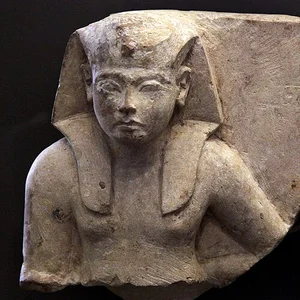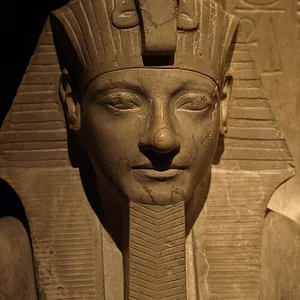

The last pharaoh of the Eighteenth Dynasty of Egypt, Horemheb was first a general under Tutankhamun and Ay before seizing the throne. He restored the traditional order and erased the traces of Akhenaten's religious revolution.
Frequently asked questions
Key Facts
- Commander-in-chief under Tutankhamun and Ay before becoming pharaoh (c. 1319 BCE)
- Restored the cult of Amun and dismantled Akhenaten's religious reforms
- Had the names of Akhenaten, Nefertiti, and Tutankhamun chiseled out to erase the Amarna period
- Issued a royal decree against corruption and abuses by royal officials
- Having no heir, he appointed his vizier Ramesses as his successor, inaugurating the Nineteenth Dynasty
Works & Achievements
A royal decree carved at Karnak, constituting one of the oldest known legislative texts in history. It organizes the courts, regulates taxation, and prescribes severe penalties for administrative and military corruption.
Massive monumental gateways erected at the entrance to the Temple of Amun at Karnak, built in part from the dismantled blocks of Akhenaten's temples. They symbolically assert the restoration of traditional worship and the renewed power of Thebes.
An exceptional funerary monument bearing witness to Horemheb's power and prestige before his accession to the throne. Its reliefs document the military campaigns and royal honors bestowed upon the future pharaoh.
A grand pharaonic tomb at Luxor, the first to present the Book of Gates in its complete form on its walls. It marks a definitive break with the Amarna style and the revival of Theban funerary canons.
The restitution of lands, revenues, and privileges to the temples of Amun and other Egyptian gods, which had been suppressed by Akhenaten. This religious restoration gave Horemheb the legitimacy he needed to rule without a dynastic heritage.
Anecdotes
Before becoming pharaoh, Horemheb had a magnificent tomb built for himself at Saqqara in his role as general. Rediscovered in 1975 by an Anglo-Dutch archaeological mission, this tomb features exceptional military reliefs that testify to his great power long before he ever ascended the throne.
Horemheb launched one of the most sweeping memory-erasure campaigns in Egyptian history: he ordered the names of Akhenaten, Tutankhamun, and Ay chiseled off monuments across the land, then claimed their years of rule as his own in the official records. Officially, his reign was backdated to the death of Amenhotep III — effectively erasing four decades of Egyptian history.
To combat the corruption that had eaten through the administration during the troubled Amarna period, Horemheb issued a sweeping reform decree carved at Karnak, one of the oldest known legislative texts in existence. It prescribed severe penalties — including mutilation — for any official who abused their position.
His builders reused stone blocks from Akhenaten's temples, known as talatat, as fill material inside the pylons at Karnak. It was only in the twentieth century, when archaeologists dismantled these structures, that thousands of carved blocks were recovered — enough to reconstruct entire scenes from the Atenist revolution.
Having no direct heir, Horemheb named his vizier Paramessu, a veteran general of advanced age, as his successor. This pragmatic choice proved historic: Paramessu took the throne as Ramesses I and founded the Nineteenth Dynasty, ushering in the great age of the Ramesside pharaohs.
Primary Sources
"His Majesty spent all his time seeking the welfare of Egypt [...] His Majesty deliberated with his heart to drive out evil and destroy falsehood, so that the strong could not oppress the weak."
The god Horus of Hout-nesout chose Horemheb to be the lord of the Two Lands, entrusting him with eternal kingship and placing the double crown upon his head before the entire divine assembly.
"Horemheb, general of generals of the king, standard-bearer at the right hand of the king, royal scribe, favorite of the king above all others, whose master rejoices in his counsel."
The earliest complete occurrences of the Book of Gates, illustrating the deceased pharaoh's nocturnal journey before the deities of the twelve hours of the night, guided by Ra.
Key Places
Major religious center where Horemheb erected the Ninth and Tenth Pylons and where his great legislative edict was inscribed. It was here that he officially restored the cult of Amun following the Atenist period.
An exceptional nobleman's tomb built before Horemheb's accession to the throne, decorated with reliefs depicting his military victories and his standing at court. It was rediscovered in 1975 by a joint archaeological mission.
Horemheb's royal tomb at Luxor, the first to feature the complete Book of Gates on its walls and one of the largest in the valley. Its decoration marks the return to traditional Theban artistic conventions.
The administrative capital of northern Egypt and Horemheb's principal residence when he commanded the armies. He also governed much of his reign from here, overseeing military and judicial affairs.
The short-lived capital founded by Akhenaten on a virgin site, abandoned after his death. Horemheb ordered its systematic dismantling, erasing it down to its foundations in an effort to wipe this episode from collective memory.
Typical Objects

A war crown made of blue cobalt leather or fabric, worn during military campaigns and royal ceremonies. Horemheb wears it in nearly all his official representations, asserting his identity as a warrior-pharaoh.

A crook-shaped scepter and fundamental emblem of Egyptian kingship. Horemheb holds it in his official representations to signify his legitimate power over the Two Lands — a power he had to fight hard to win.

A curved sword of Near Eastern origin adopted by Egyptian armies during the New Kingdom. Horemheb is depicted holding this symbol of military might in victory scenes over his Nubian and Asian enemies.

An attribute of the title of "royal scribe" that Horemheb held before his accession to the throne. It reflects his role as an enlightened administrator — a skill he put to work in carrying out his sweeping legislative reforms.

Tools used by craftsmen on Horemheb's orders to chisel out his predecessors' cartouches from monuments. They embody his policy of systematic memory erasure — a deliberate rewriting of official history.

A light military vehicle introduced by the Hyksos and mastered by the armies of the New Kingdom. As commander-in-chief, Horemheb led his campaigns from his chariot — a symbol of the military power he embodied before ascending to the throne.
School Curriculum
Vocabulary & Tags
Key Vocabulary
Tags
Daily Life
Morning
Horemheb begins his day with purification rites in the royal domain: ritual baths, anointings with scented oils, and the donning of royal insignia assisted by sem-priests. He then takes part in the morning offerings at the palace chapel dedicated to Amun, a ritual symbolizing the restoration of the cosmic order (Ma'at) that he has made his primary mission.
Afternoon
Most of his afternoon is devoted to administrative audiences: receiving viziers, military commanders, and scribes reporting on the progress of construction projects and judicial reforms. Horemheb personally reviews accounts of abuses and rules on the penalties to be imposed on corrupt officials, in accordance with the terms of his great edict.
Evening
In the evening, Horemheb presides over official banquets bringing together the court's high dignitaries, enlivened by music and dancers. Scribes read reports from the provinces while Delta wines and roasted meats are served. The day closes with further prayers to Amun before retiring to private chambers adorned with wall paintings in a deliberately traditional style.
Food
Like all pharaohs, Horemheb enjoyed a rich and varied diet: fine-flour breads, roasted beef, goose, and duck, fish from the Nile, legumes (lentils, broad beans), fresh vegetables (onions, leeks, lettuce), and fruits (dates, figs, grapes). Fine wines selected from the royal vineyards of the Delta, quality beer, and filtered water rounded out his meals.
Clothing
As pharaoh, Horemheb wore the royal shendyt kilt in finely woven white linen, belted in gold, along with a broad pectoral collar in gold and lapis lazuli adorned with the solar scarab. For military ceremonies, he wore the blue khepresh crown and the usekh collar inlaid with carnelian and turquoise. The striped nemes linen headdress and gilded sandals completed his attire during temple rituals.
Housing
Horemheb resided in the royal palace of Memphis for affairs of state and in that of Thebes during the great religious festivals of Amun. These residences featured vast audience halls with painted columns, interior gardens with pools and fruit trees, private apartments decorated with frescoes in floral motifs, and integrated scribal workshops for the daily processing of administrative documents.
Historical Timeline
Period Vocabulary
Visual Style
Le style visuel de Horemheb incarne la transition entre l'art amarnien et les canons classiques ramessides : retour à la frontalité stricte, dominance du bleu royal et de l'or, scènes militaires et judiciaires en haut-relief sur grès doré.
Sound Ambience
L'ambiance sonore de Horemheb mêle les bruits de chantier des pylônes de Karnak, les chants liturgiques d'Amon restauré, le tintement des ciseaux des scribes réformateurs et le roulement des chars militaires sur les voies processionnelles.
Liens externes & ressources
Références
Œuvres
Grand Édit de Horemheb
vers 1315 av. J.-C.
IXe et Xe pylônes de Karnak
vers 1310 av. J.-C.
Tombeau de général à Saqqara
vers 1330 av. J.-C.
Tombeau royal KV57 (Vallée des Rois)
vers 1310-1292 av. J.-C.
Campagne de restauration du clergé d'Amon
vers 1319-1310 av. J.-C.