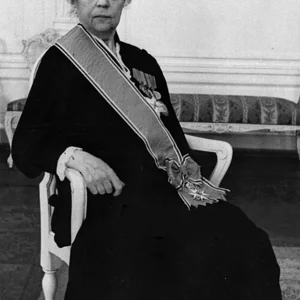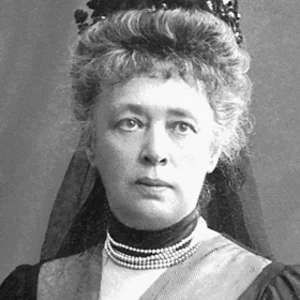

French feminist activist (1848–1914), she was one of the first to demand women's right to vote in France. Founder of the society “Le Suffrage des femmes,” she led militant actions such as refusing to pay her taxes and smashing a ballot box.
Hubertine Auclert(1848 — 1914)
Hubertine Auclert
8 min read
Frequently asked questions
Famous Quotes
« Women pay taxes, therefore they must have the right to vote.»
« Universal suffrage is not universal as long as it excludes half of humanity.»
Key Facts
- 1848: born in Tilly (Allier)
- 1876: founded the society “Le Droit des femmes,” later renamed “Le Suffrage des femmes”
- 1880: refused to pay her taxes, denouncing the fiscal injustice against women deprived of the right to vote
- 1908: smashed a ballot box during the municipal elections in Paris to protest the exclusion of women from the vote
- 1914: died in Paris, six years before the world congress that would revive the cause of women's suffrage in France
Works & Achievements
A feminist weekly founded and edited by Auclert for ten years, the leading press organ of the French suffragist movement and an essential platform for republican feminism.
A pioneering work denouncing the double discrimination suffered by Algerian women — as women and as colonized subjects — the fruit of her four years spent in Algiers between 1888 and 1892.
A major political essay in which Auclert systematically sets out all the arguments in favor of women's suffrage and refutes her opponents' objections one by one.
A collection of her articles and political writings published after her death, gathering the essence of her feminist thought and standing as the intellectual testament of a lifetime of struggle.
A series of formal petitions addressed to the French Parliament, making Auclert the first activist to officially bring the demand for women's voting rights before the institutions of the Republic.
Anecdotes
On May 3, 1908, during the municipal elections in Paris, Hubertine Auclert entered a polling station with several activists and overturned the ballot box, crying “Down with the law of men!” This spectacular act led to her arrest, but drew the attention of the entire national press to the cause of women’s suffrage.
To protest her exclusion from the right to vote, Hubertine Auclert refused to pay her taxes for several years. She argued that, not being a full citizen, she should not contribute to the finances of a State that excluded her — it was the principle of “no representation, no taxation,” turned back against the authorities.
In 1881, Hubertine Auclert founded her own newspaper, *La Citoyenne*, which she ran for ten years. Each week she published articles demanding women’s right to vote, responded to her critics, and reported on feminist advances abroad, making the paper both an educational and activist tool.
Having traveled to Algeria from 1888 to 1892 to join her partner Antonin Lévrier, Hubertine Auclert closely observed the condition of colonized Arab women. Upon her return, she published *Les femmes arabes en Algérie* (1900), a pioneering work that denounced the double discrimination suffered by these women, victims of both patriarchy and colonization.
During the 1880 census, Hubertine Auclert refused to fill out her census form correctly, arguing that if women did not exist politically, the State had no need to count them. This symbolic act of civil disobedience illustrated her strategy: making visible the absurdity of a Republic that excluded half of its inhabitants.
Primary Sources
We want to vote, because to vote is to exist politically; because without the right to vote, women can have no influence over the laws that govern them nor over the taxes they pay.
Women pay taxes, and therefore must have the right to oversee how their money is spent; they obey the laws, and therefore must take part in shaping them. Any other principle is a contradiction of democracy.
The Arabs have reduced their women to a condition so wretched that they can only be compared to the slaves of antiquity. France, which calls itself a civilizing power, cannot remain indifferent to this state of affairs.
The undersigned, French citizens, demand the application to their sex of the principle enshrined in the republican Constitution: the government of France is democratic, and democracy cannot exclude half the nation.
Key Places
Birthplace of Hubertine Auclert, born on April 10, 1848 in this rural commune in central France, into a family of landed bourgeoisie.
It was in Paris that Hubertine Auclert carried out the bulk of her activism: editing the newspaper, organizing public meetings, submitting petitions to the Chamber of Deputies, and staging high-profile militant actions.
Hubertine Auclert lived in Algiers from 1888 to 1892 with her partner Antonin Lévrier. There she observed the condition of colonized Arab women, an experience that shaped her book *Les femmes arabes en Algérie* (1900).
Home of the Chamber of Deputies, outside which Hubertine Auclert repeatedly submitted official petitions demanding women's right to vote, directly challenging the elected representatives inside.
It was at a Parisian polling station that Hubertine Auclert overturned a ballot box on May 3, 1908, during the municipal elections — one of the most striking militant acts of her life.
Typical Objects

The central symbol of women's political exclusion, the ballot box is the object Hubertine Auclert overturned during the 1908 elections to make the injustice of male-only suffrage dramatically visible.

A weekly founded by Auclert in 1881 and written almost entirely by her, it was her primary activist tool: incisive editorials, rebuttals to opponents, and reports on feminist progress abroad.

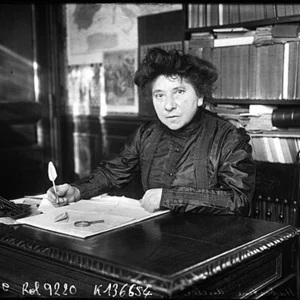
Hubertine Auclert was above all a woman of the pen: letters to lawmakers, petitions, newspaper articles, political works — writing was her daily weapon in the fight for equality.

The ballot paper, from which women were legally barred, was the central symbol of her struggle: she brandished one at demonstrations to make tangible what the Republic denied them.

Hubertine Auclert refused to pay her taxes in protest against women's lack of political representation: this tax notice embodied the injustice of a State that taxed women while denying them the right to vote.

Like the bourgeois women of her era, Auclert wore long, austere dresses; she nonetheless criticized the corset as a symbol of the oppression of the female body, advocating for more practical clothing — a forward-thinking position for the time.
School Curriculum
Vocabulary & Tags
Key Vocabulary
Daily Life
Morning
Hubertine Auclert rose early to respond to her abundant correspondence: letters to members of parliament, newspapers, and activist women in the provinces. She would then draft articles for *La Citoyenne* or prepare her petitions and speeches for upcoming meetings.
Afternoon
Her afternoons were devoted to public meetings, visits to sympathizers, or activist actions outside institutions — the Chamber of Deputies, town halls, polling stations. She also organized lectures to persuade other women to join the suffragist cause.
Evening
In the evenings, Hubertine Auclert would often gather with her fellow activists to debate strategy, read the foreign press on feminist advances, and draft the next day's texts. She led a simple, frugal life, channeling most of her resources back into the newspaper and her activist work.
Food
Like many republican activists of her era, Auclert lived frugally. She ate simply — bread, vegetables, everyday meats — with no particular interest in gastronomy, preferring to devote her time and money to the feminist cause.
Clothing
Hubertine Auclert wore the bourgeois dress of her day: dark, floor-length gowns, a closed bodice, and a hat. She was critical of the corset, however, viewing it as a symbol of the oppression of women's bodies, and advocated for more practical clothing — aligning herself with the international feminist "dress reform" movement.
Housing
In Paris, Hubertine Auclert lived in a modest bourgeois apartment that served as both her home and the editorial office of *La Citoyenne*. She received activists and journalists there, turning her residence into the true headquarters of French suffragist feminism.
Historical Timeline
Period Vocabulary
Liens externes & ressources
Références
Œuvres
La Citoyenne (journal)
1881–1891
Les femmes arabes en Algérie
1900
Le vote des femmes
1908
Les femmes au gouvernail
1923 (posthume)
Pétitions à la Chambre des députés pour le suffrage féminin
1876–1907