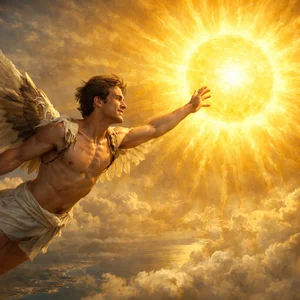

Son of Daedalus, the ingenious craftsman of Greek mythology, Icarus escapes the Labyrinth of Crete using wings made of feathers and wax. Intoxicated by flight, he soars too close to the sun despite his father's warnings, melts his wings, and perishes in the sea that now bears his name.
Icarus
Icarus
9 min read
Frequently asked questions
Key Facts
- Son of Daedalus, architect of the Labyrinth built for King Minos of Crete
- Imprisoned with his father in the Labyrinth, he escapes using wings crafted from feathers and beeswax
- Daedalus warns him to fly neither too low (the sea's moisture) nor too high (the sun's heat)
- Icarus flies too close to the sun: the wax melts, the wings fall apart, and he plunges into the Aegean Sea, since known as the Icarian Sea
- The myth is recorded in Ovid's Metamorphoses (1st century BCE) and in Diodorus Siculus
Works & Achievements
Passed down orally by bards long before it was ever written down, the myth of Icarus's flight and fall is one of the earliest great metaphors for human ambition and hubris in Greek culture.
The most complete and most influential literary version of the Icarus myth, which transmitted this story to the entire Western world for two millennia and remains on the curriculum in literature classes to this day.
A painting that shows the fall of Icarus as a barely noticeable event in a landscape where life goes on — a reflection on the world's indifference to individual tragedy, studied in art history programs.
A cut-out gouache depicting Icarus as a black silhouette against a vivid blue background, his heart a blazing red, published in the collection *Jazz*. An icon of modern art, this work is a frequent reference in art education.
A poem inspired by Bruegel's painting, in which Auden meditates on human suffering that goes unnoticed by everyone around it. This text is studied in upper secondary classes to bring together literature and the visual arts.
The myth of Daedalus and Icarus was depicted on red- and black-figure vases, spreading the story throughout the Mediterranean world and attesting to its importance in Greek moral education.
Anecdotes
Icarus was the son of Daedalus, the greatest craftsman in Greek mythology, who had built the famous Labyrinth of Crete to imprison the Minotaur. When King Minos imprisoned them both to prevent the secrets of the Labyrinth from being revealed, Daedalus devised an extraordinary plan: to craft wings from feathers and wax so they could fly over the walls.
Before their flight, Daedalus solemnly warned his son: “Do not fly too low, for the sea’s moisture would weigh down your feathers; do not fly too high, for the sun’s heat would melt the wax.” Icarus, intoxicated by the sensation of flight and the beauty of the sky, forgot this advice and climbed ever higher, until the wax melted and his wings fell apart.
Icarus plunged into the waters of the Aegean Sea, which thereafter took the name the Icarian Sea. The Greek island of Icaria, off the coast of Turkey, has likewise borne his name since Antiquity. These two place names are among the oldest testimonies to the enduring presence of a myth in collective memory.
The fall of Icarus has become in Western culture the symbol of hubris — that arrogant excess which drives human beings to overstep the limits set by nature and the gods. This myth is still taught today because it illustrates in a striking way that ambition without wisdom can lead to catastrophe.
The painting attributed to Pieter Bruegel the Elder (c. 1558) offers an unexpected and memorable vision of the myth: Icarus occupies only a tiny corner of the canvas, barely visible, while peasant life continues normally all around him. The poet W.H. Auden drew inspiration from it for his poem *Musée des Beaux-Arts* (1938), a meditation on the world’s indifference to great individual tragedies.
Primary Sources
Daedalus, exiled in Crete and longing to see his homeland again, was hemmed in by the sea. “Though Minos may bar my way by land and sea,” he said, “the sky at least lies open to me; that is the way I shall go.” [...] Icarus, whose young age should have taught him greater caution, flew with bolder daring; he left his guide behind and, lured by his desire to touch the heavens, steered his course toward the upper regions.
Daedalus built wings for himself and his son Icarus, and having prepared everything necessary for the journey, he waited for a favourable wind. Icarus, reckless and with little experience of flight, did not follow his father's instructions and rose too high; the wax melted and he perished in the sea.
Daedalus, son of Eupalamus, made wings of feathers and wax for himself and his son Icarus. Icarus, flying too high, felt the wax melt in the heat of the sun; he fell into the sea, which is still called the Icarian Sea to this day.
He wished to carve your misfortunes, O Icarus; twice his hands attempted it, twice they fell away. A father's heart could not bear to finish the image of his son's fall.
The myth of Daedalus and Icarus circulated among the aoidoi — singing poets — long before it was committed to writing. These oral tales associated Daedalus with technical ingenuity and Icarus with reckless youth, and were sung at festivals and banquets throughout Greece and Crete.
Key Places
Palace of King Minos where Daedalus built the Labyrinth, and where he and Icarus were imprisoned. It was from this place that father and son took flight toward freedom.
Part of the Aegean Sea between the Greek islands and the Turkish coast, the place where Icarus drowned after his wings melted. This geographical name is one of the most enduring traces of the myth in the real world.
Greek island in the Aegean Sea that has borne the name of Icarus since Antiquity, located near the spot where he is said to have drowned according to tradition. It is the most visible geographical memorial to the mythological figure.
Birthplace of Daedalus, who had been forced to flee after killing his nephew Perdix out of jealousy over the boy's talent. It was from Athens that Daedalus had taken refuge in Knossos, drawing Icarus into that exile.
Daedalus's final destination after the death of Icarus: he found refuge at the court of King Cocalus in Sicily, where he continued to invent and build until the end of his days.
Typical Objects

A masterpiece of Daedalus's craft, these wings were built by binding bird feathers of varying sizes together with linen thread and beeswax. They symbolize both human ingenuity and its fragility in the face of the laws of nature.

The material that held the feathers together in the wings. Its melting point was too low to withstand the heat of the sun, making it the direct cause of Icarus's death, and a symbol of the limits of human ambition.

Daedalus gathered feathers of all sizes to recreate the shape of a natural wing. Taken from free-flying birds, they represent the freedom that father and son were striving to claim for themselves.

An architectural prison designed by Daedalus himself to confine the Minotaur, it became, ironically, his own cage — and Icarus's. The place embodies the paradox of genius turning against its creator.

The thread given by Ariadne to Theseus on Daedalus's advice, allowing him to find his way out of the Labyrinth. It was because of this help given to Theseus that Daedalus was punished by Minos and imprisoned alongside his son Icarus.

The stretch of the Aegean Sea between Greece and Turkey where Icarus plunged to his death. Named in his memory since antiquity, it is the most enduring natural monument raised to the memory of the myth.
School Curriculum
Vocabulary & Tags
Key Vocabulary
Daily Life
Morning
In the Labyrinth of Knossos where he was imprisoned with his father, Icarus woke each day in a maze of dimly lit stone corridors. From dawn, Daedalus would watch the birds visible through the few openings in the walls, studying the shape of their wings and passing on to his son this passion for flight and mechanics.
Afternoon
The afternoons were devoted to crafting the wings: Daedalus sorted feathers by size, binding the large ones together with linen thread and the small ones with beeswax. Young and impatient, Icarus learned to mimic the movements of birds, to feel the air currents and to control his balance — an apprenticeship that seemed to him a promise of freedom.
Evening
The evenings were filled with Daedalus's stories of Athens and the wonders he had built before his exile. Icarus grew up in that enclosed space, sustained by his father's tales and the longing for the blue sky glimpsed through cracks in the stone — a promised freedom that made him ever more impatient.
Food
As prisoners of King Minos, Daedalus and Icarus received the usual rations allotted to palace captives: barley bread, legumes, goat's cheese, and a few olives. This simple Mediterranean diet was enough to keep them alive, but only sharpened their desire to escape.
Clothing
Icarus wore the plain linen tunic (*chiton*) common to Greeks of his time. For the flight, Daedalus fastened wings of feathers to his arms and shoulders using bindings of wax and thread, transforming his silhouette into a form suggesting a giant bird — half man, half winged creature.
Housing
Daedalus and Icarus lived in a section of the palace-labyrinth of Knossos, the architectural complex that Daedalus himself had designed. The tragic irony of their captivity was being imprisoned within the father's own masterpiece: only a man capable of inventing beyond the possible could hope to escape it.
Historical Timeline
Period Vocabulary
Liens externes & ressources
Références
Œuvres
Le mythe du vol d'Icare (tradition orale grecque)
VIIIe siècle av. J.-C. environ
Métamorphoses, Livre VIII — Ovide
vers 8 apr. J.-C.
Paysage avec la chute d'Icare — Pieter Brueghel l'Ancien (attribué)
vers 1558
Icare — Henri Matisse (Jazz)
1943-1947
Musée des Beaux-Arts — W.H. Auden (poème)
1938
Représentations sur céramiques grecques
Ve-IVe siècle av. J.-C.