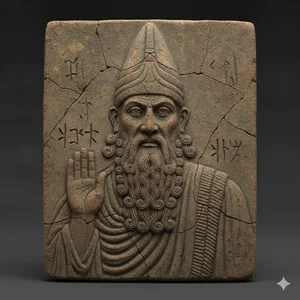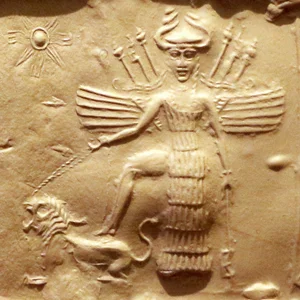

Sumerian goddess of love, war, and fertility, venerated in Mesopotamia since the 4th millennium BCE. She is the best-documented female deity of the ancient world, celebrated in cuneiform hymns among the oldest known literary texts. Her cult, centered on the city of Uruk, influenced the religious traditions of the ancient Near East.
Inanna
Inanna
8 min read
Frequently asked questions
Famous Quotes
« I am she who puts on the sky like a garment, I am she who covers the earth like a floor. (Sumerian hymn attributed to Inanna, written tradition)»
Key Facts
- Attested in cuneiform texts from around 3200 BCE, among the earliest known examples of writing found at Uruk
- Her Descent into the Underworld narrative is one of the oldest myths transmitted in written form, dating to approximately 2100–2000 BCE
- Enheduanna, priestess and daughter of King Sargon of Akkad (c. 2285–2250 BCE), dedicated to her the first literary hymns in history signed by an identified author
- Assimilated into Ishtar in Akkadian mythology, then into Astarte and Venus in other Mediterranean cultures
- Her cult is documented across more than three millennia, from Sumer through the late Babylonian period
Works & Achievements
Composed by Enheduanna, this long poem in Sumerian is the first signed literary text in history. It celebrates the universal power of Inanna and stands as an exceptional testimony to Mesopotamian religion.
A major mythological narrative recounting Inanna's journey into the subterranean realm of Ereshkigal. One of the earliest texts on death and rebirth, this myth went on to influence many later religious traditions.
A myth telling how Inanna obtains from the god Enki the arts and techniques of civilization — writing, kingship, music — to bestow them upon the city of Uruk. It reflects the Sumerian belief in the divine origins of culture.
A collection of lyric poems celebrating the union of Inanna and the shepherd-king Dumuzi, among the oldest and most beautiful poetic texts in human history. They accompanied the annual royal ritual meant to ensure fertility.
A Sumerian myth in which a gardener offends Inanna while she sleeps, and the goddess unleashes plagues upon humanity in pursuit of justice. The text illustrates the vengeful and warlike dimension of the goddess.
A ritual alabaster vase discovered at Uruk, depicting a procession of offerings toward Inanna's temple. Considered one of the earliest works of narrative art in history, it is on display at the National Museum of Iraq in Baghdad.
Anecdotes
Inanna is the first deity in history to have a hymn written in her honor by an identified author: the priestess Enheduanna, daughter of King Sargon of Akkad, around 2285 BCE. This text, titled 'The Exaltation of Inanna', is considered the oldest signed literary work in human history. In it, Enheduanna implores the goddess to restore her to her position after a political exile.
According to the Sumerian myth of 'The Descent of Inanna into the Underworld', the goddess undertakes a perilous journey to the realm of the dead, ruled by her sister Ereshkigal. At each of the seven gates of the underworld, she must surrender a garment or ornament, arriving naked and defenseless before her sister. This story is one of the earliest symbolic depictions of the cycle of death and rebirth.
Inanna is famous for stealing the 'me' — the divine principles of civilization (writing, kingship, music, the crafts) — from the god Enki during a banquet at which he was drunk. She carried them away on her celestial boat to Uruk, bestowing upon her city all the hallmarks of a great civilization. Enki, once he had sobered up, attempted in vain to reclaim them.
The sacred marriage (hieros gamos) of Inanna with the shepherd-king Dumuzi was celebrated each year in Uruk through a ritual ceremony. The king embodied Dumuzi and symbolically united with the goddess to ensure the fertility of the land and the prosperity of the kingdom. These wedding hymns rank among the most moving poetic texts in all of Mesopotamian literature.
Primary Sources
Queen of all the me, resplendent light, woman clothed in splendor, beloved of Heaven and Earth, hierodule of An, adorned with great ornaments, enamored of the tiara befitting the high priesthood.
From the great above, from the great above, she set her mind toward the great below. Inanna, from the great above, she set her mind toward the great below. She abandoned heaven, abandoned earth, descended to the underworld.
My beloved bridegroom, delight of my eyes, my heart longs for you. Wash yourself with soap, anoint your body with sweet oil, put on your royal robe.
Enki and Inanna drank beer together. They drank wine together. When Enki's heart was filled with joy... he offered the mé to Inanna: the high priesthood, the divine priesthood, the crown...
Key Places
The main city of Inanna's cult, Uruk was home to the Eanna ('House of Heaven'), the goddess's great temple. This is where the sacred marriage took place and where the first hymns in her honor were written.
A great Sumerian city where Enheduanna served as high priestess of Inanna/Nanna. Ur's massive ziggurat stood at the heart of religious life dedicated to the lunar deities and to Inanna.
The religious and intellectual center of Mesopotamia, Nippur housed the great Sumerian literary archives. Most of the clay tablets recounting the myths of Inanna were discovered here.
A legendary mountain city associated with the myths of Inanna, celebrated for its lapis lazuli and great wealth. In Sumerian texts, Inanna chooses Uruk over Aratta, thereby legitimizing the supremacy of that city.
Built by Nebuchadnezzar II around 575 BCE, this monumental gate decorated with blue glazed tiles and lapis lazuli was dedicated to Ishtar, the Babylonian equivalent of Inanna. It stands as a testament to the enduring worship of the goddess.
Typical Objects

The most widespread symbol of Inanna is an eight-pointed star or radiating disc, representing both the planet Venus and the divine power of the goddess. It appears engraved on cylinder seals and votive tablets throughout Mesopotamia.

The eight-petaled rosette is another sacred emblem of Inanna, abundantly depicted in the architecture and jewelry of the Eanna (her temple in Uruk). It symbolizes divine beauty and the generosity of the goddess.

Carved reed bundle posts, archaic architectural symbols, marked Inanna's sanctuaries as early as the proto-urban period of Uruk. These poles topped with looped reed ribbon rings are among the oldest known divine symbols.

This alabaster vase from the 4th millennium BCE, discovered at Uruk, depicts a procession of offerings intended for Inanna. Considered one of humanity's earliest works of narrative art, it illustrates the central ritual of the goddess's cult.
Inanna is frequently depicted standing on the back of a lion, an animal that symbolizes her warrior power and divine majesty. The lion is her sacred animal par excellence in Mesopotamian iconography.

Among the mé (divine attributes) that Inanna claims for herself are the royal scepter and the throne. These insignia of power symbolize her role as the goddess who legitimizes kingship and ensures the stability of the city.
School Curriculum
Vocabulary & Tags
Key Vocabulary
Tags
Daily Life
Morning
Inanna's ritual day begins at dawn in the Eanna, her temple at Uruk, where priestesses light the first incense fires and recite the morning hymns. Priests purify the sacred statues with water and perfumed oil, renewing the food offerings laid out on the altars. Sunrise and the appearance of the morning star (Venus) are sacred moments dedicated to the goddess.
Afternoon
Throughout the day, the temple hums with activity: receiving offerings brought by worshippers (livestock, grain, precious textiles), dictating hymns to scribes, and managing accumulated wealth. Singer-priestesses (kalû) rehearse sacred lamentations while artisans carve and restore votive images of the goddess. Seasonal festivals give rise to great colorful processions through the streets of Uruk.
Evening
In the evening, rites of the sacred marriage with Dumuzi were celebrated during major festivals: the king, embodying the divine shepherd, would symbolically join the goddess in the sanctuary. Ritual banquets brought together priests, dignitaries, and worshippers around offerings of beer, bread, and sacrificial meat. As the stars appeared, the planet Venus was hailed as Inanna's celestial manifestation.
Food
Food offerings made to Inanna included finely crafted barley loaves, quality beer, sesame oil, and dates. Sacrificed animals — oxen, sheep, doves — were cooked and ritually consumed by priests and ceremony participants. Honey and figs were among the luxury foods offered to the goddess during major festivals.
Clothing
Inanna is depicted wearing sumptuous robes with multicolored embroidery, adorned with lapis lazuli and gold. She wears the multi-horned tiara, emblem of supreme divinity, and a necklace of carnelian and lapis lazuli beads. Her priestesses wore long dyed wool robes, often trimmed with ritual fringes, and jewelry symbolizing their rank within the temple hierarchy.
Housing
The goddess's temple, the Eanna ('House of Heaven'), was the most imposing monument in Uruk: a vast enclosure of fired brick decorated with colored ceramic cones forming geometric mosaics. At its center rose the ziggurat, a stepped tower dominating the Mesopotamian plain, with the most sacred sanctuary at its summit. The inner halls housed cult statues, cuneiform tablet archives, and storerooms for the accumulated offerings.
Historical Timeline
Period Vocabulary
Visual Style
Style artistique sumérien hiératique : représentation frontale, tons lapis-lazuli et or, orné de l'étoile à huit branches emblématique d'Inanna, avec lions et symboles de roseaux sacrés.
Sound Ambience
Ambiance sonore du temple d'Inanna à Uruk : chants liturgiques sumériens, percussions rituelles, encens crépitant sur les autels et bruissement des palmeraies mésopotamiennes.
Liens externes & ressources
Références
Œuvres
L'Exaltation d'Inanna (Inninsagurra)
v. 2285 av. J.-C.
La Descente d'Inanna aux Enfers
v. 2000 av. J.-C.
Inanna et Enki : le transfert des mé
v. 2000 av. J.-C.
Hymnes nuptiaux du mariage sacré (Dumuzi-Inanna)
v. 2100 av. J.-C.
Inanna et Shukaletuda
v. 2000 av. J.-C.
Vase de Warka (œuvre visuelle)
v. 3200 av. J.-C.