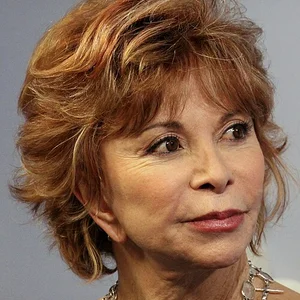

Isabel Allende is a Chilean novelist born in 1942, considered one of the most widely read Hispanic authors in the world. Her work blends magical realism, political history, and women's destinies. Her first novel, The House of the Spirits (1982), brought her international fame.
Isabel Allende(1942 — ?)
Isabel Allende
États-Unis, Chili
8 min read
Frequently asked questions
Famous Quotes
« We are only the stories we tell.»
« Writing is my way of celebrating what I love and fighting against what I hate.»
Key Facts
- Born on August 2, 1942, in Lima (Peru), Chilean national
- Published The House of the Spirits in 1982, her first novel, translated into more than 35 languages
- Exiled after Pinochet's coup d'état in 1973, she eventually settled in the United States
- Founded the Isabel Allende Foundation in 1996 in memory of her daughter Paula
- Received the Presidential Medal of Freedom from the United States in 2014
Works & Achievements
Isabel Allende's debut novel, a family saga spanning four generations of women in Chile, blending magical realism and political history. Translated into more than 40 languages, it brought her immediate worldwide recognition.
A novel inspired by a true story set under the Chilean dictatorship, following a journalist who discovers a mass grave of political disappeared. The work denounces the crimes of Pinochet's dictatorship.
A novel narrated by a Latin American storyteller whose personal history intertwines with the political upheavals of her country. The work celebrates the power of women and of storytelling.
A moving memoir written as a long letter to her daughter Paula, who fell into a coma in 1991 and died in 1992. One of her most personal works, translated into more than 30 languages.
A nostalgic and ironic memoir in which Isabel Allende explores her Chilean identity, her relationship with exile, and her conflicted yet loving bond with her homeland.
The first volume of an adventure trilogy for young adults, following a teenager through the Amazon rainforest. This novel marks Isabel Allende's entry into literature for younger readers.
A historical novel tracing the exile of Spanish Republican refugees to Chile after the Civil War, aboard the ship Winnipeg chartered by Pablo Neruda. Acclaimed by international critics.
Anecdotes
On January 8, 1981, Isabel Allende begins writing a long letter to her dying grandfather in Chile, whom she cannot visit because of the exile imposed by Pinochet's dictatorship. The letter grows into a novel of more than 500 pages, published under the title The House of the Spirits. Since then, she begins each new book on January 8, a date she considers lucky.
Isabel Allende is the niece of Chilean socialist president Salvador Allende, who was overthrown and died during the military coup of September 11, 1973, led by General Pinochet. This traumatic event forced her into exile in 1975 and left a deep mark on all her work, which often explores political violence and women's resistance in the face of oppression.
In 1991, her daughter Paula falls into a coma in Madrid following a medical error during treatment for hereditary porphyria. Isabel stays by her bedside for a year, writing down the history of their family for her. Paula dies in December 1992, at the age of 28, and this heartbreaking account becomes the memoir Paula (1994), one of her most personal works.
A committed journalist in Chile during the 1960s and 1970s, Isabel Allende writes feminist articles for Paula magazine and interviews figures such as Pablo Neruda. After the 1973 coup, she helps political opponents hide or flee the country, at the risk of her own safety, before being forced into exile herself in Venezuela in 1975.
Isabel Allende was rejected by several Spanish publishers before The House of the Spirits was finally published in Barcelona in 1982. The novel met with immediate worldwide success, translated into more than 40 languages. Gabriel García Márquez, a towering figure of magical realism, publicly praised the work, contributing to its international recognition.
Primary Sources
Barrabás came to us by sea, the child Clara noted in her diary that day. He was in a wretched cage, covered in excrement and misery, but his tranquil bearing and ancient gaze immediately revealed his royal dignity.
Listen, Paula, I am going to tell you a story, so that when you wake you will not feel lost in the labyrinth of sleep. The family legend begins at the end of the last century, when a courageous Basque sailor landed on the shores of Chile.
Chile is an invention, a capricious doodle by a drunken God, whose idea was to take every variety of terrain, climate, vegetation, and inhabitants that exist on the planet and cram them into a long lace of land and sea between the Andes and the Pacific.
This book was born of a long fascination with the story of the Winnipeg, the ship chartered by Pablo Neruda to transport two thousand Spanish Republican refugees to Chile in 1939. Neruda said it was the most beautiful work of his life.
Key Places
Capital of Peru where Isabel Allende was born on August 2, 1942, her father being a Chilean diplomat. She lived there only a few years before leaving for Chile with her mother.
Capital of Chile where Isabel grew up and built a career as a journalist during the 1960s and 1970s. The city is also the historical backdrop of the 1973 coup d'état that permanently upended her life.
Seat of the Chilean government where her uncle Salvador Allende resisted the coup plotters on September 11, 1973, before dying there. This defining event haunts the entirety of Isabel Allende's literary and political work.
Capital where Isabel went into exile with her family from 1975 to 1988 to escape Pinochet's dictatorship. It was there that she wrote and published her first major novels, including *The House of the Spirits*.
City where Isabel Allende settled in 1988 and where she still lives today. It is in her California home that she writes every morning and where the Isabel Allende Foundation is based.
Typical Objects

Isabel Allende writes every morning at her desk — first on a typewriter, then on a computer — always beginning her books on January 8th. The discipline of daily writing is central to her identity as an author.

Inspired by her grandmother's secret notebooks, Isabel Allende built much of *The House of the Spirits* around a woman who records her life in a journal. These notebooks symbolize the transmission of memory across generations of women.

Family photos — especially those of her uncle, President Salvador Allende — hold a central place in Isabel's personal world. They represent her painful bond with Chile and the memory of a tragic political past.

Isabel Allende is known for surrounding herself with flowers in her workspace. They symbolize the life, beauty, and hope that run through her work, even in the darkest moments of her stories.

Shaped by Chile's magical worldview and the legacy of magical realism, Isabel Allende collects objects to which she assigns symbolic or protective value — a trait she shares with several of her female characters.

Deeply influenced by García Márquez's magical realism, Isabel Allende read and reread his works before writing *The House of the Spirits*. She went on to develop her own distinct style, centered on women and political memory.
School Curriculum
Vocabulary & Tags
Key Vocabulary
Tags
Daily Life
Morning
Isabel Allende rises early and begins writing at her desk around 9 in the morning. She works with strict discipline, surrounded by fresh flowers and photographs of her loved ones. Every new book is started on January 8th, a ritual date she has honored since 1981.
Afternoon
Afternoons are reserved for correspondence, meetings with readers, and managing her philanthropic foundation. Isabel Allende receives an impressive volume of letters from readers around the world, which she tries to answer personally.
Evening
Evenings are devoted to family and friends, as Isabel places great importance on shared meals and human connection. She often cooks Chilean and Latin American dishes, keeping alive culinary traditions that also nourish her writing.
Food
Isabel Allende is deeply attached to Chilean and Latin American cuisine: empanadas, cazuelas, slow-cooked stews with spices and fresh herbs. Food holds a symbolic place in her work, often associated with the cultural transmission between women across generations.
Clothing
Isabel Allende favors a relaxed yet polished style, often colorful, reflecting her warm temperament and Latin American cultural roots. She readily wears artisan jewelry and vibrant patterned clothing during her many public appearances and lectures.
Housing
She lives in a large house in San Rafael, California, surrounded by a garden she loves to tend. Her home is an open, welcoming space adorned with Latin American artwork, books, and flowers — a reflection of her creative and hospitable personality.
Historical Timeline
Period Vocabulary
Liens externes & ressources
Références
Œuvres
La Maison aux esprits
1982
De l'amour et de l'ombre
1984
Eva Luna
1987
Mon pays inventé
2003
La Cité des bêtes
2002
Largo pétalo de mar
2019