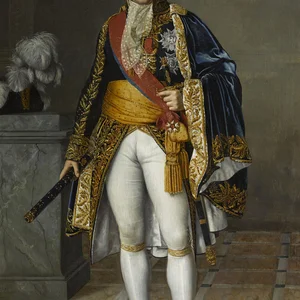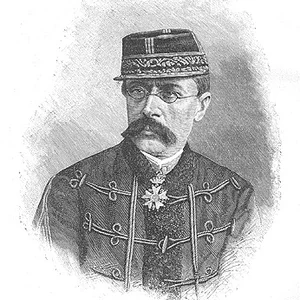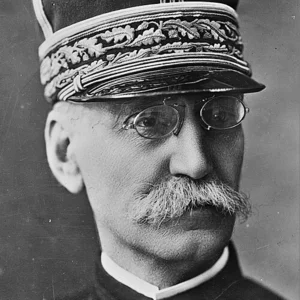

General and Marshal of France, Gallieni was a great colonial administrator in Madagascar and Indochina. Military Governor of Paris in 1914, he organized the counter-offensive at the Marne, saving the capital thanks to the famous “taxis of the Marne.”
Joseph Gallieni(1849 — 1916)
Joseph Galliéni
France
9 min read
Frequently asked questions
Key Facts
- 1849: born in Saint-Béat (Haute-Garonne)
- 1896–1905: Governor-General of Madagascar, modernized the island and abolished slavery
- September 1914: organized the counter-offensive at the Marne as Military Governor of Paris
- 1916: appointed Marshal of France posthumously in 1921
- 1916: died on May 27, before the end of the war
Works & Achievements
Over nine years as governor, Gallieni transformed Madagascar by building roads, railways, hospitals, and schools. His administration, which relied on existing local structures, has remained in textbooks as both a model — and a subject of debate — for French colonial organization.
A work in which Gallieni recounts his two missions in French Sudan. He outlines his methods of pacification and colonial administration, which profoundly influenced French military doctrine and Lyautey's school of colonial thought.
As Military Governor of Paris, Gallieni identified the exposed flank of the German First Army and urged Joffre to launch a counter-attack. This initiative, combined with the requisitioning of taxis, contributed to the "Miracle of the Marne" that halted the enemy advance.
A comprehensive account of his governorship of Madagascar, in which Gallieni describes administrative reforms, infrastructure projects, and colonial administration methods. An essential reference work for the history of French colonialism.
Published after his death, these memoirs are an essential source on the defense of Paris in August–September 1914 and on the often strained relations between Gallieni and General Joffre's Grand Headquarters.
Anecdotes
In September 1914, as German armies threatened Paris, military governor Gallieni made a bold decision: requisitioning around 600 Renault AG1 taxis to transport reserve soldiers from the Paris garrison to the Marne front. Though their actual military impact was modest — a few thousand soldiers transported — the famous “Taxis of the Marne” became a powerful symbol of popular mobilization and French ingenuity in the face of invasion.
In 1896, just a few weeks after arriving in Madagascar as governor-general, Gallieni had Queen Ranavalona III arrested and sent into exile — first to Réunion, then to Algeria. He abolished the Malagasy monarchy and proclaimed the island a French colony, bringing centuries of Merina royalty to an end. The queen never saw her homeland again and died in exile in Algiers in 1917.
In Madagascar, Gallieni developed an administrative method he called the “politique des races”: rather than destroying local social structures, he relied on the traditional chiefs of each ethnic group and built roads, schools, and hospitals. Convinced that development and education were more effective than repression alone, he paired this approach with the “oil spot” method — gradually expanding pacified zones outward — which was later taught in French military schools.
Appointed Minister of War in October 1915, Gallieni clashed relentlessly with General Joffre and Grand Headquarters. Exhausted by these disputes and gravely ill, he resigned in March 1916. He died on 27 May 1916, before the Battle of Verdun had even ended, without having seen the victory he had helped prepare. France paid him a belated tribute by naming him Marshal of France posthumously in 1921.
During his missions in French Sudan in the 1880s, Gallieni found himself facing the forces of the Toucouleur ruler Ahmadou Tall. Rather than risk a frontal battle, he favored negotiation and secured significant concessions through diplomacy. This ability to alternate between dialogue and military action — and to understand local political balances — became the hallmark of his entire colonial career.
Primary Sources
Gallieni describes his methods of progressive pacification, alternating between negotiations with local chiefs and targeted military operations, laying the groundwork for what would become his colonial doctrine of the “oil stain.”
In this official report submitted to the Ministry of Colonies, Gallieni outlines his method: start from secured zones, develop infrastructure and civilian administration, then gradually extend French control across the entire island.
A stocktaking of nine years of governance, in which Gallieni presents the achievements of his administration: road and railway construction, development of public education, and the organization of an administration built on local ethnic structures.
Published posthumously, these memoirs recount the decisions made during the first weeks of the war, most notably the requisitioning of the Paris taxis and the coordination with Joffre to launch the counter-offensive on the Marne.
Key Places
A small town in the Pyrenees where Joseph Galliéni was born on November 24, 1849. The son of a French-naturalized captain of Italian origin, he spent his childhood there before entering the École spéciale militaire de Saint-Cyr.
Capital of Madagascar where Galliéni established his government from 1896 to 1905. He oversaw the construction of roads, schools, and hospitals, transformed the island's administration, and left a lasting mark on the country.
Seat of the Military Governor of Paris in 1914, it was from this command post that Galliéni organized the defense of the capital and ordered the counter-offensive at the Marne. The building now houses his tomb.
The region east of Paris where the First Battle of the Marne was fought in September 1914. Galliéni dispatched the famous taxis loaded with soldiers there and coordinated the counter-attack that halted the German advance and saved Paris.
The administrative center of Tonkin where Galliéni served from 1892 to 1896, first as commander of troops and then as lieutenant governor. He put his methods of pacification and colonial administration into practice there before being sent to Madagascar.
The city where Galliéni died on May 27, 1916, a few weeks after resigning from the government due to failing health. His remains were subsequently transferred to the Invalides in Paris.
Typical Objects

Standard headgear of French generals, adorned with gold embroidery symbolizing rank. Gallieni wore it during troop inspections and official ceremonies, both in the tropical colonies and in Paris in 1914.

This iconic Parisian taxi of the Belle Époque era was requisitioned by the hundreds on Gallieni's orders in September 1914 to transport soldiers to the Marne. It became a symbol of the general's foresight and the Parisian spirit of mobilization; one example is preserved at the Musée de l'Armée in Paris.

An indispensable tool of military command, Gallieni used topographic maps to plan his campaigns in Africa, Asia, and France. It was on such a map that he identified, in September 1914, the gap in the German lines that made the Marne counter-offensive possible.

In 1914, Gallieni was one of the first military commanders to make intensive use of the telephone to coordinate the defense of Paris and communicate with Joffre at the Grand Quartier Général. This instrument symbolizes the modernity of his command methods.

In the absence of passable roads during the early years of his governorship, Gallieni often traveled by filanzane — a traditional Malagasy sedan chair — during his inspection tours across the island to meet with local chiefs.

The supreme symbol of the French military hierarchy, the Marshal of France's baton was presented to Gallieni's family posthumously in 1921, in recognition of his decisive role at the Battle of the Marne and his colonial career.
School Curriculum
Vocabulary & Tags
Key Vocabulary
Daily Life
Morning
Gallieni rose very early, faithful to military discipline. In Madagascar, his mornings began with a review of the dispatches that had arrived during the night from the island's various regions. In Paris in 1914, they were dominated by front-line situation bulletins and conferences with his staff officers at the Invalides.
Afternoon
His afternoons were devoted to administrative decisions and audiences: Malagasy ethnic chiefs or colonial officers in the colonies, generals and ministers in 1914. An avid walker and man of the field, he preferred to inspect ongoing works himself — roads, fortifications, defensive positions — rather than relying solely on written reports.
Evening
Evenings were often spent drafting reports and correspondence to the Ministry of Colonies or the government. A man of wide reading, Gallieni took a keen interest in the languages and cultures of the territories he administered. Sober and not one for socializing, he had little appreciation for official receptions and preferred solitary study.
Food
Gallieni shared the frugality of field officers, with little concern for gastronomy. In the colonies, he adapted to local resources: rice and vegetables in Madagascar, local dishes in Indochina. He attached little importance to meals, viewing them as a necessity rather than a pleasure.
Clothing
On duty, he wore the regulation general's uniform — austere and free of superfluous ornament — along with his kepi adorned with gold braid. In the colonies, he sometimes adapted his dress to climatic conditions, wearing lighter clothing in the tropics. He sought no ostentation and was indifferent to sartorial elegance.
Housing
In Antananarivo, Gallieni resided in the governor-general's palace, the former residence of the Merina sovereigns, which he regarded above all as a workplace and a symbol of French authority. In Paris, he occupied the official apartments of the military governor at the Invalides. In his final years, he lived in Versailles in relative simplicity.
Historical Timeline
Period Vocabulary
Liens externes & ressources
Références
Œuvres
Pacification et organisation de Madagascar
1896-1905
Deux campagnes au Soudan français (1886-1888)
1891
Organisation de la contre-offensive de la Marne
Septembre 1914
Madagascar de 1896 à 1905
1908
Mémoires du Gouverneur militaire de Paris
1920 (posthume)