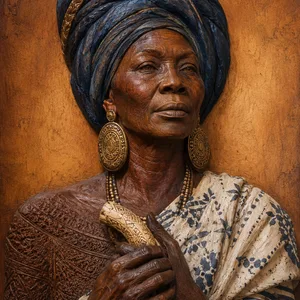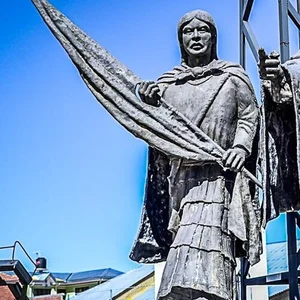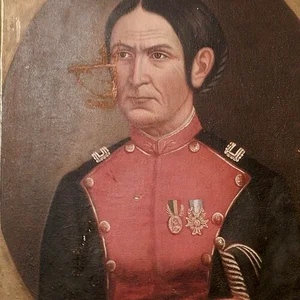

A mestiza guerrilla fighter born in 1780 in Upper Peru (present-day Bolivia), she commanded indigenous troops against the Spanish during the independence wars. Known as "the Pachamama of freedom," she was appointed lieutenant colonel by Simón Bolívar.
Frequently asked questions
Key Facts
- 1780: born in Toroca, in Upper Peru (present-day Bolivia)
- 1809–1816: actively participates in the independence wars, commanding indigenous guerrilla forces
- 1816: awarded the rank of lieutenant colonel by Simón Bolívar in recognition of her victories
- 1825: independence of Bolivia, of which she is considered a national heroine
- 1862: dies in poverty in Sucre, Bolivia
Works & Achievements
Juana Azurduy recruited, trained, and commanded a corps of indigenous fighters known as the 'Leales', made up of several hundred men from Quechua communities. This popular militia was one of the most active resistance forces in Upper Peru.
During this decisive battle, Juana personally charged the enemy lines and seized the Spanish flag — an act that earned official recognition from the patriot command and boosted the morale of the insurgents.
For six years, Juana waged a war of attrition against royalist forces in the mountains of Upper Peru, cutting supply lines and making Spanish control of the region precarious and costly.
Official recognition by Liberator Simón Bolívar of her entire military career, making her one of the very few women to receive a senior officer's rank in the armies of South American independence.
Anecdotes
At the Battle of Pintatora in May 1816, Juana Azurduy — several months pregnant — rode at the head of her troops and personally seized the Spanish enemy's flag. She gave birth just days after the victory, an act of courage that became legendary among the insurgents of Upper Peru.
After the capture and execution of her husband Manuel Asencio Padilla in 1816, Juana did not surrender. She fought on, sometimes bringing their children to camp, until she lost four of the five to illness and the hardships of war. Her personal resistance became a symbol of Andean resilience in the face of colonization.
Simón Bolívar is said to have personally awarded her the rank of Lieutenant Colonel in the patriot army in 1825, in tribute to her fifteen years of guerrilla warfare. He reportedly hailed her as a braver soldier than himself — a phrase that, whether true or embellished, speaks to the prestige she had earned among the liberators of the continent.
In her final years, Juana Azurduy fell into near-total obscurity. When she died in 1862 in Sucre at the age of 82, she was living in extreme poverty and was buried in a common grave. It was not until the twentieth century that Argentina and Bolivia officially recognized her role, awarding her posthumous honors and commemorating her on banknotes and monuments.
Primary Sources
In recognition of her distinguished services rendered to the cause of independence, General Simón Bolívar confers upon Doña Juana Azurduy de Padilla the rank of Lieutenant Colonel in the patriot army.
Señora Azurduy and her husband are holding their ground against the royalists in the mountains of Upper Peru with a handful of men and a resolve that commands admiration. I urge that ammunition and reinforcements be sent to them without delay.
The guerrillas commanded by Padilla and his wife have harassed Spanish columns along the roads of Chuquisaca, making any regular resupply of royalist forces in the region impossible.
Baptized Juana, legitimate daughter of Matías Azurduy and Eulalia Bermúdez, mestiza, in the parish of Toroca, province of Chayanta, on the twelfth of July, seventeen eighty.
Key Places
Juana Azurduy's birthplace, located in the province of Chayanta (present-day department of Potosí). It was in this rural Andean setting that she grew up among Quechua-speaking communities.
The main city of colonial Upper Peru and the birthplace of the first independence junta in 1809. Juana lived there for part of her life and died in poverty there in 1862.
The most important mining center of the Spanish Empire, whose silver funded the Crown. The extreme inequality between indigenous miners and colonial elites fueled the uprisings in which Juana took part.
The main guerrilla territory of Juana and her husband Manuel. The mountain passes allowed effective ambushes against the more heavily equipped royalist columns.
The site of Juana's landmark victory in May 1816, where she seized the enemy's flag. This battle remains the most celebrated moment of her military career.
Capital of the United Provinces of the Río de la Plata, under whose administrative authority the Upper Peru guerrillas operated. General Belgrano reported Juana's exploits to the patriot government there.
Typical Objects
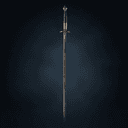
The primary weapon of mounted guerrillas, the saber enabled swift charges through Andean mountain passes. Juana Azurduy carried one and used it personally in combat — a rare distinction for a woman of her era.

A traditional garment of the Quechua and Aymara peoples, the poncho provided protection against the cold at high altitudes. Juana wore it to blend in among her indigenous fighters and to assert her belonging to the mestizo community.

At the Battle of Pintatora in 1816, Juana personally seized the Spanish royalist flag — a symbolic act of great military and moral value for the insurgent troops.
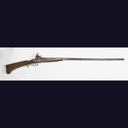
The standard firearm of patriot forces in the early 19th century, often seized from Spanish soldiers. The guerrillas of Upper Peru suffered a chronic shortage of ammunition and gunpowder.
📷 Attribution · Wikimedia Commons ↗
A sacred Andean plant used by indigenous peoples to combat fatigue and altitude sickness. Essential during long mountain marches, it was consumed daily by fighters.

Juana Azurduy was renowned for her exceptional horsemanship. Mastery of the horse was vital in mountain guerrilla warfare for rapid movement and surprise attacks.
School Curriculum
Vocabulary & Tags
Key Vocabulary
Tags
Daily Life
Morning
Juana rose before dawn in the guerrilla camp, often set up in a cave or stone hut at high altitude. She inspected the sentries, checked on the horses, and held council with her Quechua captains to plan the day's movements, switching between Spanish and Quechua depending on who she was speaking to.
Afternoon
Afternoons were spent making swift rides on horseback through Andean mountain passes, laying ambushes along the mule tracks used by Spanish supply convoys, or drilling indigenous recruits in the use of weapons captured from the enemy. She took part directly in combat — something exceptional for a woman of her era.
Evening
In the evenings at camp, she shared communal meals with her soldiers — typically chicha, corn, boiled potatoes, and dried llama meat. She worked to keep morale high, recounting past victories and mentally preparing the next day's operations, sometimes carrying one of her children on her back in the traditional Andean style.
Food
Campaign rations relied on Andean staples: potatoes (dehydrated chuño), corn, quinoa, dried llama and alpaca meat, supplemented by whatever local indigenous communities could provide. Coca leaves were chewed daily to ward off fatigue and altitude sickness at elevations above 3,000 meters.
Clothing
Juana wore a practical mix of military and Andean clothing: riding trousers, leather boots, a dark military jacket — either captured or sewn in the patriot style — and over it all a poncho or aguayo woven in the bright colors of Quechua communities. She often wore a wide-brimmed hat to shield herself from the harsh high-plateau sun.
Housing
During the guerrilla years, Juana had no fixed home. She lived in temporary shelters — natural caves, abandoned stone houses, camps in the quebrada forest. Before the war, she had lived in a typical Andean adobe house, with an inner courtyard, a central hearth, and little furniture.
Historical Timeline
Period Vocabulary
Visual Style
Style pictural épique inspiré de la peinture d'indépendance latino-américaine : palette de tons ocres et bruns des Andes, lumière dramatique de tempête, tenue mêlant uniforme militaire et tissage andin traditionnel.
Sound Ambience
Ambiance sonore des Andes au début du XIXe siècle : vent des hauteurs, chevaux sur les chemins de pierre, camp de guérilleros indigènes avec instruments traditionnels andins, échos lointains des colonnes espagnoles.
Liens externes & ressources
Références
Œuvres
Création et commandement des 'Leales'
1811-1816
Victoire de Pintatora et capture du drapeau royaliste
Mai 1816
Campagne de guérilla dans les vallées andines (1811-1817)
1811-1817
Grade de lieutenant-colonelle décerné par Bolívar
1825