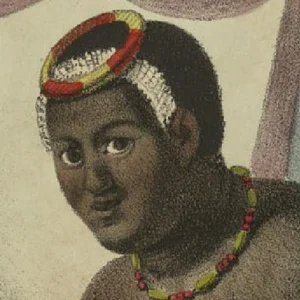

Queen consort and later regent of the Kingdom of Hawaii, Kaʻahumanu was the favorite wife of King Kamehameha I. In 1819, she abolished the system of religious taboos (kapu) and played a key role in introducing Christianity to Hawaii.
Frequently asked questions
Key Facts
- Born around 1768 on the island of Maui, from the Hawaiian high nobility
- Favorite wife of King Kamehameha I, unifier of the Hawaiian Islands
- In 1819, she abolished the kapu system (religious taboos) by publicly eating with men — a groundbreaking act of transgression
- Became Kuhina Nui (prime minister / co-ruler) upon the death of Kamehameha I in 1819
- Converted to Protestantism in 1825 and actively supported American missionaries until her death in 1832
Works & Achievements
By orchestrating the public breaking of food taboos alongside Kamehameha II, Kaʻahumanu dismantled the religious and social system that had structured Hawaiian society for centuries, paving the way for a profound transformation of the kingdom.
Kaʻahumanu created and embodied the role of kuhina nui (co-regent prime minister), effectively establishing a dual government that gave noblewomen an unprecedented institutional political role in Hawaiʻi.
Under her authority, Hawaiʻi adopted its first written laws, prohibiting murder, theft, adultery, and desecration of the Sabbath — a founding act of the modern Hawaiian state, blending chiefly tradition with Christian values.
By actively supporting Protestant missions and learning to read herself, Kaʻahumanu helped drive the widespread adoption of written Hawaiian: within less than a generation, Hawaiʻi achieved one of the highest literacy rates in the world.
Following her conversion, Kaʻahumanu issued edicts banning ancient religious practices (ceremonial hula, awa, certain rituals) and promoted the establishment of missionary schools throughout the archipelago.
Anecdotes
Kaʻahumanu was the favorite wife of Kamehameha I, who loved her so deeply that he granted her exceptional authority. According to Hawaiian tradition, on his deathbed he told her: "Here are my chiefs, my children, and my wives — take care of them." It was thus that she became kuhina nui, co-regent of the kingdom — a role without precedent for a woman in Hawaii.
In November 1819, just months after the death of Kamehameha I, Kaʻahumanu and the new king Liholiho (Kamehameha II) shared a public meal together — men and women seated side by side — deliberately breaking the kapu, the system of religious taboos that forbade women from eating with men, among other restrictions. This simple yet symbolic act overturned centuries of Hawaiian tradition in a single moment.
When the first American Protestant missionaries arrived in 1820, Kaʻahumanu was initially hostile toward them. But a serious illness around 1823 brought her closer to them: nursed back to health by a missionary's wife, she was deeply moved and asked to receive Christian instruction. She was baptized in 1825 and took the Christian name Elizabeth.
Having become a devout Christian, Kaʻahumanu learned to read and write in Hawaiian through the missionaries, who had reduced the language to writing. She then promulgated the first written laws of the Kingdom of Hawaii, inspired by Christian values, prohibiting murder, theft, and desecration of the Sabbath. She died on June 5, 1832, with a Hawaiian Bible in her hands.
Kaʻahumanu was renowned for her imposing stature and indomitable character. During Captain George Vancouver's visit in 1793, he noted in his journal that she was remarkably beautiful and commanded a striking presence. Kamehameha I, jealous of her admirers, even had a fortified residence built for her — to protect her, or perhaps to keep watch over her.
Primary Sources
She (Kaahumanu) assumed the office of Kuhina-nui or premier, with a degree of authority nearly co-ordinate with that of the king himself, and exercised it with great ability and decision for more than twelve years.
Amongst the females, the most conspicuous was Caahumanna, the favourite wife of Tamaahmaah... She was about sixteen years of age, of a most amiable countenance and fine person.
Kaahumanu has this day received baptism and taken the name of Elizabeth. Her conversion is sincere and her influence upon the chiefs and people is beyond all our hopes.
It shall not be permitted to kill. It shall not be permitted to steal. It shall not be permitted to profane the Lord's day. It shall not be permitted to commit adultery. These laws apply to all the islands.
Ua make o Kaahumanu i keia la, o ka la 5 o Iune, ka makahiki 1832. He wahine nui ia i ka pono o ko Hawaii nei pae aina.
Key Places
Coastal region on the eastern side of Maui where Kaʻahumanu was born around 1768. This territory was under the authority of Chief Keʻeaumoku, her father, an ally of the great ruling lineages of Maui.
The primary residence of Kamehameha I's court; Kaʻahumanu spent much of her adult life here as the king's favorite wife and exercised her political influence from this base.
The kingdom's emerging capital, where Kaʻahumanu resided increasingly after 1820 and where she regularly met the American missionaries who would shape her conversion to Christianity.
The place where Kamehameha I died in May 1819; it was here that Kaʻahumanu proclaimed her role as kuhina nui and took the reins of power alongside the new king.
Hawaiʻi's first stone church, built between 1836 and 1842 by American missionaries on the site of a chapel that Kaʻahumanu had supported; it remains a symbol of her Christian legacy.
Typical Objects

A cloak of yellow and red feathers reserved for the Hawaiian high nobility, a symbol of rank and sacred power. Kaʻahumanu wore such garments during official ceremonies to assert her authority as kuhina nui.

An ivory ornament carved into a hook shape and worn on a braid of human hair, reserved for high-ranking Hawaiian chiefs. It symbolized the power and noble lineage of its wearer.

A traditional Hawaiian fabric made from the bark of the paper mulberry tree (wauke), worn draped around the body. Before the introduction of Western cloth, kapa was the everyday garment of all social classes, including royalty.

After her conversion, Kaʻahumanu learned to read in order to access the Scriptures translated by missionaries. She died in 1832 with a Hawaiian Bible in her hands, a symbol of her spiritual transformation.

A traditional Hawaiian percussion instrument used during ceremonies, chants (mele), and hula dancing. It set the rhythm for court life and the rituals in which Kaʻahumanu participated before the abolition of the kapu system.

A ceremonial necklace made of hundreds of animal or human teeth, worn by aliʻi (chiefs) on important occasions. It embodied the accumulation of mana (sacred power) by its wearer.
School Curriculum
Vocabulary & Tags
Key Vocabulary
Tags
Daily Life
Morning
Kaʻahumanu rose at dawn in her residence (hale), a large wood-framed house thatched with pandanus, open to the sea. She began the day with ritual ablutions and prayers — after her conversion to Christianity, replacing the ancient kapu rituals with readings from the Hawaiian Bible.
Afternoon
Afternoons were devoted to the affairs of the kingdom: receiving chiefs (aliʻi) from the various islands, arbitrating land disputes, and meeting with missionaries to discuss new laws or the progress of schools. She took part in deliberations with an authority her contemporaries described as nearly sovereign.
Evening
Evenings brought the court together around communal meals — a powerful symbolic act following the abolition of kapu, which had forbidden men and women from eating together. Songs, genealogical chants (mele koʻihonua), and conversation stretched on by torchlight, in an atmosphere that blended Hawaiian traditions with new influences.
Food
The staple food was poi (fermented taro paste), served alongside raw or cooked fish, seafood (sea urchin, clams, octopus), sweet potato, and tropical fruits (banana, coconut, breadfruit). Royal meals also included pork and dog, festive dishes reserved for the aliʻi.
Clothing
Kaʻahumanu wore draped kapa (beaten bark cloth) garments with finely decorated geometric patterns, paired with feather cloaks (ʻahuʻula) and sperm whale ivory ornaments on ceremonial occasions. As missionary influence grew, she gradually adopted long Western-style dresses, which Hawaiian women came to call holokū.
Housing
Her main residence was a compound of large Polynesian-style structures (hale) on the island of Hawaiʻi and later in Honolulu, built of wood and thatch using traditional techniques but on a royal scale. After her conversion, she also had school buildings and chapels constructed and maintained near her residences.
Historical Timeline
Period Vocabulary
Visual Style
Style aquarelle ethnographique des récits de voyage du début XIXe siècle, alliant la palette tropicale de Hawaï (or, rouge volcanique, turquoise) à la dignité solennelle d'un portrait de chef polynésien.
Sound Ambience
Ambiance sonore de Hawaï au tournant du XIXe siècle, mêlant l'omniprésence de l'océan Pacifique, les chants et percussions traditionnels, et les sons quotidiens d'une cour royale polynésienne en pleine mutation.
Liens externes & ressources
Références
Œuvres
Abolition du système kapu
Novembre 1819
Institution de la fonction de kuhina nui
1819
Premier code de lois écrit du Royaume d'Hawaï
1827
Promotion de l'alphabétisation en langue hawaïenne
1820–1832
Interdiction du culte traditionnel et des pratiques kapu
1824–1830