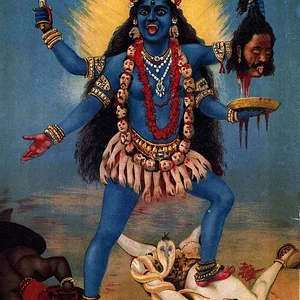

A Hindu goddess rooted in Vedic and Tantric tradition, Kali is the fierce and destructive aspect of the goddess Durga. Venerated by the people of India since antiquity, she embodies both the destruction of evil and cosmic renewal. Her complex figure symbolizes the cycle of death and rebirth.
Kali
Kali
8 min read
Frequently asked questions
Key Facts
- First mentioned in the Devi Mahatmya (c. 5th–6th century CE), a foundational text of Shaktism
- In oral and written tradition, she defeats the demon Raktabija by drinking his blood to prevent him from multiplying
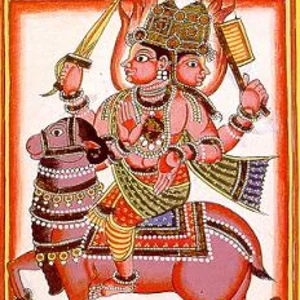
- Her distinctive iconography — dark skin, protruding tongue, garland of skulls — appears in Indian sculpture from the first millennium CE onward
- She is the tutelary deity of Tantrism, a highly influential religious movement across South and Southeast Asia
- Her cult is especially vibrant in Bengal, where the Kali Puja festival remains a major celebration to this day
Works & Achievements
This foundational text of Shaktism recounts the exploits of Kali and Durga against demonic forces. It is the most important textual source for understanding the mythology and symbolism of Kali.
A sacred text from Assam dedicated entirely to Kali, it describes her forms, rituals, and myths. It is the primary reference for Kali worship in northeastern India.
This tantric treatise places Kali at the center of the pantheon and describes the rituals of her veneration. It has profoundly influenced modern tantric thought.
A collection of Bengali devotional songs in honor of Kali, composed by the poet-mystic Ramprasad. These hymns, still sung today, popularized a tender and maternal vision of the goddess.
A popular pictorial style that emerged around the Kalighat temple, Kalighat paintings depict Kali with a vivid and expressive style. They spread the image of the goddess throughout India and among Western travelers.
Kali has become a pervasive figure in modern Indian and global art, inspiring paintings, sculptures, films, and literature. Her image is regularly revisited by feminist artists as a symbol of female power.
Anecdotes
According to the Devi Mahatmya, Kali was born from the furious brow of the goddess Durga during a cosmic battle against the demons Chanda and Munda. Her bloodlust was so intense that she could not stop killing; only Shiva, lying beneath her feet, managed to calm her. This is why she is often depicted with her tongue sticking out — a sign of her shock at nearly trampling her own husband.
In the Tantric tradition, Kali is associated with worship practiced in cremation grounds known as shamshana. Her most devoted followers would meditate among the ashes of the dead to overcome their fear of death and attain spiritual liberation. This practice, shocking to many, symbolized victory over the ego and illusion.
Ramakrishna Paramahamsa, the great Bengali mystic of the 19th century, worshipped Kali as his divine mother at the Dakshineswar temple near Calcutta. He claimed to speak with her directly and would fall into a trance in her presence. His spiritual experiences have influenced millions of believers around the world to this day.
The name 'Kali' comes from the Sanskrit 'kala', which means both 'time' and 'black'. Kali thus embodies Time, which devours all things — even the gods themselves. This profound philosophy reminds us that everything born is destined to disappear, and that destruction is the necessary condition for all renewal.
Primary Sources
Then from the face of Chandika, darkened with fury, suddenly sprang forth Kali, terrible, bearing a sword and a noose, wielding a skull-topped staff, clad in a tiger's skin.
Kali, the great goddess, is worshipped in cremation grounds and on battlefields. She is the one who destroys time itself and liberates souls from the cycle of rebirth.
Kali is the first and foremost of the ten Mahavidyas. She is the ultimate reality, pure consciousness beyond form and time, worshipped by sages who seek liberation.
O Mother Kali, you are my only treasure. Though you wear a garland of skulls, your feet are gentle to those who love you with a sincere heart.
Key Places
One of the four holiest Shakti Peethas in Hinduism, this temple is dedicated to Kali and draws millions of pilgrims each year. According to legend, the toe of Sati (wife of Shiva) fell at this very spot.
A temple founded in 1855 on the banks of the Ganges, made famous by the mystic Ramakrishna, who lived there and experienced his visions of Kali. It remains a major center of Kali devotion in Bengal.
A major center of Tantrism dedicated to the goddess Kamakhya, a form of Kali worshipped in Assam. The temple is renowned for its ancient tantric rituals and the Ambubachi festival, which celebrates the goddess's feminine cycle.
A sacred city on the banks of the Ganges, Varanasi is associated with both Shiva and Kali. Its open-air cremation grounds, where bodies burn around the clock, are emblematic of Kali's philosophy of death and renewal.
A shrine dedicated to Vindhyavasini, a form of Kali venerated in the forests of the Vindhya hills. This site is associated with the very ancient origins of goddess worship in central India.
Typical Objects

Held in one of her hands, Kali's sword cuts through ignorance and evil. It symbolizes divine wisdom capable of destroying the illusions that bind the human soul.

Kali often holds a severed head, representing the defeat of the ego and the demon Raktabija. This symbol is a reminder that spiritual liberation requires the death of the illusory self.

Her necklace of fifty skulls represents the fifty letters of the Sanskrit alphabet, a symbol of divine speech and the creative power of language. Each skull also evokes the impermanence of all life.

Used in tantric rituals, this cup made from a human skull collects offerings of blood or wine. It symbolizes the total acceptance of death as an integral part of the cycle of life.

Kali is often depicted wearing or standing on a tiger skin, the tiger being an animal that symbolizes the fierce, untameable power of nature. This signals her mastery over the wild forces of the universe.

In her more serene depictions, Kali holds a red lotus symbolizing compassion and the beauty hidden behind her terrifying appearance. It is a reminder that the destruction she embodies serves the purpose of rebirth.
School Curriculum
Vocabulary & Tags
Key Vocabulary
Daily Life
Morning
In the temples dedicated to her, the day begins before dawn with the abhisheka ritual: priests bathe Kali's statue with milk, honey, and Ganges water. Bells ring out to awaken the goddess, and the first devotees arrive barefoot, bringing red hibiscus flowers — Kali's sacred bloom.
Afternoon
The midday rituals include food offerings (naivedya) and the chanting of hymns from the Devi Mahatmya by the priests. Pilgrims perform circumambulation (pradakshina) around the shrine, reciting the goddess's names. In devout Bengali households, women sing the devotional songs of Ramprasad as they go about their daily tasks.
Evening
The evening puja is the most solemn: priests wave oil lamps before the goddess in a ritual called aarti, accompanied by drums and cymbals. Night is Kali's sacred time; some Tantric devotees meditate in cremation grounds by the light of funeral pyres, seeking to transcend the fear of death.
Food
Offerings to Kali traditionally include rice, lentils, sweets, and flowers, but in certain Tantric traditions, rice wine (madira) and, historically, animal sacrifices were also practiced. Devout worshippers observe fasts (upavasa) during new moons and festivals such as Kali Puja, purifying themselves before approaching the goddess.
Clothing
Kali is depicted wearing a tiger skin or a simple veil of the starry sky, for she stands beyond the conventions of clothing. Her devotees often wear red or black during her rituals; Tantric priests don specific garments for nocturnal ceremonies, sometimes anointed with funeral ashes to symbolize their detachment from the world.
Housing
Kali dwells in liminal spaces: cremation grounds (shamshana), crossroads, deep forests, and battlefields. Her temples are often built away from urban centers or on high ground, such as Kamakhya in Assam. The interior of her sanctuary is dark, lit by flickering oil lamps, and the air is thick with incense and the scent of offered flowers.
Historical Timeline
Period Vocabulary
Visual Style
Esthétique de la peinture tantrique et Kalighat : Kali en bleu nuit sur fond de crématorium, ornée d'or, entourée de flammes, dans un contraste saisissant entre terreur et grâce divine.
Sound Ambience
Ambiance sonore d'un temple hindou dédié à Kali : tambours rituels, cloches sacrées, chants dévotionnels et crépitement des lampes à huile lors d'une cérémonie nocturne.
Liens externes & ressources
Références
Œuvres
Devi Mahatmya
IVe–VIe siècle
Kalika Purana
Xe siècle
Mahanirvana Tantra
XVIIIe siècle (texte écrit)
Shyamasangit de Ramprasad Sen
XVIIIe siècle
Représentations iconographiques classiques (peintures Kalighat)
XIXe siècle