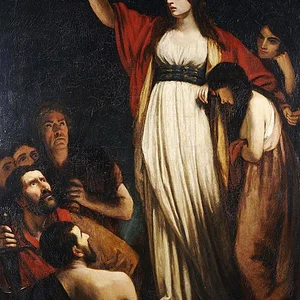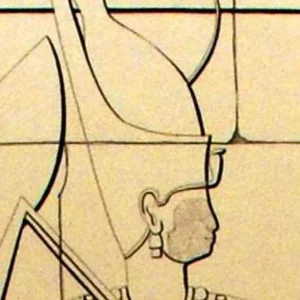

Warrior queen of the Kingdom of Meroë (Nubia, present-day Sudan), Amanirenas led Kushite armies against the Roman legions of Augustus around 27–21 BCE. According to Roman sources and Sudanese oral tradition, she lost an eye in battle yet never surrendered, ultimately securing a peace treaty favorable to her kingdom.
Kandake Amanirenas
Kandake Amanirenas
8 min read
Frequently asked questions
Famous Quotes
« "She would rather lose an eye on the battlefield than bow the knee before Rome." (words attributed by Sudanese oral tradition)»
Key Facts
- Reign estimated around 40–10 BCE over the Kushite Kingdom of Meroë (based on archaeological and Roman sources)
- Around 25 BCE, her armies seized the Roman city of Syene (Aswan) and toppled statues of Augustus
- Wounded in combat, she reportedly lost an eye — a detail attested by Roman sources (Strabo, Cassius Dio)
- The Roman general Petronius recaptured Syene and sacked Napata, the Kushite capital, but failed to subdue Meroë
- Around 21–20 BCE, a peace treaty was negotiated at Samos, considered favorable to the Kushites: Rome abandoned its demands for tribute
Works & Achievements
A diplomatic agreement signed after five years of war, in which Rome renounced tributes on Meroë and returned territories. It stands as one of the rare instances in history where an African state secured favorable terms against Roman power.
A series of coordinated military operations that allowed the Kushites to temporarily seize Syene, Elephantine, and Philae, demonstrating Amanirenas's strategic ability to wage war across a broad front.
Inscriptions and reliefs discovered in Meroitic temples attest to significant building activity during the reign of Amanirenas, reinforcing the royal prestige and religious authority of the kandake.
Though never written down, Amanirenas's legacy lives on through the richness of the oral cycle dedicated to her in Nubian and Sudanese traditions, preserving a model of resistance and female sovereignty.
Anecdotes
During the capture of the city of Syene (modern-day Aswan) in 25 BC, Kushite warriors beheaded a bronze statue of Emperor Augustus and brought the head back to Meroë as a trophy. The head was buried beneath the threshold of a temple so that soldiers would symbolically walk over their enemy's face every time they entered.
Amanirenas is said to have lost an eye during a battle against the Romans, most likely at Syene or Napata. Far from weakening her authority, this wound only strengthened her legend: she was nicknamed 'the brave one-eyed queen,' and Roman sources themselves noted her remarkable courage despite her injury.
After the Roman counter-offensive led by Gaius Petronius, which destroyed Napata, Amanirenas did not surrender. She continued the resistance for several years until securing a peace treaty at Samos in 21 BC: Rome agreed to waive the tribute and return part of the occupied territories — a rare diplomatic victory against Augustus.
Sudanese oral tradition preserves the memory of Amanirenas as a warrior queen who personally led her troops into battle, riding a war chariot. Nubian griots and singers passed these stories down from generation to generation, making her a symbol of resistance and national pride long before Western historians took an interest in her.
Primary Sources
Strabo describes the Kushite military expeditions against Roman garrisons in Egypt and mentions a queen of the Ethiopians, 'a masculine woman, blind in one eye', who directed military operations with vigor.
Augustus recounts in his official memoirs the expedition into Ethiopia and the submission of peoples beyond Egypt, without explicitly mentioning the favorable treaty granted to the Meroites.
Songs and recitations passed down by Nubian communities describe Amanirenas as an invincible kandake who faced the Roman eagle and never bowed her head, winning peace with weapons in hand.
Pliny cites the kings and queens of Meroë while discussing the Roman campaigns in Nubia, attesting to the political and military power of the Kushite kingdom in the face of Rome.
Key Places
Capital of the Kushite kingdom and main residence of Amanirenas, located on the Nile in northern present-day Sudan. The city housed royal pyramids, temples, and the royal palace from which the kandake coordinated resistance against Rome.
City in Upper Egypt stormed by Amanirenas's forces in 25 BCE. It was here that the bronze head of Augustus was seized as a war trophy, marking the high point of the Kushite offensive.
Ancient religious and political capital of the Kingdom of Kush, home to the great temple of Amun at Jebel Barkal. Destroyed by Petronius during the Roman counter-offensive, its resistance symbolized the spiritual and political stakes of the conflict.
A strategic fortress on the Nile that the Kushites besieged and the Romans later fortified. This major archaeological site, now partly submerged beneath Lake Nasser, has yielded inscriptions and artifacts attesting to the Roman-Kushite conflict.
Sacred island and temple complex dedicated to Isis, captured during Amanirenas's offensive. A place of syncretism between Egyptian, Kushite, and Greek cultures, it symbolized the contested frontier zone between Rome and Meroë.
Liens externes & ressources
Références
Œuvres
Traité de paix de Samos avec Rome
21 av. J.-C.
Construction et restauration de temples à Méroé et Napata
Ier siècle av. J.-C.
Transmission de la mémoire épique koushite
depuis le Ier siècle av. J.-C.