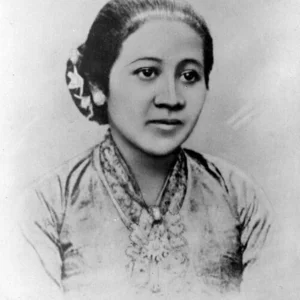

Kartini (1879-1904) was a Javanese noblewoman who fought for Indonesian women's access to education under Dutch colonial rule. Her letters in Dutch, published posthumously under the title "Through Darkness into Light," inspired the Indonesian feminist movement and made her a major national figure.
Kartini(1879 — 1904)
Kartini
Indes orientales néerlandaises
7 min read
Frequently asked questions
Famous Quotes
« "Educate a woman, and everything else will follow."»
Key Facts
- 1879: born in Jepara (Java), into a Javanese noble family
- 1892: confined to the home after primary school, in accordance with the Javanese purdah custom
- 1899-1904: engaged in extensive correspondence with progressive Dutch contacts, notably Rosa Abendanon
- 1903: founded a school for girls in Jepara
- 1904: died at age 25 following the birth of her first child
- 1911: her letters were published posthumously under the title *Door Duisternis tot Licht*
Works & Achievements
A collection of letters written between 1899 and 1904, published by J.H. Abendanon. A founding text of Indonesian feminism, translated into many languages and inscribed in UNESCO's Memory of the World Register.
The first school for the daughters of Javanese civil servants, founded by Kartini at her father's residence. It foreshadowed the Kartini schools that would multiply after her death.
An intense exchange of letters with a Dutch feminist activist, in which Kartini first articulated her ideas on women's education, colonialism, and Javanese tradition.
A translation of Kartini's letters into Malay/Indonesian by Armijn Pane. The title means 'After Darkness Comes Light' and helped spread her ideas within Indonesian society itself.
Kartini encouraged and organized the production and export of local batik to give Javanese women a source of economic independence, working in collaboration with Dutch commercial networks.
Anecdotes
At age 12, Kartini was subjected to the practice of pingitan: according to Javanese aristocratic custom, she was confined within the family compound until her marriage, cut off from the outside world. This abrupt seclusion, coming after years of Dutch schooling, only strengthened her determination to fight against the inequalities faced by women.
Kartini maintained an intense correspondence with Dutch friends, most notably Stella Zeehandelaar and Rosa Abendanon. These letters, written in remarkable Dutch, reveal an intellectual who hungered for freedom, books, and progressive ideas. She quotes Victor Hugo, references European newspapers, and probes the contradictions of colonialism.
In 1903, Kartini founded a small school in Jepara for the daughters of Javanese civil servants, teaching them reading, writing, and needlework. It was one of the first female education initiatives led by an indigenous woman in the Dutch East Indies.
Kartini died on September 17, 1904, at just 25 years old, four days after giving birth to her son. Her early, tragic death gave her letters a particular resonance. Published in 1911 under the title Door Duisternis tot Licht (Through Darkness into Light), they became a founding text of Indonesian feminism.
Every year on April 21st, Kartini's birthday, Indonesia celebrates Kartini Day: women and girls wear traditional Javanese dress and ceremonies are held in schools across the archipelago, in tribute to the woman who believed every girl deserved access to education.
Primary Sources
Oh! I struggle so hard, and the struggle is so difficult. To be or not to be free, that is the question. I want to be free, I want to be able to live independently, to depend on no one, to not have to do what my heart rejects.
We want to do something, we want to act, not only talk and think. We want to work for our people, to lift up the women of our country.
The light you gave me, I want to pass on to others. Education is the key that opens all doors.
I dream of a school where our girls would learn to think for themselves, to no longer endure without understanding, to become mothers capable of raising free and enlightened children.
Key Places
Kartini's hometown and the residence of her father, the regent. It is here that she grew up, underwent pingitan, and founded her first school for girls in 1903.
The city where Kartini settled after her marriage to the regent of Rembang in 1903. She opened a second school there and died in September 1904.
Kartini's burial site, now a national pilgrimage destination. Every April 21st, delegations gather here to pay tribute to the founding figure of Indonesian feminism.
Housed in the former residence of Kartini's father, this museum preserves portraits, letters, and personal belongings. It is the primary memorial site dedicated to her life.
The city where Rosa Abendanon, Kartini's main correspondent, resided. It is also where her collected letters were published in 1911, securing her international recognition.
Typical Objects

Kartini wrote hundreds of letters in Dutch to her European correspondents. The quill was the central tool of her intellectual resistance and her fight for women's emancipation.

A traditional Javanese blouse made of cotton or silk worn by aristocratic women. Kartini wore it with pride while asserting an intellectual modernity that transcended outward appearances.

Wax-dyed fabric featuring codified patterns that signal social and regional identity. Kartini championed the promotion of Jepara's batik craftsmanship as a source of economic independence for women.

Confined within the family compound, Kartini fed her mind with reading: novels, feminist essays, and newspapers. These works from the Netherlands were her window to the world and fueled her thinking.

A set of traditional Javanese instruments found in aristocratic residences. The music of the gamelan set the rhythm of court life in which Kartini grew up, caught between tradition and a longing for modernity.

A recurring symbol in Kartini's writings: "From darkness into light" evokes this flame struggling against the darkness of ignorance and oppression.
School Curriculum
Vocabulary & Tags
Key Vocabulary
Daily Life
Morning
Kartini rises early in the regent's residence, observing Javanese morning rituals. She joins the household prayers and shared chores before withdrawing to her quarters to read or write her letters in Dutch.
Afternoon
The afternoon is devoted to visits and social obligations that come with her rank as an aristocrat. From the pingitan, she oversees the instruction of the young girls in the household, or works to promote local batik with craftswomen from Jepara.
Evening
In the evening, by the light of an oil lamp, Kartini returns to her correspondence. She writes long letters to Stella Zeehandelaar or Rosa Abendanon, sharing her dreams of emancipation, her recent readings, and her hopes for Javanese women.
Food
Kartini's diet is that of the Javanese aristocracy: nasi rice served with sides of tempeh, tofu, vegetables stir-fried with chili and coconut milk, and tropical fruits such as mangosteen and papaya. Meals are served in the Javano-Dutch tradition of the bupati's residence.
Clothing
Kartini wears the kebaya, an embroidered blouse in cotton or silk, paired with a batik sarong in traditional Javanese patterns. Her dress is neat and befitting her aristocratic rank, yet free from the ostentatious excess she criticizes in her letters.
Housing
Kartini lives in the official residence of the bupati (regent) of Jepara, a spacious home blending Dutch colonial architecture with Javanese ornament: shaded inner courtyards, open pavilions (pendopo), tropical gardens, and separate rooms for the women of the household.
Historical Timeline
Period Vocabulary
Visual Style
Esthétique coloniale javanaise fin XIXe : lumière dorée tropicale, architecture néerlandaise ornée de motifs javanais, kebaya et batik indigo, bureau d'écriture à la lampe à huile.
Sound Ambience
Ambiance sonore d'une résidence aristocratique javanaise de la fin du XIXe siècle : gamelan, pluie tropicale, appel à la prière et grattement de plume sur papier.
Liens externes & ressources
Références
Œuvres
Door Duisternis tot Licht (À travers l'obscurité vers la lumière)
1911 (posthume)
Fondation de l'école de Jepara
1903
Correspondance avec Stella Zeehandelaar
1899–1903
Habis Gelap Terbitlah Terang (traduction indonésienne)
1922
Promotion de l'artisanat batik de Jepara
1900–1903