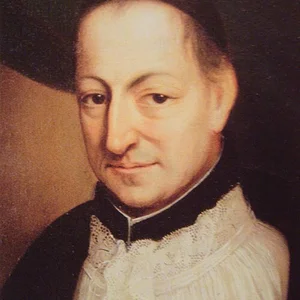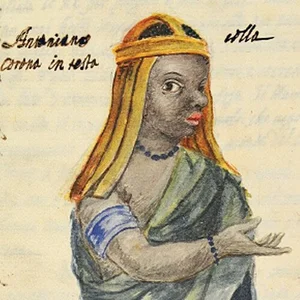

A Kongolese prophetess of the Bakongo people, Kimpa Vita founded around 1704 the Antonian movement, preaching an African interpretation of Christianity. Arrested by Capuchin missionaries, she was burned at the stake in 1706 for heresy and witchcraft.
Kimpa Vita(1684 — 1706)
Kimpa Vita
royaume de Kongo
7 min read
Frequently asked questions
Famous Quotes
« "God is Kongolese" — words attributed by Bakongo oral tradition to Kimpa Vita during her preaching»
Key Facts
- Born around 1684 in the Kongo Kingdom (present-day Democratic Republic of the Congo/Angola)
- Around 1704, she claimed to be possessed by Saint Anthony of Padua and founded the Antonian movement
- She preached an African reinterpretation of Christianity, claiming that Jesus and the Virgin Mary were Kongolese
- Arrested on the orders of King Pedro IV and the Capuchin missionaries, she was tried for heresy
- Burned at the stake on July 2, 1706, along with her companion and their infant, in San Salvador (present-day M'banza-Kongo)
Works & Achievements
Kimpa Vita founded this syncretic religious movement that blended Catholic Christianity with Bakongo spirituality, advocating an African interpretation of the Gospel message and the reunification of the Kongo Kingdom.
Oral compositions sung by her followers, adapting Catholic prayers into the Kikongo language. These chants formed the liturgical heart of the Antonian movement and were passed down orally for generations.
Kimpa Vita traveled on foot across the fragmented Kongo Kingdom, preaching political and spiritual reconciliation. Her message drew tens of thousands of followers and reignited efforts to rebuild São Salvador.
Her doctrine held that Jesus, Mary, and the apostles were African, and that European missionaries were distorting the Gospel. This theology stands as one of the earliest examples of radical inculturation of Christianity in sub-Saharan Africa.
Anecdotes
Around 1704, Kimpa Vita claimed to be possessed by the spirit of Saint Anthony of Padua every Monday morning, and that the saint's soul would leave her body each Friday. This dual identity — simultaneously a woman and a Catholic saint — granted her a unique spiritual authority in the eyes of her Bakongo followers.
Kimpa Vita taught that Jesus Christ was born in São Salvador (the former capital of the Kongo Kingdom, present-day Mbanza Kongo) and not in Bethlehem, and that the apostles were African. This radical reinterpretation of Christianity aimed to free Congolese faith from European tutelage.
She traveled through the ruined Kongo Kingdom, drawing thousands of believers who followed her singing hymns known as 'Salve Antonia' — African adaptations of Catholic prayers. Her movement gathered tens of thousands of people around the effort to rebuild São Salvador, which had lain abandoned for decades.
Arrested in 1706 on the orders of King Pedro IV with the complicity of Capuchin missionaries, Kimpa Vita was tried for heresy and witchcraft. Accused of being the mother of an illegitimate child, she was burned alive on July 2, 1706, alongside her companion João Barro, barely twenty-two years old.
The Antonian movement she founded did not die with her: some historians see it as one of the earliest African forms of an indigenized Christianity, and a direct influence on later prophetic movements in Central Africa, such as Kimbanguism in the twentieth century.
Primary Sources
She claimed to be possessed by Saint Anthony and asserted that Jesus was born in the land of the Black peoples, thereby attracting a multitude of followers who accompanied her and rebuilt São Salvador.
The said Dona Beatriz was condemned to the fire along with her companion and her child, as a heretic and false prophetess, for having led the people astray with false doctrines.
Hail Antonia, full of grace, the Lord is with thee… Thou who wast born in Kongo, thou who suffered for us, intercede for the Bakongo people.
The elders said she walked barefoot along dusty roads, and that wherever she stopped to pray, people would leave their homes to follow her toward the lost capital.
Key Places
Former capital of the Kongo Kingdom, abandoned after the civil wars. Kimpa Vita led her followers there to symbolically rebuild its former glory and make it the center of the Kongo's renaissance.
The likely region of origin of Kimpa Vita, in the northwest of present-day Angola. This coastal territory was both exposed to Portuguese missionary influence and deeply rooted in Bakongo traditions.
A refuge area for Bakongo populations during the civil wars, where Kimpa Vita attracted many followers before being arrested. It was in this mountainous region that she carried out most of her preaching.
An unidentified location near São Salvador where Kimpa Vita was executed on July 2, 1706. This site is commemorated in collective Bakongo memory as a place of martyrdom.
Typical Objects

Kimpa Vita carried a cross during her preachings, a symbol of Christianity that she sought to reinterpret from an African perspective. For her, the cross embodied a reconciliation between the Catholic faith and Bakongo spiritual traditions.

Before becoming a prophetess, Kimpa Vita was a nganga, an initiator into nkisi rituals. These ritual objects, charged with spiritual power, represent the Bakongo cultural roots from which her movement drew its strength.

A traditional Bakongo garment woven from raffia palm fibers, worn by women of the Kongo. Despite her spiritual authority, Kimpa Vita dressed simply, which reinforced her image as a prophetess of the people.

During her healing and blessing rituals, Kimpa Vita used water that she blessed in the manner of Catholic priests, merging Christian practices with traditional Bakongo purification rituals.

Followers of the Antonian movement often carried woven palm fronds as a sign of devotion, referencing Jesus's entry into Jerusalem while also honoring the sacred plants of Kongo traditions.

The pyre on which Kimpa Vita was executed on July 2, 1706, has become a symbol of her martyrdom and of the violence of religious colonization. Her memory is passed down orally as that of an African saint unjustly condemned.
School Curriculum
Vocabulary & Tags
Key Vocabulary
Daily Life
Morning
Kimpa Vita rose before dawn to pray, claiming that the spirit of Saint Anthony possessed her every Monday at daybreak. She performed ritual ablutions blending Catholic gestures with traditional Bakongo purification practices before beginning her day of preaching.
Afternoon
Afternoons were devoted to traveling on foot between villages, accompanied by disciples who sang the "Salve Antonia." She would stop at crossroads and in forest clearings to preach the reunification of the Kongo and the rebuilding of São Salvador, and was said by her followers to sometimes heal the sick.
Evening
In the evenings, Kimpa Vita presided over communal gatherings where hundreds of people sang and prayed. She claimed that her soul left her body every Friday evening to join Saint Anthony in heaven, returning on Sunday — placing her beyond the ordinary rules of social life.
Food
The diet in the Kongo in the early 18th century was built around cassava (introduced by the Portuguese in the 16th century), beans, plantains, and smoked fish. As an itinerant prophetess, Kimpa Vita depended on food offerings from her disciples and likely observed ritual fasts.
Clothing
Kimpa Vita wore a raphia cloth wrap, the traditional Bakongo garment, and went barefoot despite her constant travel along laterite paths. The simplicity of her dress stood in stark contrast to the ornaments reserved for nobles and chiefs, underscoring her message of humility and universality.
Housing
During her years of itinerant preaching, Kimpa Vita had no fixed home and slept in makeshift shelters or with followers. Before her prophetic movement, she likely lived in a mud-and-thatch dwelling typical of Bakongo villages in the mountainous Kibangu region.
Historical Timeline
Period Vocabulary
Visual Style
Style pictural inspiré de l'art kongo du XVIIIe siècle : tons chauds ocre et terre cuite, influences de la sculpture nkisi et de l'iconographie catholique africaine, atmosphère crépusculaire et spirituelle.
Sound Ambience
Ambiance sonore du Kongo de 1704 : chants collectifs des pèlerins antonianistes, percussions rituelles et bruits de la forêt équatoriale, évoquant à la fois ferveur spirituelle et contexte de crise politique.
Liens externes & ressources
Références
Œuvres
Fondation du mouvement antonianiste
vers 1704
Hymnes « Salve Antonia »
vers 1704-1706
Prédications itinérantes dans le royaume Kongo
1704-1706
Réinterprétation africaine du christianisme
1704-1706