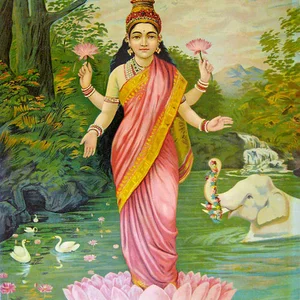

Hindu goddess of prosperity, fortune, and beauty, venerated in the Vedic tradition since antiquity. Consort of the god Vishnu, she symbolizes abundance, grace, and good fortune in the mythology of Indian civilization.
Lakshmi
Lakshmi
9 min read
Frequently asked questions
Key Facts
- Mentioned in the Rigveda (c. 1500–1200 BCE) under the name Sri, associated with fertility and prosperity
- According to tradition, she was born from the churning of the cosmic ocean (Samudra Manthan), a central episode in Puranic mythology
- She is one of the most widely venerated deities in the Hindu pantheon, alongside Saraswati and Parvati, forming the feminine trinity (Tridevi)
- Her main festival, Diwali (the Festival of Lights), is celebrated each autumn and remains one of the most important celebrations in the Hindu calendar
- She is depicted standing or seated on a lotus, holding lotuses and pouring gold coins — codified symbols passed down through the iconographic tradition
Works & Achievements
A foundational Vedic text dedicated to Lakshmi, still recited today in Hindu rituals. It is one of the oldest literary attestations of the goddess and defines her essential attributes: beauty, abundance, and divine grace.
A fundamental cosmogonic narrative of Lakshmi's birth, telling how she emerged from the primordial waters during the churning performed by gods and demons. This myth is one of the most widely depicted in Indian and Southeast Asian sacred art.
A hymnic list of one hundred and eight names and attributes of the goddess, used in daily devotional rituals. This liturgical text illustrates the richness and diversity of the roles attributed to Lakshmi in the Hindu tradition.
The canonical artistic form depicting Lakshmi flanked by two elephants pouring water over her, developed first in Buddhist and then in Hindu art. This image appears on thousands of temples, coins, and ritual objects across Asia.
An annual collective ritual in which homes are lit up to welcome Lakshmi on the darkest night of autumn. Now one of the most widely celebrated festivals in the world, it keeps devotion to the goddess alive across cultures.
A theological elaboration in which Lakshmi intercedes with Vishnu on behalf of humanity, acting as a benevolent mediator. This doctrine has profoundly shaped Vaishnava piety in southern India.
Anecdotes
During the great myth of the churning of the cosmic ocean (Samudra Manthan), gods and demons whipped the primordial waters to extract the nectar of immortality. It was from these churning depths that Lakshmi emerged, radiant, seated on a lotus, holding flowers in her hands. This moment is considered her divine birth and explains why she is always depicted on or surrounded by lotus blossoms.
Lakshmi is known as a devoted yet independent wife: according to several Puranic texts, she left the realm of the gods on multiple occasions when they showed disrespect or impurity. Her departure brought misery and drought, serving as a reminder that prosperity cannot dwell where pride or neglect hold sway.
In the Hindu tradition, Lakshmi has eight forms known as the Ashta Lakshmi, each representing a different aspect of abundance: material prosperity, courage, victory, beauty, knowledge, nourishment, progeny, and triumph over enemies. Each form is venerated separately in certain temples across southern India.
The festival of Diwali, celebrated each autumn by hundreds of millions of people around the world, is directly linked to Lakshmi. Families light their homes with oil lamps (diyas) to welcome the goddess and help her find their household in the darkness. It is believed that Lakshmi visits homes that are clean, well-lit, and open to her arrival on that night.
Primary Sources
"Shri is beautiful, radiant, beloved of the gods; she shines like gold, blooms like the moon. May she come to us, bringing fortune and abundance."
"From the churning of the ocean arose Lakshmi, clad in white, holding a lotus, choosing Vishnu as her husband before the assembly of the gods."
"O Shri, you who dwell in the lotus, whose face is like the lotus, grant me glory, prosperity, and progeny."
"Lakshmi is inseparable from Vishnu as light is from the sun; where he goes, she goes; what he creates, she sustains and nurtures."
"Sri dwells in pure hearts, in fresh flowers, in the generous cow, in the just king, and in homes where harmony reigns."
Key Places
One of the largest Hindu pilgrimage centers in the world, dedicated to Vishnu-Venkateswara and his consort Lakshmi (Padmavati). Millions of devotees flock here each year to receive the goddess's blessing.
One of the 51 sacred Shakti Peethas, entirely dedicated to Lakshmi in her Mahalakshmi form. This thousand-year-old temple is renowned as one of the rare sites where the goddess presides without Vishnu, asserting her own independent power.
A vast Vaishnavite complex situated on a river island, consecrated to the reclining Vishnu (Ranganatha) and Lakshmi (Ranganayaki). It is one of the largest active Hindu temples in the world and a major center of the Sri Vaishnavism tradition.
A Buddhist site dating to the 2nd century BCE where the earliest known sculptural depictions of Gaja Lakshmi (Lakshmi flanked by elephants) were discovered. These reliefs bear witness to the antiquity and widespread reach of her cult.
A Hindu island in Southeast Asia where the worship of Lakshmi has been maintained since medieval times. She is venerated here as goddess of the earth, fertility, and rice abundance, integrated into a unique Balinese spirituality.
Typical Objects

Lakshmi's emblematic flower, the lotus grows in mud yet blooms immaculate — a symbol of purity, beauty, and spiritual prosperity. Lakshmi is almost always depicted sitting or standing on a lotus, holding a flower in each hand.
📷 CC BY-SA 3.0 · Wikimedia Commons ↗
A vessel filled with gold coins or sacred water, symbolizing the material and spiritual abundance that Lakshmi bestows. It appears in rituals dedicated to her and features in her iconography as a sign of her infinite generosity.

Two white elephants pouring water over Lakshmi form one of her oldest representations. The elephant symbolizes royalty, power, and life-giving rain; this image expresses that prosperity comes to those the goddess chooses to bless.

The owl is Lakshmi's vahana (mount), which may seem paradoxical since it also symbolizes the blindness that comes with wealth misused. This animal serves as a reminder that fortune can blind us, and that wisdom is needed to make good use of the goddess's gifts.

A small clay lamp lit during Diwali to welcome Lakshmi into homes. The diya's light guides the goddess through the darkness and symbolizes hope, knowledge, and the triumph over ignorance.

Lakshmi is often depicted with one hand pouring a shower of gold coins, a gesture known as the Varada mudra (gesture of giving). This symbol illustrates her boundless generosity and her primary role: to distribute wealth and prosperity to those who worship her with sincerity.
School Curriculum
Vocabulary & Tags
Key Vocabulary
Daily Life
Morning
In mythological tradition, Lakshmi awakens with the dawn, carried by the nascent light of the sun over the cosmic waters. Devotees dedicated to her perform the purifying bath ritual at daybreak and recite the Shri Sukta to draw her grace upon the day ahead.
Afternoon
Lakshmi presides over activities of prosperity and exchange: in households that honor her, women weave garlands of fresh flowers to lay at her effigy, and merchants place her image in their shops to bless their transactions. Temples offer her ablutions (abhisheka) with milk, honey, and perfumed waters.
Evening
Evening is Lakshmi's favored time: oil lamps are lit in every household to invite her in. The evening liturgy includes songs (bhajans), offerings of fruits, flowers, and incense, as well as the recitation of her one hundred and eight names. It is believed that the goddess moves through the night, visiting illuminated and pure homes.
Food
Lakshmi is associated with pure and abundant food: offerings made to her include rice pudding (kheer), sweet fruits such as coconut and mango, ghee (clarified butter), and sweets. These foods symbolize the abundance and sweetness of life she grants to her devotees.
Clothing
Lakshmi is invariably dressed in a red or golden silk sari — the colors of prosperity and happiness in the Hindu tradition. She wears heavy gold jewelry — necklaces, bracelets, earrings, and a crown — and her garments are embroidered with lotus motifs. Red is also the color worn by Hindu brides at wedding ceremonies, linking Lakshmi to conjugal bliss.
Housing
Lakshmi symbolically resides in pure, prosperous, and orderly spaces: a clean, flower-adorned, and well-lit home is her preferred dwelling. In the myths, she lives in Vishnu's palace on the cosmic mountain Vaikuntha, surrounded by lotus gardens and fountains of pure water. On earth, she is invited to dwell in homes through ritual drawings traced at the threshold (kolam or rangoli).
Historical Timeline
Period Vocabulary
Visual Style
Style indo-classique inspiré des bronzes Chola et de la peinture de cour de l'Inde ancienne : tons or, rouge et bleu profond, déesse radieuse sur lotus entourée d'éléphants royaux.
Sound Ambience
Atmosphère sonore d'un temple hindou au crépuscule : cloches, eau, chants dévotionnels et lampes à huile crépitantes évoquent la présence de Lakshmi.
Liens externes & ressources
Références
Œuvres
Shri Sukta (Hymne à Shri)
Vers 1000–800 av. J.-C.
Mythe du Samudra Manthan (barattage de l'océan)
Transmis oralement, consigné vers IVe–Ve s. apr. J.-C. (Vishnou Purâna)
Lakshmi Ashtottara Shatanamavali (108 noms de Lakshmi)
Tradition purânique, vers Ier–IXe s. apr. J.-C.
Iconographie Gaja Lakshmi
À partir du IIe s. av. J.-C. (Bharhut, Sanchi)
Fête de Diwali — Rite d'accueil de Lakshmi
Tradition attestée depuis au moins le Ier millénaire de notre ère
Doctrine du Purushakara (Sri Vaishnavisme)
Formalisée par Ramanuja et ses successeurs, XIe–XIIe s. apr. J.-C.