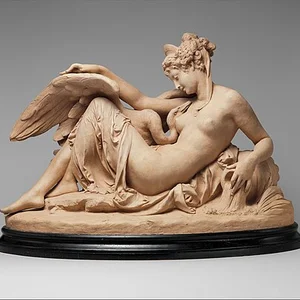

Queen of Sparta and figure from Greek mythology, Leda is seduced by Zeus in the form of a swan. From this union are born Helen of Troy, Clytemnestra, Castor, and Pollux — central figures of the Greek epic tradition.
Leda
Leda
8 min read
Frequently asked questions
Key Facts
- Wife of King Tyndareus of Sparta
- Zeus, transformed into a swan, seduces her and she lays eggs
- Mother of Helen (future queen of Troy), Clytemnestra, Castor, and Pollux
- Castor and Pollux (the Dioscuri) were venerated as demigod protectors of sailors
- Her story inspired many artists of the Renaissance and antiquity
Works & Achievements
A short epic poem celebrating Castor and Pollux, sons of Leda, as protectors of sailors and warriors. It bears witness to the importance of the cult of the Dioscuri throughout ancient Greece.
A tragedy in which Helen, daughter of Leda, reflects on her divine origins. Euripides offers an alternative version of the myth in which Helen never actually went to Troy, calling into question the worth of wars.
A painting depicting Leda embraced by the divine swan, surrounded by her children born from eggs. This work illustrates the Italian Renaissance's fascination with the divine metamorphoses of Zeus.
A composition commissioned by Alfonso d'Este depicting the union of Leda and the swan. The original has been lost, but several copies attest to Michelangelo's artistic boldness in approaching this mythological subject.
A modernist sonnet that reinterprets Zeus's seduction of Leda as a pivotal moment in human history, from which the Trojan War and all of Western civilization spring from a single divine act.
Anecdotes
According to Greek mythology, Zeus, king of the gods, fell desperately in love with Leda, queen of Sparta. To approach her without arousing the suspicion of her husband Tyndareus, he transformed himself into a white swan and seduced her on the banks of the Eurotas river. This union between a mortal woman and the master of Olympus illustrates one of the most powerful themes in Greek mythology: the blurred boundary between the divine and the human.
From her union with Zeus in the form of a swan, Leda is said to have laid one or two eggs, depending on the version of the myth. From these extraordinary eggs were born some of the most famous figures in all of Greek mythology: Helen, whose beauty would trigger the Trojan War, and the twins Castor and Pollux, heroes of the Argonauts. This birth from an egg — an exceptionally rare mythological motif — underscores the utterly supernatural nature of these children.
Leda was the mother of two sets of children with very different statuses: Helen and Pollux, born of Zeus, were semi-divine, while Clytemnestra and Castor, born of her mortal husband Tyndareus, were fully human. This unique divide between divine and mortal offspring lies at the heart of many Greek tragedies and explains the strikingly contrasting fates of her four children.
Leda's two sons, Castor and Pollux — known as the Dioscuri, meaning 'sons of Zeus' — became legendary heroes celebrated throughout Greece. Pollux, who was immortal, asked the gods to share his eternity with his brother Castor, who was mortal. In reward for this unmatched brotherly love, they were together transformed into the constellation Gemini, still visible in the Mediterranean sky.
Leda's most famous daughter, Helen of Troy, was considered in antiquity the most beautiful woman in the known world. Her abduction by Paris, a Trojan prince, sparked the Trojan War, which lasted ten years and mobilized the whole of heroic Greece. By giving birth to Helen, Leda thus became the indirect cause of one of the foundational conflicts of Western civilization.
Primary Sources
Helen is presented as the daughter of Zeus and Leda, her incomparable beauty having driven Paris to abduct her from her husband Menelaus, thus triggering the war against Troy.
Castor and Pollux, sons of beautiful Leda, born in Lacedaemon on the heights of Taygetus, tamers of swift horses, saviors of ships in peril on the seas.
Helen herself evokes her origins: 'My mother Leda was seduced by Zeus in the form of a winged swan; thus was I brought into the world, according to the inscrutable will of the gods.'
Zeus, transformed into a swan, united with Leda. She laid two eggs: from the first were born Castor and Clytemnestra, from the second Pollux and Helen, the most beautiful of mortals.
Jupiter, cloaked in the feathers of a deceitful swan, beguiled Leda; from this union were born children whose destiny would shake Greece and the world of men.
Key Places
Capital of the kingdom ruled by Tyndareus, husband of Leda. It was here that Zeus came to seduce the queen, and where the children born of this divine union between a mortal woman and the king of the gods came into the world.
A sacred river flowing through the plain of Lacedaemon, on whose banks Zeus, transformed into a swan, is said to have encountered Leda. A symbolic site of the meeting between the divine and the mortal in Greek tradition.
Home of the Greek gods and seat of Zeus, king of Olympus. It was from here that Zeus beheld Leda and resolved to seduce her, illustrating the boundless divine power that imposes itself upon mortals without restraint.
City in Asia Minor to which Helen, daughter of Leda, was brought after her abduction by Paris. Her beauty, inherited from her divine birth, triggered the greatest conflict in Greek mythology.
Kingdom of Agamemnon, husband of Clytemnestra, daughter of Leda. Mycenae stands at the heart of the cycle of the Atreides and the tragedies that tore the royal family apart in the aftermath of the Trojan War.
Typical Objects

The quintessential mythological object, the egg laid by Leda after her union with Zeus is the miraculous cradle of Helen and Pollux. It symbolizes the extraordinary birth of demigods and appears in numerous works of ancient art.

The white feathers of the swan into which Zeus transformed himself evoke the divine seduction of Leda. In Greek mythology, the swan is a sacred bird associated with the divine and with Apollo, god of light.

As queen of Lacedaemon, Leda wears the golden diadem, a symbol of her sovereignty. This attribute serves as a reminder that, despite her union with Zeus, she remains a mortal ruling over a people.

Traditional attributes of queens and wives in ancient Greece, the distaff and spindle symbolize the noble occupations of the women's quarters. Leda uses them to oversee the weaving work of her handmaidens.

Women of high rank wore long veils of white or saffron linen during religious ceremonies. Leda is often depicted veiled, expressing both her royal dignity and her piety toward the gods.

In Sparta, altars were dedicated to the Dioscuri, the sons of Leda. These sanctuaries recalled the divine lineage of the queen and the exceptional honor attached to her bloodline.
School Curriculum
Vocabulary & Tags
Key Vocabulary
Daily Life
Morning
Leda, queen of Sparta, begins her day in the gynaikonitis, the women's quarters of the royal palace. She presides over the morning offerings to the household gods, particularly Hera, goddess of marriage. Her handmaidens help her dress in her white linen peplos and put on her gold jewelry.
Afternoon
In the afternoon, Leda oversees the weaving and embroidery work of the palace women — a noble and essential activity in ancient Greece. She receives the wives of Spartan nobles, takes part in religious ceremonies, and attends to the upbringing of her four children, each destined for an extraordinary fate.
Evening
In the evening, Leda joins Tyndareus for the royal banquet in the great hall — a meal served by torchlight, accompanied by a bard singing the deeds of heroes. Before retiring, she pours wine libations to the household gods to protect the royal house through the night.
Food
The queen of Sparta's diet is that of the Greek aristocracy: barley and wheat bread, olives and olive oil, sheep's cheese, dried fish, figs and fresh grapes, and roasted lamb at ritual feasts. Wine diluted with water is the drink of royal banquets.
Clothing
Leda wears the peplos, a long robe of white or saffron linen cinched at the waist with a gold-embroidered belt. A himation, a large fine-wool cloak, is draped over the shoulders in cool weather. She adorns herself with earrings, bracelets, and a gold diadem — emblems of her royal status.
Housing
Tyndareus's palace in Sparta is a Mycenaean-style columned residence: a large central hall, the megaron, with a circular hearth, painted wooden columns, and colorful frescoes depicting hunting scenes. The royal apartments are decorated with purple-dyed wool hangings and red-figure vases.
Historical Timeline
Period Vocabulary
Visual Style
Style inspiré de la céramique à figures rouges athénienne et de la sculpture hellénistique classique : formes idéalisées, drapés fluides en lin blanc et or, dominantes d'ocre, d'ivoire et de bleu méditerranéen profond.
Sound Ambience
Ambiance sonore du bord du fleuve Eurotas à Sparte, mêlant les bruits apaisants de la nature méditerranéenne aux sons discrets du palais royal de Lacédémone, avec la présence mystérieuse des cygnes sacrés.
Liens externes & ressources
Références
Œuvres
Hymne homérique aux Dioscures
vers -700
Hélène, Euripide
412 av. J.-C.
Léda et le Cygne — Léonard de Vinci (copie d'après original perdu)
vers 1505-1510
Léda et le Cygne — Michel-Ange (carton perdu, copies existantes)
vers 1530
Léda et le Cygne — poème de W.B. Yeats
1923