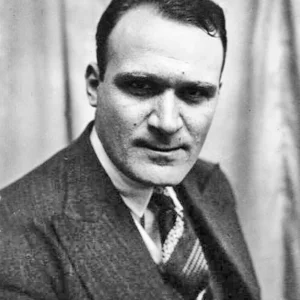

A French socialist politician, Léo Lagrange was appointed Under-Secretary of State for Sports and Leisure in the Popular Front government in 1936. He worked to make sport and holidays accessible to the working classes, before dying in combat in June 1940.
Léo Lagrange(1900 — 1940)
Léo Lagrange
France
8 min read
Frequently asked questions
Famous Quotes
« We want to give workers, as well as the young people of France, the opportunity to relax, to enjoy themselves, and to practice sports.»
Key Facts
- 1900: Born in Bourg-en-Bresse
- 1936: Appointed Under-Secretary of State for Sports and Leisure in Léon Blum's government
- 1936: Creation of the Fédération Léo Lagrange to promote popular sport and leisure
- 1936: Introduction of reduced SNCF rail fares for paid holidays, allowing workers to travel
- 1940: Killed in action at Évergnicourt on 9 June 1940 during the Battle of France
Works & Achievements
Lagrange was the first French government official to head a structure entirely dedicated to popular sports and leisure, building from scratch a public sports policy in France.
A measure negotiated with railway companies allowing workers to benefit from a 40% discount on train tickets during their paid holidays, making travel accessible to millions of working-class people for the first time.
A national sports certification, free and open to all, comprising simple athletics and swimming events, aimed at encouraging mass participation in sport outside of elitist clubs.
Lagrange actively promoted the development of youth hostels in France, which grew from a few dozen to more than 300 establishments, offering very low-cost accommodation to young travellers of all social backgrounds.
Lagrange supported the creation of popular aviation clubs allowing young people from working-class backgrounds to discover flying, an activity until then reserved for the wealthy and the military.
Lagrange worked to strengthen the role of sport in workers' associations and public facilities, convinced that physical activity was a driver of social emancipation and health for all.
Anecdotes
When Léo Lagrange was appointed Under-Secretary of State for Sports and Leisure in June 1936, he became the very first French government official dedicated exclusively to sport and leisure for workers. The position had not existed before him: he had to build everything from scratch — offices, programs — in just a few weeks, with very limited resources.
To ensure that workers could truly benefit from the paid vacations voted into law in June 1936, Lagrange negotiated a 40% discount with the railway companies on train tickets, dubbed the "billets populaires de congé annuel." For the first time, working-class families from Paris took the train to see the sea or the mountains — images that caught the public imagination and came to symbolize an entire era.
In 1937, Lagrange created the "brevet sportif populaire
a certificate open to everyone that combined running, the long jump, swimming, and throwing. Organized free of charge in public stadiums and swimming pools, it allowed hundreds of thousands of French people to take part in supervised sport for the very first time in their lives.
A passionate advocate for youth hostels, Lagrange actively supported the movement that saw their numbers grow from a few dozen to more than 300 establishments across France within just a few years. He wanted every young French person, regardless of their social background, to be able to travel and discover their country for just a few centimes a night.
Called up at the outbreak of the war as an infantry officer, Lagrange refused to use his political prominence to keep himself out of harm's way. He was shot and killed on June 9, 1940, near Évergnicourt (Aisne), during a French counter-attack, two days before the Germans entered Paris. He was 39 years old.
Primary Sources
An Under-Secretariat of State responsible for the organization of sports and leisure is hereby created within the Ministry of Public Health, entrusted to Mr. Léo Lagrange, Member of Parliament.
Our ambition is not to produce champions, but to ensure that as many of our fellow citizens as possible can share in the benefits of physical activity and well-earned rest. Paid holidays will only be a complete victory if we give workers the real means to enjoy them.
The popular sports certificate aims to foster a taste for physical effort among the general population, regardless of social class or sex, by offering simple tests accessible to all French citizens.
I want the worker's son to be able to swim, run, and climb a mountain, just like the bourgeois's son. Sport must not remain the privilege of a few; it is a right for all.
Key Places
Birthplace of Léo Lagrange, born on November 23, 1900. The son of a republican schoolteacher, he grew up in an environment deeply committed to popular education and the values of the Republic.
Seat of the National Assembly where Lagrange served as a Socialist deputy and delivered his speeches in support of working-class sport, leisure for labourers, and paid holidays.
The office from which Lagrange directed, from June 1936 to June 1937 and again from March to April 1938, France's first public policy aimed at democratising sport and holidays.
One of the major popular sports venues in the Paris region, where events for the *brevet sportif populaire* and mass-sport days championed by Lagrange were organised.
Village in the Aisne department where Léo Lagrange was fatally wounded on June 9, 1940, during the fighting of the Battle of France. He died there the same day, aged 39, a soldier to the last.
Typical Objects

A reduced-fare rail ticket (40% discount) created at Lagrange's initiative to allow workers to travel during their paid holidays. It symbolizes the democratization of vacations for the working classes.

Official booklet issued to participants who passed the popular sports certificate tests. Lagrange made it a symbol of universal access to sport, regardless of social class or income level.

The bicycle was the quintessential popular leisure item of the 1930s. Lagrange encouraged cycling as an accessible way to explore nature and get around during paid holidays.

Camping and the outdoors became popular thanks to Lagrange's reforms. Working-class families could, for the first time, head to the countryside or the seaside with light, inexpensive equipment.

Youth hostels, supported by Lagrange, welcomed travelers at very low cost. Their register bears witness to the social mixing the Under-Secretary of State envisioned: workers, students, and clerks rubbing shoulders with young people from all walks of life.

Lagrange died wearing his military uniform on the Aisne front in June 1940, having refused to abandon the fight despite his political standing. It embodies his commitment to the ultimate sacrifice.
School Curriculum
Vocabulary & Tags
Key Vocabulary
Daily Life
Morning
Lagrange starts his day early in his Parisian apartment, reading the political press and administrative reports. A trained lawyer, he meticulously prepares his parliamentary speeches and addresses, keen to argue with precision on the social issues surrounding sport and popular leisure.
Afternoon
His afternoons are devoted to meetings with sports federations, workers' unions, and popular tourism associations. He regularly visits sports grounds, swimming pools, or youth hostels to ensure that his reforms are taking shape on the ground and truly reaching the working classes.
Evening
In the evenings, he often attends branch meetings or SFIO congresses, sharing his socialist convictions with fellow militants. Whenever possible, he comes home to have dinner with his family, convinced that the right to rest and family life should apply to everyone — starting with those who fight for it.
Food
Like many French people in the 1930s, Lagrange follows a simple, seasonal diet: bread, vegetables, and modest amounts of meat. A parliamentarian from a modest background, he remains close to working-class habits and readily shares a meal with workers during his trips to the provinces.
Clothing
As a parliamentarian and former lawyer, Lagrange wears the dark suit and tie expected at the Chamber of Deputies. During his visits to sports grounds or electoral rallies, he adopts a simpler, more relaxed outfit, in keeping with his image as a politician close to the people.
Housing
He lives in Paris, in an unpretentious apartment that serves as the hub of his political and administrative activity. He travels by metro or official car for his ministerial appointments and visits to sports facilities in the Paris region.
Historical Timeline
Period Vocabulary
Liens externes & ressources
Références
Œuvres
Création du sous-secrétariat d'État aux Sports et aux Loisirs
juin 1936
Billets populaires de congé annuel
juillet 1936
Brevet sportif populaire
1937
Soutien au mouvement des auberges de jeunesse
1936-1938
Développement de l'aviation populaire
1936-1937
Politique de démocratisation de l'éducation physique
1936-1938