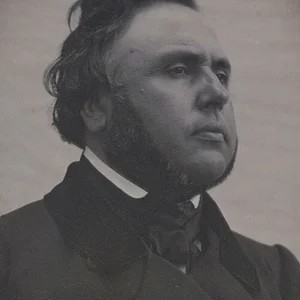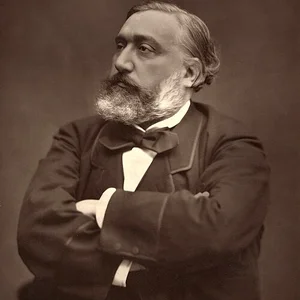

Lawyer and republican statesman, Léon Gambetta proclaimed the Third Republic on September 4, 1870 following the defeat at Sedan. He organized national resistance during the Franco-Prussian War, escaping besieged Paris by balloon. A key architect of the republican regime, he served as President of the Chamber of Deputies from 1879 to 1881.
Léon Gambetta(1838 — 1882)
Léon Gambetta
France, royaume de Sardaigne
9 min read
Frequently asked questions
Famous Quotes
« Clericalism — there is the enemy!»
« We must set our sights on winning over the countryside.»
Key Facts
- Born on April 2, 1838 in Cahors, died on December 31, 1882
- Proclaimed the Third Republic on September 4, 1870 at the Paris City Hall
- Left besieged Paris by hot-air balloon to organize national defense from Tours (October 1870)
- President of the Chamber of Deputies from 1879 to 1881
- President of the Council (head of government) from November 14, 1881 to January 26, 1882
Works & Achievements
The founding act of the Third Republic, proclaimed by Gambetta at the Paris City Hall following the capitulation of Napoleon III. This political gesture, made in a moment of urgency, permanently altered the course of France's destiny.
From Tours and then Bordeaux, Gambetta directed the war effort of the French provinces against the Prussian invader, raising new armies and attempting to break the siege of Paris — ultimately unable to prevent final defeat.
A republican press organ founded by Gambetta after the war to champion the republican ideal and shape public opinion in favor of the Third Republic, in opposition to those who sought a return to monarchy.
A collection of Gambetta's major speeches delivered in the Chamber of Deputies and at republican gatherings. These texts are an essential source for understanding nineteenth-century French republican thought.
By presiding over the Chamber, Gambetta consolidated republican institutions and symbolically embodied the victory of the republican people over the monarchists who had dominated the early years of the Third Republic.
The government formed by Gambetta in November 1881, long anticipated by republicans. Brought down after just 66 days, it nonetheless gave expression to his reformist ambitions, particularly constitutional revision and proportional list voting.
Anecdotes
On October 7, 1870, with Paris surrounded by Prussian troops, Gambetta escaped the capital aboard a gas-filled balloon, the *Armand-Barbès*. After a perilous journey of several hours over enemy lines, he landed in the Somme, near Montdidier, and made his way to Tours to organize the national resistance from the provinces.
After the defeat and the Treaty of Frankfurt (1871) ceding Alsace-Lorraine to Germany, Gambetta categorically refused to accept this loss. He even left the National Assembly rather than vote for the cession, and summed up the French stance in a phrase that has since become famous: “Think of it always, speak of it never.”
Gambetta was renowned as one of the greatest orators of his era. In 1868, during the Baudin trial — brought against a republican newspaper that had recalled the memory of a deputy killed during the coup d'état of 1851 — his thunderous plea against the regime of Napoleon III made him famous throughout France overnight.
In November 1881, Gambetta finally formed his government, nicknamed the “Grand Ministry” given the immense republican hopes it embodied. But the cabinet lasted only sixty-six days before being brought down. A few weeks later, on December 31, 1882, Gambetta died in Ville-d'Avray at just 44, under circumstances clouded by a gunshot wound that was never fully explained.
A champion of moderate republicanism nicknamed “opportunism,” Gambetta gradually convinced the French that the Republic was not synonymous with disorder or revolution, but could be a regime of stability and progress. He thus helped to permanently anchor the Third Republic in French political life.
Primary Sources
The Government of National Defense has been formed to defend, support, and deliver France. The people of Paris are summoned to their assemblies to elect their representatives.
We call as witness to what we assert the very recent history of the past eighteen years, during which universal suffrage has been systematically falsified, corrupted, and debased by every means at the disposal of an unscrupulous government.
Think of it always, speak of it never. Let us remain in solemn and composed mourning, but ready for anything, resolved to anything, and watching for the hour of revenge, recovery, and deliverance.
Rise up en masse! Every able-bodied man must take up arms and march against the enemy. The homeland is in danger; only an immense national effort can save it from invasion and shame.
We want absolute freedom of the press, without reservation. We want freedom of assembly without restriction, with the right to discuss all religious, philosophical, political, and social matters.
Key Places
Birthplace of Léon Gambetta, born on April 2, 1838. He spent his childhood here before moving to Paris to study law and begin his political rise.
On September 4, 1870, Gambetta proclaimed the Third Republic here before a jubilant Parisian crowd, bringing the Second Empire — discredited by the defeat at Sedan — to an end.
Seat of the Government Delegation of National Defense following Gambetta's escape by balloon. He organized the mobilization of the provincial armies here from October to December 1870.
The Government Delegation retreated to Bordeaux in December 1870 in the face of the Prussian advance. It was here that Gambetta delivered his famous speech refusing the cession of Alsace-Lorraine.
Seat of the Chamber of Deputies, of which Gambetta served as president from 1879 to 1881. Here he embodied the triumph of the Republic over the monarchists and was at the heart of every parliamentary battle.
Gambetta died on December 31, 1882, at his Villa des Jardies — formerly the residence of Balzac — following a mysterious gunshot wound and weeks of suffering.
Typical Objects

A gas-filled balloon used by Gambetta to flee besieged Paris on October 7, 1870. With a capacity of around 2,000 cubic meters, it symbolizes the republican's determination to continue the resistance at all costs.

Gambetta practiced at the Paris Bar before entering politics. His black robe recalls his early career as a courtroom orator, where he honed the rhetorical talent that would make him the tribune of the Republic.

The rostrum of the Chamber of Deputies was the stage for his greatest republican speeches. Gambetta was renowned for his powerful voice and breath that swept assemblies along with him.

A republican newspaper founded by Gambetta in 1871, serving as the press organ for his political movement. He used it to defend his ideas, shape public opinion, and counter the monarchists.

During the siege of Paris, Gambetta used the telegraph from Tours and Bordeaux to coordinate the resistance of provincial armies and maintain contact with the government trapped inside the capital.

An official poster announcing the birth of the Third Republic, posted throughout Paris on September 4, 1870. Born out of the urgency of defeat, this document is the founding act of the French republican regime.
School Curriculum
Vocabulary & Tags
Key Vocabulary
Daily Life
Morning
Gambetta rose early and devoted his mornings to a thorough reading of the political press and an extensive correspondence. As a lawyer and later a statesman, he carefully prepared his briefs and arguments before heading to the Palais-Bourbon or the Paris bar.
Afternoon
His afternoons were often taken up by the long sessions of the Chamber of Deputies, where Gambetta spoke frequently and brilliantly. When he was not at the rostrum, he received journalists, republican activists, and political figures in his offices, tirelessly expanding his network.
Evening
Gambetta enjoyed dinners in good company and lively discussions in Parisian salons and cafés. A sociable man renowned for his wit and eloquence, he loved debating well into the night. Evenings at the homes of his republican friends were as many occasions to forge the political tactics of the following day.
Food
Gambetta was known for his hearty appetite and his marked taste for good food. He was fond of the cuisine of the Lot, his home region, and readily frequented the bourgeois restaurants of Paris. His increasing stoutness over the years bore witness to this unabashed fondness for the pleasures of the table.
Clothing
Gambetta dressed in the bourgeois fashion of his era: black frock coat, waistcoat, cravat, and top hat for official occasions. His understated attire contrasted with the splendour of the Second Empire and projected the image of a self-made man of the people, true to republican values.
Housing
Gambetta long lived in modest apartments in Paris, cultivating an image of republican simplicity in keeping with his rhetoric. In the final years of his life, he stayed at the Villa des Jardies in Ville-d'Avray, the former home of Balzac, where he liked to retreat to work and receive his closest friends.
Historical Timeline
Period Vocabulary
Liens externes & ressources
Références
Œuvres
Proclamation de la IIIe République
4 septembre 1870
Organisation de la résistance nationale (Délégation de Tours et Bordeaux)
Octobre 1870 — janvier 1871
Fondation du journal La République française
1871
Discours et plaidoyers politiques (recueil posthume)
Publié entre 1880 et 1885
Présidence de la Chambre des députés
1879 — 1881
Grand Ministère Gambetta
Novembre 1881 — janvier 1882