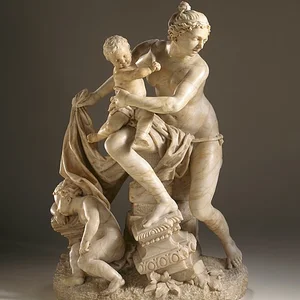

A Titaness of Greek mythology, Leto is the mother of Apollo and Artemis, born of her union with Zeus. Pursued by a jealous Hera, she gave birth on the island of Delos after a long wandering.
Leto
Leto
9 min read
Frequently asked questions
Key Facts
- Leto is a Titaness, daughter of the Titans Coeus and Phoebe
- Beloved by Zeus, she conceives the twins Apollo and Artemis
- Hera, out of jealousy, forbids any land from receiving her for childbirth
- She finally gives birth on the floating island of Delos, which becomes a sacred site
- Apollo and Artemis avenge their mother, notably by slaying the children of Niobe
Works & Achievements
A long epic poem in ancient Greek recounting the birth of Apollo on Delos and the origins of his cult. The text describes at length the wandering of Leto, the successive refusals of islands and lands, and the pains of childbirth.
Cosmogonic poem that presents Leto within the divine genealogy of the Titans and Olympians. She appears among the unions of Zeus that populated Olympus with its most powerful deities.
An Alexandrian poem celebrating Delos and narrating in detail Leto's journey in search of a place to give birth. It is one of the richest and most poetic sources on the wandering and suffering of the Titaness.
A group of sculptures depicting the slaughter of Niobe's children by Apollo and Artemis, avenging the slighted honor of their mother Leto. Remarkable Roman copies are preserved at the Uffizi museum in Florence.
Ovid narrates the episode of Niobe and Leto's revenge with remarkable dramatic vividness. It is the most complete Latin account of the protective power of the divine mother and the punishment of human pride.
Numerous red-figure and black-figure vases depicting Leto protected by her children against the giant Tityus. These ceramics illustrate the fundamental theme of the divine mother defended by her all-powerful offspring.
Anecdotes
Hunted by Hera's jealousy, Leto wandered the world for a long time without finding a single land willing to shelter her for childbirth. The queen of the gods had decreed that no stable ground would offer her refuge, condemning the Titaness to an exhausting odyssey across the seas and shores of the entire Mediterranean.
It was on the small floating island of Delos that Leto finally found refuge, for since the island was not anchored to the seabed, it was not subject to Hera's ban. Clinging to a palm tree on the shore of a sacred lake, Leto gave birth to the divine twins Apollo and Artemis after nine days and nine nights of agonizing labor.
During her wanderings in Lycia, Leto, exhausted and parched with thirst, asked some peasants working beside a pond for a drink of water. They roughly drove her away and stirred up the mud so she could not drink. As punishment for their lack of hospitality, the gods transformed them into frogs condemned to live forever in the mud.
The Theban queen Niobe dared to boast that she was superior to Leto because she had fourteen children — seven sons and seven daughters — compared to only two for the goddess. This sacrilegious insult called down terrible vengeance: Apollo and Artemis let fly their arrows and killed every one of Niobe's children, and she was turned into a weeping rock that cries for all eternity.
The giant Tityus attempted to assault Leto on Hera's orders as she was making her way to Delphi. Apollo and Artemis immediately came to their mother's aid and slew the giant with their arrows. Zeus, to punish Tityus for this sacrilegious crime, cast him into Tartarus, where two vultures devoured his liver for all eternity.
Primary Sources
How shall I sing worthily of one who is so sweet to celebrate? For everywhere, O Phoebus, the range of your song extends. Leto bore you in her arms, rejoicing to have given birth to so glorious a son among the immortals.
Leto bore Apollo and arrow-loving Artemis, a glorious pair above all the children of Heaven, born of Leto's union with the lord of the Aegis.
And you, O Delos, if you would be the nurse of my Apollo, no island would be more glorious than you, nor more beloved of Apollo, who chose you above all lands.
Leto, remembering the sufferings of old, called her two children to take revenge. The Theban Niobe had dared to place her own fertility above her; but the arrows of Apollo and Artemis answered this sacrilegious affront.
Apollo, born of lovely-haired Leto on the island of Delos, watches over mortals and presides over the oracles of Delphi, the center of the world.
Key Places
Island in the Cyclades where Leto gave birth to Apollo and Artemis, clinging to a palm tree. It became the principal sanctuary of Apollo in the Greek world, and Delos is today an archaeological site listed as a UNESCO World Heritage Site.
The place where Apollo, son of Leto, slew the serpent Python, which had tormented his mother. The Oracle of Delphi, founded in memory of this act of vengeance, became the most important and most consulted sanctuary in all of ancient Greece.
A region of Asia Minor where Leto, parched with thirst during her wanderings, was refused water by peasants who were then transformed into frogs. This myth explains the legendary origin of the Lycian people in some versions of the story and accounts for the strong presence of the cult of Leto in this region.
The sacred mountain home of the Greek gods, where Leto dwells as a honored Titaness among the Olympians — mother of two of the most venerated deities in the Hellenic pantheon.
A great Lycian sanctuary dedicated to Leto, located near the city of Xanthos. This place of worship, listed as a UNESCO World Heritage Site, bears witness to the exceptional importance of the goddess in Lycia — a region where her myth was especially vibrant.
Typical Objects

Leto clung to a palm tree at the edge of the Inopos lake during her labor. This tree became one of the most sacred symbols of Delos, venerated as a witness to the birth of the twin gods Apollo and Artemis.

In ancient depictions, Leto is often draped in a long dark or bluish veil, symbolizing her condition as a fugitive and the suffering she endured during her forced wandering, driven by Hera's jealousy.

Although these are the attributes of her children Apollo and Artemis, the bow frequently appears in scenes depicting Leto, as it symbolizes the divine protection she passed on to them and the vengeance they carried out in her name.

In certain cultic representations, Leto carries a torch, symbolizing her nature as a Titaness connected to light and the illumination she brings as the mother of the gods of solar and lunar light.

The lotus flower is associated with the waters and marshes Leto crossed during her wandering. It symbolizes rebirth and fertility, directly echoing the divine motherhood of the Titaness.

Leto is sometimes depicted wearing a peplos with golden sheen, reflecting her divine nature as a Titaness. This ceremonial garment evokes her restored dignity after giving birth and her honored place among the Olympians.
School Curriculum
Vocabulary & Tags
Key Vocabulary
Daily Life
Morning
At daybreak on Olympus, Leto takes part in the morning libations offered to the gods. She watches Apollo's chariot begin its luminous journey across the sky, gazing with pride at the son she brought into the world through great pain on the island of Delos.
Afternoon
Leto receives the prayers of mothers in labor and pregnant women who call upon her protection, for she herself endured the sufferings of childbirth. She sometimes intercedes with the other Olympians on behalf of mortals devoted to her at her sanctuaries in Delos and Lycia.
Evening
In the evening, Leto reunites with her two divine children on Olympus and presides over the banquets of the gods. She is venerated as one of the wisest Titanesses, seated with quiet dignity among the elder gods and respected even by Hera, who eventually came to accept her presence in the divine palace.
Food
Like all Greek gods, Leto feeds on ambrosia and drinks nectar — the divine foods that ensure immortality and eternal youth. Mortals offer her sacrifices of white bulls and heifers during her cult festivals, most notably at the great Delia celebrations on Delos.
Clothing
Leto is depicted wearing a fine linen chiton with a golden shimmer and a draped himation that sometimes covers her head as a gesture of maternal modesty. Her veils in shades of blue evoke the Aegean Sea, across which she wandered for so long before finding refuge on Delos.
Housing
Leto dwells on divine Olympus among the great gods, honored as the mother of the twins Apollo and Artemis. Her most important earthly sanctuary is the Letoon of Lycia near Xanthos, and she remains intimately bound to the island of Delos, which was held eternally sacred in her honor.
Historical Timeline
Period Vocabulary
Visual Style
Style art grec classique aux teintes or et bleu Égée, représentant Léto comme une Titanide majestueuse et sereine drapée de blanc, sur fond de mer et de ciel lumineux méditerranéen.
Sound Ambience
Ambiance maritime méditerranéenne mêlant le ressac de la mer Égée sur les rochers de Délos, le bruissement des palmiers sacrés et l'écho lointain de chants rituels apolliniens.
Liens externes & ressources
Références
Œuvres
Hymne homérique II — À Apollon
VIIe siècle av. J.-C.
Théogonie, Hésiode
vers 700 av. J.-C.
Hymne IV — À Délos, Callimaque
IIIe siècle av. J.-C.
Groupe sculptural des Niobides
Ve siècle av. J.-C.
Métamorphoses (Livre VI), Ovide
vers 8 apr. J.-C.
Céramiques attiques — Apollon défendant Léto contre Tityos
VIe-Ve siècle av. J.-C.