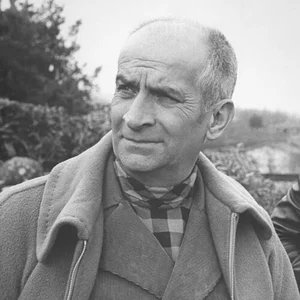

French comic actor (1914–1983), Louis de Funès is one of the defining figures of popular French cinema. Famous for his expressive acting style, his facial contortions, and his roles as authoritarian, hot-tempered characters, he remains one of the most beloved comedians in France.
Louis de Funès(1914 — 1983)
Louis de Funès
France
9 min read
Frequently asked questions
Famous Quotes
« I'm not an actor, I'm a reactor.»
« Comedy is a very serious business.»
Key Facts
- Born on 31 July 1914 in Courbevoie (Hauts-de-Seine)
- Late bloomer: achieved fame after the age of 40, in the 1950s
- *La Grande Vadrouille* (1966): the most-watched film in France for nearly 40 years (17 million admissions)
- Over 140 films made throughout his career
- Died on 27 January 1983 in Nantes; Knight of the Légion d'honneur
Works & Achievements
The first film in the Gendarmes saga, directed by Jean Girault, with de Funès as Sergeant Cruchot. It launched a series of six films and definitively established de Funès as the undisputed star of popular French cinema.
A historical comedy directed by Gérard Oury alongside Bourvil, set during the German Occupation. It drew 17.3 million viewers and remained the most-watched French film for over forty years, until 2008.
An adventure comedy directed by Gérard Oury, loosely adapted from Victor Hugo's *Ruy Blas*. De Funès plays a miserly and tyrannical minister in 17th-century Spain, one of his most accomplished dramatic roles.
A comedy by Gérard Oury in which de Funès plays an antisemitic businessman forced to disguise himself as a rabbi. Praised for its message of tolerance and respect for difference, it long ranked among the ten biggest box-office successes in French cinema.
A comedy alongside the young Coluche, in which de Funès plays a food critic and champion of traditional French cuisine. His first film after his heart attack, it confirmed his triumphant comeback with over 5 million admissions.
The sixth and final film in the Gendarmes saga, shot shortly before de Funès's death. It drew over 4 million viewers and stands as the last filmed testament to his inimitable comic art.
Anecdotes
Before becoming an actor, Louis de Funès survived on music: he played piano in bars, cabarets, and Parisian nightclubs throughout the Occupation and the postwar years. It was not until the age of 30 that he landed his first film role, in 1945, after a long stretch of small uncredited walk-on parts.
Louis de Funès had a passionate love of roses and personally cultivated hundreds of varieties in the grounds of his château de Clermont, in Saint-Augustin-des-Bois in the Maine-et-Loire. A rose was even named "Louis de Funès" in his honor in 1987, four years after his death, in recognition of a passion that was an integral part of his private life.
A devout Catholic, de Funès had a private chapel installed in his château de Clermont. He attended Mass there regularly with his wife Jeanne, and this sincere faith stood in sharp contrast to the image of the hot-tempered, irreverent characters he played on screen.
In 1975, Louis de Funès suffered a serious heart attack that forced him to step back from his career. His doctors urged caution, but he returned to cinema with *L'Aile ou la Cuisse* in 1976, refusing to give up the profession he loved.
*La Grande Vadrouille* (1966), filmed alongside Bourvil, remained the most-watched French film in France for over forty years, until the arrival of *Bienvenue chez les Ch'tis* in 2008. More than 17 million viewers packed theaters within just a few months — an absolute record for the time, and a testament to the place de Funès held in the hearts of the French public.
Primary Sources
I am not trying to make people laugh, I am trying to be truthful. Comedy always involves someone who takes themselves too seriously. If the character rings true, the laughter comes on its own.
I played piano for years just to get by. Those hard years taught me to observe people, to understand their quirks and their habits. That is where I found all my characters.
Louis had a prodigious memory and an iron discipline. He was always the first on set, knew his lines and everyone else's, and every day came up with new comic ideas that we very often kept.
Louis would spend hours in front of the mirror working on his expressions and gestures. His face was his primary instrument. He left nothing to chance, even what appeared completely spontaneous on screen.
Key Places
Birthplace of Louis de Funès, on July 31, 1914. He grew up there in a modest family of Spanish origin, far from the world of entertainment that would eventually become his own.
Family estate acquired by de Funès at the height of his fame. He tended his roses there, had a private chapel built on the grounds, and died there on January 27, 1983. The château is now a museum and memorial site open to the public.
The main Parisian studios where many of Louis de Funès's films were shot, notably with director Jean Girault. These studios were at the heart of French film production from the 1950s through the 1980s.
The primary real-world setting for the *Gendarmes* saga (six films from 1964 to 1982). The town, made famous by Brigitte Bardot in the 1950s, became inextricably linked with the image of de Funès and his fellow comedian Gilles Lellouche.
It was in the cabarets and nightclubs of these districts that de Funès played piano during the Occupation and throughout the 1940s and 1950s. Those years of struggle sharpened his keen eye for human foibles.
Typical Objects

The instrument on which de Funès played for years in Parisian bars and cabarets to make ends meet before his breakthrough in cinema. Music was his first profession and taught him the art of comic timing.

The khaki uniform and kepi worn by the character of Brigadier Ludovic Cruchot in the *Gendarmes de Saint-Tropez* series (1964–1982), which became one of the most recognizable costumes in popular French cinema.

The synchronization tool used on every film set where de Funès worked, from the studios of Billancourt to the outdoor locations of Saint-Tropez. It symbolizes the production process behind popular French cinema.

Louis de Funès passionately cultivated hundreds of rose varieties in the grounds of his Château de Clermont. A variety named "Louis de Funès" was created in 1987 in tribute to this deep passion, which allowed him to recharge far from the spotlight.

The standard format of professional French cinema, used for all of de Funès's films. The 35 mm format guaranteed the image quality required for theatrical release and the international export of his comedies.

De Funès attached enormous importance to his makeup and facial expressions, working closely with production teams to amplify his grimaces. His hyper-expressive face was his primary comic instrument and a genuine tool of performance.
School Curriculum
Vocabulary & Tags
Key Vocabulary
Daily Life
Morning
Louis de Funès rose early and was always the first to arrive on set. He would meticulously rehearse his scenes and facial expressions in front of the mirror, perfecting every gesture before the crew had even set up.
Afternoon
Afternoon shoots were intense: de Funès would power through takes with boundless energy, often improvising extra gags that directors were quick to keep. Between takes he studied the script constantly and proposed comic tweaks as the day went on.
Evening
Far from the bustle of the studios, de Funès led a quiet, private family life at the Château de Clermont. He loved walking through his rose garden, spending time with his loved ones, and attending Mass with his wife Jeanne in the chapel he had fitted out on the estate.
Food
De Funès had a fondness for traditional French cuisine — a theme he even brought to the screen in *L'Aile ou la Cuisse*. With Spanish roots on his mother's side, he also had a soft spot for Iberian dishes. After his heart attack in 1975, he adopted a more carefully monitored diet on medical advice.
Clothing
On screen, de Funès wore costumes that highlighted the absurdity of his characters: overly starched uniforms, overly stiff bourgeois suits, or outright burlesque getups. In private life he dressed simply and without fuss, preferring the comfort of his country retreat to any form of ostentation.
Housing
At the height of his fame, Louis de Funès purchased the Château de Clermont in **Saint-Augustin-des-Bois** in Maine-et-Loire — a sprawling estate with parkland and gardens. This rural retreat stood in sharp contrast to the Parisian studio world and allowed him to recharge away from the spotlight, surrounded by his roses and his family.
Historical Timeline
Period Vocabulary
Liens externes & ressources
Références
Œuvres
La Folie des grandeurs
1971