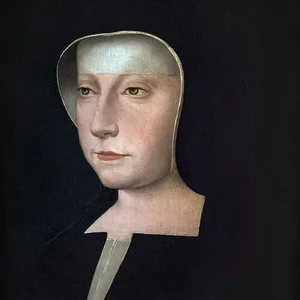

Louise de Savoie (1476–1531), Duchess of Angoulême, was the mother of Francis I and Margaret of Navarre. She served twice as regent of France and played a major diplomatic role by negotiating the Peace of Cambrai in 1529.
Louise de Savoie(1476 — 1531)
Louise de Savoie
Saint-Empire romain germanique, royaume de France, duché de Savoie
8 min read
Frequently asked questions
Famous Quotes
« I begin to write a memorable chronicle of myself, Louise of Savoy… for the exaltation of my glorious Caesar.»
Key Facts
- 1476: born at Pont-d'Ain, daughter of Philip II of Savoy
- 1515: first regency of France during Francis I's Italian campaign (victory at the Battle of Marignano)
- 1524–1526: second regency during the captivity of Francis I, taken prisoner at Pavia by Charles V
- 1529: negotiates the Ladies' Peace (Treaty of Cambrai) with Margaret of Austria, ending the Franco-Habsburg war
- 1531: died at Gretz-sur-Loing; she had kept a personal diary, a valuable historical source
Works & Achievements
A personal journal and family chronicle kept from adolescence, this text is one of the rare female autobiographical writings from the early French Renaissance and an irreplaceable historical source.
Louise governed France alone during Francis I's Italian campaign, maintaining the kingdom's internal stability and managing royal finances with skill throughout the victory at Marignano.
After the capture of Francis I at Pavia, Louise held the government together, resisted pressure from Charles V, and negotiated the terms for the return of her imprisoned son from Spain.
Negotiated directly by Louise of Savoy and Margaret of Austria, this treaty ended the war between France and the Empire and stands as the defining diplomatic achievement of Louise's political career.
Louise actively contributed to expanding the Crown's collections of manuscripts and printed books, laying the groundwork for what would become the Bibliothèque nationale de France.
Anecdotes
From the age of eleven, Louise of Savoy began keeping a personal diary that she maintained throughout her life, recording important events in the kingdom and her family. This text, known as the Annales, is one of the rare medieval chronicles written in a woman's own hand and stands as a precious historical source on the French court.
Louise devoted herself utterly to her son Francis and referred to him in her diary as 'my king, my lord, my Caesar and my son.' When Francis I was captured at the Battle of Pavia in 1525, she single-handedly governed the kingdom as regent for over a year, managing the diplomatic crisis with impressive skill despite her anguish as a mother.
In 1529, Louise of Savoy and Margaret of Austria, aunt of Charles V, met privately in Cambrai to negotiate peace between France and the Empire. The agreement was so remarkable that it became known as the 'Ladies' Peace' — a rare acknowledgment of two women who had resolved through diplomacy what men had failed to settle by force of arms.
Raised at the strict court of Anne of Beaujeu, daughter of Louis XI, Louise received an exceptional education for a woman of her time: Latin, science, music, and political administration. Anne of Beaujeu passed on the art of governance with the repeated lesson that 'no wise woman should show that she wishes to govern' — a lesson in discretion that Louise applied brilliantly throughout her life.
Louise was a cultivated patron of the arts who actively contributed to bringing the Italian Renaissance to France. She encouraged her son to invite Leonardo da Vinci to court, helped assemble a rich royal library, and supported artists and poets. Her daughter Margaret of Navarre, the future author of the Heptameron, owed much of her exceptional intellectual formation to her mother's influence.
Primary Sources
In the year fourteen hundred and ninety-four, on the twelfth day of September, was born at Cognac Francis, by the grace of God King of France, first of that name, my most dear and most perfect son, in whom I place all my trust after God.
We, Louise of Savoy, Duchess of Angoulême and Countess of Maine, mother of the Most Christian King Francis, acting on behalf of our said lord and son, have agreed and concluded the present peace with the most illustrious lady Margaret of Austria.
The king our lord, having departed for his campaign in Italy, has charged and commanded us to hold and govern his kingdom of France, to administer justice, and to provide for all things necessary for the welfare and preservation of said kingdom.
My son, the grief I feel at your captivity is so great that it surpasses all expression. Yet I cease not to labor, by every means in my power, to secure your deliverance, and I do not despair of the success of my efforts.
Key Places
The principal residence of the counts of Angoulême, it was here that Francis I was born in 1494. Louise spent her early years of motherhood here, forging her unshakeable devotion to her son.
Capital of the County of Angoulême, of which Louise was countess, this city was the heart of her domain and the cradle of the Valois-Angoulême branch that acceded to the throne of France in 1515.
A royal residence in the Loire Valley where Louise frequently stayed during the reigns of Charles VIII and Louis XII. This château was the center of court life and the gateway through which the Italian Renaissance entered France.
A city in the Spanish Netherlands where Louise de Savoie and Margaret of Austria negotiated peace between France and the Empire in 1529 — a diplomatic achievement so remarkable that the treaty became known as the 'Ladies' Peace'.
The seat of government during her regencies, Louise administered the kingdom of France here with firm resolve, holding the reins of power and managing diplomatic and military crises as they arose.
Typical Objects

A daily devotional object for every great lady of the Renaissance, the Book of Hours contained prayers marking the rhythm of the day. Louise, a pious and learned woman, owned several richly adorned copies illustrated with miniatures.

From adolescence onward, Louise recorded the significant events of her life and of the kingdom in a personal register. This one-of-a-kind document bears witness to her political acuity and her sensitivity as a woman.

A wax matrix used to authenticate royal ordinances during regencies, the seal bore the arms of France and symbolized the sovereign authority delegated to Louise by her son.

Louise maintained an extensive correspondence with the sovereigns and ambassadors of Europe. These letters, written in Latin or French, reveal a skilled diplomat capable of maneuvering between the great powers.

The great residences of Louise were adorned with tapestries depicting mythological or allegorical scenes — symbols of their owner's rank and refined culture in the Renaissance era.

Louise assembled a remarkable library that included ancient texts, chronicles, and humanist works. Her collections helped enrich what would become the future Royal Library of France.
School Curriculum
Vocabulary & Tags
Key Vocabulary
Daily Life
Morning
Louise rose at dawn, attended Mass in her private chapel with her ladies-in-waiting, then received her secretary to dictate diplomatic correspondence and review dispatches from ambassadors that had arrived overnight. Her mornings were devoted to affairs of state or the management of her domains.
Afternoon
Afternoons were divided between granting audiences to courtiers and foreign envoys, consulting with her advisors, and spending time in study at the library. Louise also oversaw her children's education and took part in the court's artistic pursuits — music or reading aloud.
Evening
In the evening, Louise presided over dinner in the great hall surrounded by her court, following the strict protocol inherited from royal tradition. After supper, refined entertainments — music, readings, and learned conversation — filled the hours before she withdrew to write in her personal journal.
Food
Louise's table reflected the splendor of the French royal kitchen: roasted meats, fish in sauce, pastries, and spices from the East, accompanied by wines from the Loire Valley. On fast days prescribed by the liturgical calendar, fish and vegetables replaced meat, even at a princess's table.
Clothing
Louise dressed in keeping with the fashions of early sixteenth-century France: long gowns of velvet or brocade in deep, stately colors (purple, black, royal blue), surcoats lined with fur, and a French hood with a white veil. Her jewelry — necklaces, pendants, and bracelets — proclaimed the dynastic power of the Valois.
Housing
Louise lived in the royal châteaux of the Loire Valley — Amboise, Blois, Cognac — and stayed at the Paris palace during her regencies. Her apartments, hung with tapestries and lit by tall mullioned windows, reflected the taste of the emerging Renaissance: carved furniture, a library, a private oratory, and a pleasure garden.
Historical Timeline
Period Vocabulary
Visual Style
Le style visuel de Louise de Savoie s'inspire des portraits de cour à la manière de Jean Clouet : sévérité aristocratique, drapés de velours et de brocart dorés, lumière dorée Renaissance sur fond d'architecture gothico-renaissance des châteaux de la Loire.
Sound Ambience
L'univers sonore de Louise de Savoie est celui d'une cour royale studieuse et raffinée : le grattement de la plume sur le parchemin se mêle aux airs de luth, aux cloches de l'office et au murmure feutré des conseillers dans les antichamrbes du château.
Liens externes & ressources
Références
Œuvres
Annales de Louise de Savoie
rédigées de 1488 à 1522
Première régence du royaume de France
1515
Deuxième régence du royaume de France
1525-1526
Traité de Cambrai — Paix des Dames
5 août 1529
Constitution et enrichissement de la bibliothèque royale
1515-1531