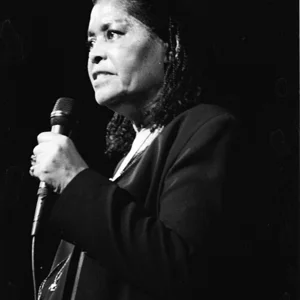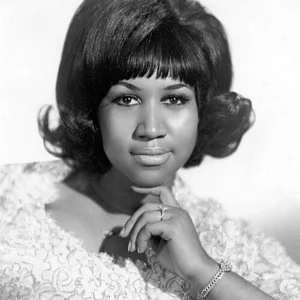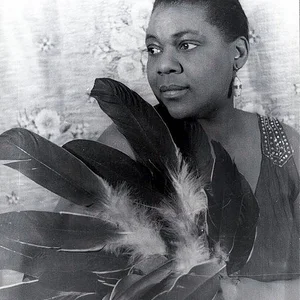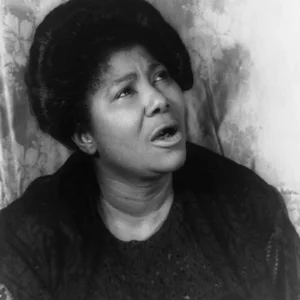

Mahalia Jackson (1911-1972) was the greatest American gospel singer of all time. A powerful voice of Black Christian faith, she was also a major figure in the civil rights movement alongside Martin Luther King.
Mahalia Jackson(1911 — 1972)
Mahalia Jackson
États-Unis
9 min read
Frequently asked questions
Famous Quotes
« I sing God's music because it makes me feel free.»
« Gospel music is nothing but the blues turned toward God.»
Key Facts
- Born on October 26, 1911 in New Orleans into a poor and deeply religious family
- Recorded 'Move On Up a Little Higher' in 1947, which sold more than one million copies
- Sang at the March on Washington on August 28, 1963, just before MLK's “I Have a Dream” speech
- The first gospel singer to perform at the White House and at Carnegie Hall
- Died on January 27, 1972; her funeral brought together 45,000 people in Chicago
Works & Achievements
Her first major commercial success, selling 8 million copies — a record for a gospel title. This record revolutionized the distribution of Black American sacred music and made Mahalia a national star.
One of her most moving recordings, which earned her airplay on major American radio stations for the first time. It helped bring gospel music into white households.
A rendition of the celebrated hymn by Thomas Dorsey, which became one of the anthems of the civil rights movement. Mahalia sang this song at Martin Luther King Jr.'s funeral in 1968, before the eyes of the entire world.
A hymn to resilience and faith, which she performed at the March on Washington in 1963. For many, this song embodied the struggle of an entire people for their dignity and freedom.
A legendary performance that crossed the boundaries between sacred and secular music, drawing an international audience and proving that gospel could move people far beyond the walls of the church.
A memoir written with Evan McLeod Wylie, in which Mahalia recounts her impoverished childhood in New Orleans, her artistic rise, and her commitment to civil rights. An invaluable historical document on segregation-era America.
Anecdotes
On August 28, 1963, during the March on Washington, Mahalia Jackson sang 'How I Got Over' before 250,000 people. As Martin Luther King Jr. began his prepared speech, she called out to him from the crowd: “Tell them about the dream, Martin!” It was at that moment that he improvised his legendary “I Have a Dream” passage — one of the greatest speeches of the 20th century.
In 1946, Mahalia recorded 'Move On Up a Little Higher' for the small Apollo Records label. The record sold over 8 million copies, an absolute record for a gospel title. Almost overnight, she became a national star, proof that sacred music could reach millions of Americans far beyond the walls of the church.
Despite considerable financial offers from the top jazz clubs in Chicago and New York, Mahalia Jackson always refused to sing the blues or secular songs. She would say: “The blues and gospel are born in the same place in the soul, but they travel in opposite directions.” Even Louis Armstrong, her childhood friend from New Orleans, never managed to convince her.
When Martin Luther King Jr. was arrested in Birmingham in 1963, Mahalia called President Kennedy directly to plead his case. Her international fame gave her rare access to the corridors of power, and she did not hesitate to use it for the civil rights movement. In 1968, after King's assassination, she was the one called upon to sing at his funeral, before the entire world.
Born in a wooden shack in a poor neighborhood of New Orleans, Mahalia grew up in a deeply devout Baptist family. As a child, she secretly listened to records by Bessie Smith and blues singers that her family disapproved of. This dual influence — the faith of the church and the emotional intensity of the blues — forged the unique style that would go on to revolutionize gospel music.
Primary Sources
I was born to sing the glory of God. People tell me my voice comes from above — I say it comes from New Orleans, from the bayou, from the Baptist church of my childhood, and from everything my people have endured.
When I sing, I don't sing for myself. I sing for those who are suffering, for those who are afraid, for those who need to feel that God hears them. That's why I will never sing in a nightclub.
Gospel music is not merely prayer set to music. It is the story of our people, the memory of our resistance, the promise of a better world. Every note I sing is an act of faith.
We have been singing for centuries to keep standing. Now the laws must finally give us the right to walk upright, freely, in this country that is ours.
Key Places
Mahalia's birthplace and the cradle of her childhood in a poor neighborhood. It was here that she grew up to the sound of Baptist spirituals and French Quarter jazz, two influences that would forge her incomparable style.
The city where Mahalia settled at age 16 and built her entire career. Chicago was the capital of American gospel music in the 1930s–1950s, and it was here that she met Thomas Dorsey and recorded her greatest hits.
The site of the March on Washington on August 28, 1963, where Mahalia sang before 250,000 people just before Martin Luther King Jr.'s "I Have a Dream" speech. This moment remains one of the most iconic in American history.
The temple of classical music and New York jazz where Mahalia performed for the first time in 1950, proving that gospel deserved its place in prestigious concert halls. This performance marked a milestone in the history of American music.
The church of her childhood where Mahalia first sang in a choir, between the ages of 6 and 10. It was within this Baptist congregation that she discovered the power of sacred music as an expression of collective faith.
Typical Objects

A central tool in Mahalia's career, which she commanded with a mastery few singers of her era could match. Her voice — extraordinary in both power and expressiveness — was at once an instrument of faith and a tool for political mobilization.

A lifelong companion, annotated and carried everywhere. Mahalia drew from the Psalms and the Gospels the texts she set to music, turning every concert into a genuine religious ceremony.

The dominant format of the 1940s and 1950s, on which Mahalia recorded her first major hits for Apollo Records. These fragile shellac discs carried her voice into Black American homes far beyond the walls of any church.

Mahalia wore long, elegant gowns — often flowing and richly colored — that reflected both the dignity of her faith and her status as an international star. She refused the suggestive outfits that were sometimes offered to female singers of the era.

The instrument of the Baptist gospel tradition, found in every church across the American South where Mahalia first honed her craft. She played piano herself and carefully chose her accompanists.

A quiet but powerful symbol of her influence: Mahalia used her network to directly lobby political leaders in support of the civil rights movement, sometimes calling the White House or state governors to advocate for imprisoned activists.
School Curriculum
Vocabulary & Tags
Key Vocabulary
Tags
Daily Life
Morning
Mahalia began each day with personal prayer and Bible reading, a habit rooted in her childhood. She would then enjoy a hearty breakfast, faithful to the Creole cooking of New Orleans, before attending to her mail and responding to requests from civil rights organizations.
Afternoon
Afternoons were devoted to rehearsals with her accompanists, recording sessions at studios in Chicago, or travel to perform at churches and concert halls. She personally oversaw the choice of songs and musical arrangements, refusing any artistic compromise that would take her away from authentic gospel.
Evening
Evenings were often filled with concerts or religious services, where she could sing for two to three hours straight with remarkable energy. Back home, she frequently welcomed activists, pastors, and artists — including her friend Martin Luther King Jr. — for impromptu shared meals.
Food
Mahalia was a passionate cook, deeply attached to the Creole and Cajun traditions of New Orleans: gumbo, red beans and rice, fried chicken, cornbread. She had opened a Southern cooking restaurant in Chicago in the 1960s, viewing the table as an extension of community and togetherness.
Clothing
On stage, Mahalia wore elegant long gowns, often in silk or chiffon, in vibrant or understated colors depending on the occasion, always in a spirit of dignity and respect for religious ceremony. In everyday life, she dressed carefully but simply, rejecting the provocative outfits some promoters suggested to attract a wider audience.
Housing
After years of poverty, Mahalia settled into a comfortable home on Chicago's South Side, the city's Black neighborhood, remaining loyal to her community despite her fame. Her home was open to visitors, activists, and artists alike, and became an informal gathering place for the civil rights movement throughout the 1950s and 1960s.