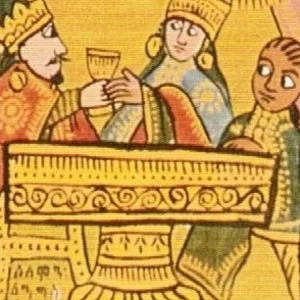

Makeda is the central figure of the Ethiopian tradition (Kebra Nagast), venerated as the legendary queen of the Kingdom of Sheba. Rooted in Ethiopian and Eritrean oral tradition, she is known for her encounter with King Solomon of Jerusalem, from which Menelik I would be born — the founding ancestor of the Ethiopian imperial lineage.
Makeda
Makeda
Allemagne
9 min read
Frequently asked questions
Famous Quotes
« "Wisdom is more precious than gold and riches." (words attributed to Makeda by the Ethiopian tradition of the Kebra Nagast)»
« "I have come from afar to hear your wisdom, for its fame has spread across all lands." (Ethiopian oral tradition, Kebra Nagast)»
Key Facts
- Mentioned in the Bible (1 Kings 10 and 2 Chronicles 9) as the 'Queen of the South' visiting Solomon, with no personal name given in the Hebrew text
- The Kebra Nagast ('Glory of Kings'), an Ethiopian text compiled around the 14th century but based on much older oral traditions, gives her the name Makeda and identifies her as the mother of Menelik I
- Menelik I, her son according to tradition, is said to have brought the Ark of the Covenant to Axum (Ethiopia), legitimizing the Ethiopian imperial lineage's claim to Solomonic descent
- Present in three major religious traditions: the Bible (Old Testament), the Quran (Surah An-Naml, where she is named Bilqis), and Ethiopian Orthodox Christianity
- The dating remains uncertain — oral traditions place her reign around the 10th century BCE, but no direct archaeological source confirms her historical existence
Works & Achievements
By conceiving Menelik I with Solomon, Makeda is regarded as the founder of the longest royal dynasty in history: the Solomonic line of Ethiopia, which ruled until the deposition of Haile Selassie in 1974.
According to the Kebra Nagast, Makeda renounced the worship of idols and the sun following her encounter with Solomon. She thus initiated Ethiopia's embrace of monotheism, which would predate the country's official Christianization in the 4th century CE.
During Makeda's supposed reign, the Kingdom of Sheba controlled the frankincense and myrrh routes between the Horn of Africa, Arabia, and the Mediterranean. This trade network made Sheba one of the most powerful economic forces of the ancient world.
Though written centuries after Makeda's time, the Kebra Nagast is the principal literary monument that immortalizes her story. This foundational text of Ethiopian culture served as the basis for the legitimacy of every Ethiopian emperor through the 20th century.
The biblical account of the Queen of Sheba's visit to Solomon is one of the oldest written sources referencing Makeda. By posing riddles to Solomon, she embodies the ideal of feminine wisdom in world literature.
Anecdotes
According to the Kebra Nagast, Makeda undertook an extraordinary journey to Jerusalem to meet King Solomon, whose wisdom had reached her across the seas. She is said to have traveled with a caravan of camels laden with gold, spices, and precious stones, covering thousands of kilometers across Arabia and the Sinai.
Ethiopian tradition holds that Solomon, captivated by Makeda's intellect, made her swear not to take anything from his house without permission. During a banquet, parched by heavily spiced food, she drank water in the middle of the night — and Solomon declared the oath broken, thereby winning her to his bed. From that night, Menelik I would be born.
Menelik, son of Makeda and Solomon, traveled to Jerusalem as an adult to meet his father. According to the Kebra Nagast, he brought back to Ethiopia the Ark of the Covenant — the sacred chest containing the Tablets of the Law. This is why the Ethiopian Orthodox Church claims to this day that it holds the Ark in Aksum.
In Islamic tradition, Makeda is known as Bilqis. The Quran (Surah An-Naml) speaks of her wisdom and her conversion to monotheism after her encounter with Solomon. She is thus venerated in Ethiopian Christianity, Judaism, and Islam alike, making her one of the rare figures shared by all three major Abrahamic religions.
The title 'Queen of Sheba' likely referred to the ruler of a prosperous kingdom controlling the incense and myrrh trade routes between the Horn of Africa and the Arabian Peninsula. Makeda thus embodies the economic and diplomatic power of ancient East Africa, long before European colonization.
Primary Sources
And the Queen of the South heard of the wisdom of King Solomon, and her heart was moved to go to him. She gathered great riches and came to Jerusalem with a large retinue. Solomon taught her the law of God, and she abandoned the worship of the sun to worship the God of Israel.
The Queen of Sheba, having heard of Solomon's fame, came to test him with riddles. She arrived in Jerusalem with a very large retinue, with camels loaded with spices, a great quantity of gold, and precious stones.
He said: 'I come to you from Sheba with certain news. I found a woman ruling over them, who has been given everything, and who possesses a magnificent throne.' [...] She said: 'My Lord, I have wronged myself, and I submit with Solomon to Allah, Lord of the worlds.'
Traditional Ethiopian singers preserve the legend of Makeda in the form of sung epic poems, passed down from generation to generation by the priests and scribes of the Kingdom of Aksum. These accounts describe her beauty, her intellectual curiosity, and her benevolent reign over the Kingdom of Sheba.
Archaeological excavations at Marib (the ancient capital of the Kingdom of Sheba, in present-day Yemen) have uncovered inscriptions mentioning female rulers in the region, confirming the existence of powerful queens in this area during the presumed time of Makeda.
Key Places
Capital of the ancient Aksumite Empire, Aksum is considered the cradle of the royal lineage founded by Menelik I, son of Makeda. According to Ethiopian tradition, the Church of Our Lady Mary of Zion houses the Ark of the Covenant.
Ancient capital of the Kingdom of Sheba in the Arabian Peninsula, Marib is home to the ruins of the great ancient dam and the Moon Temple (Mahram Bilqis). This archaeological site is associated with the figure of Bilqis/Makeda in Islamic tradition.
The legendary meeting place of Makeda and King Solomon, as recounted in the Bible and the Kebra Nagast. In Ethiopian tradition, Jerusalem represents the point of contact between African wisdom and Abrahamic monotheism.
The source of the Blue Nile, Lake Tana is surrounded by island monasteries that preserve illustrated manuscripts of the Kebra Nagast. These Ethiopian illuminations are among the richest iconographic sources on the figure of Makeda.
A historical region of Ethiopia considered one of the possible cradles of Makeda's legendary kingdom according to certain local traditions. Tigrinya oral narratives preserve a version of the queen's story unique to this region.
Typical Objects

The Kebra Nagast describes Makeda's throne as a monumental seat adorned with ivory and gold, a symbol of her royal power. This type of throne was characteristic of rulers from the Sabaean region and the Horn of Africa during this period.

Aromatic goods formed the primary wealth of the Kingdom of Sheba and the heart of its trade with Egypt, Israel, and Mesopotamia. Makeda is said to have given Solomon '120 talents of gold, a large quantity of spices, and precious stones' (1 Kings 10:10).

Archaeological excavations in the Marib region have uncovered gold cups used in Sabaean royal rituals. These ritual vessels symbolize the spiritual and political authority of the queen in court ceremonies.

Ornaments of pearls, carnelian, and amber were among the prized jewels of Sabaean queens. They bear witness to Makeda's trade networks stretching as far as India and the Red Sea.

The scepter of command was the central emblem of royal power in East Africa and ancient Arabia. In Ethiopian iconographic representations, Makeda is often depicted holding a scepter, a sign of her sovereignty.

According to tradition, Solomon presented Makeda with scrolls and tablets containing divine laws. This gift symbolizes the transmission of knowledge between the two civilizations and the spiritual foundation of Ethiopian kingship.
School Curriculum
Vocabulary & Tags
Key Vocabulary
Daily Life
Morning
Makeda began her day with purification rituals and prayers to the Sabaean deities (before her reputed conversion), assisted by priestesses. She then received reports from her advisors on the state of the trade caravans and the affairs of the kingdom.
Afternoon
Afternoons were devoted to royal audiences where merchants, ambassadors, and tribal chiefs came to pay homage. Makeda settled disputes, oversaw the trading of spices and gold, and received foreign delegations in a throne room adorned with hanging tapestries.
Evening
Evening court gatherings brought musicians, poets, and storytellers together around the queen. Bards sang the deeds of the ancestors to the sound of the krar (Ethiopian lyre). Makeda was renowned for her intellectual jousting through riddles — a tradition said to have defined her famous encounter with Solomon.
Food
The royal diet of Sheba included injera (fermented teff flatbread), meat stews spiced with berbere, abundant honey, figs and pomegranates, and drinks made from tej (Ethiopian honey wine). Royal banquets incorporated spices brought from India and Arabia.
Clothing
Makeda wore long robes of fine linen dyed in purple and white, embroidered with gold thread along the borders. Her elaborate hairstyle was adorned with gold diadems and carnelian beads. She wore broad gold necklaces and bracelets inlaid with lapis lazuli, markers of her wealth and divine status.
Housing
Makeda's royal palace was likely built from cut stone on a high plateau, featuring columns, inner courtyards, and irrigated gardens. The main chambers were decorated with woven carpets, bronze braziers burning incense, and painted tapestries depicting the exploits of the royal ancestors.
Historical Timeline
Period Vocabulary
Visual Style
Style inspiré des enluminures éthiopiennes médiévales du Kebra Nagast : traits épais, perspective plate, palette chaude d'ocre, cramoisi et bleu lapis-lazuli, avec la majesté dorée des cours royales aksoumites.
Sound Ambience
Ambiance de cour royale de l'Afrique de l'Est antique : tambours cérémoniels, chants liturgiques en guèze, caravanes commerciales et encens brûlant dans les palais de pierre du plateau éthiopien.
Liens externes & ressources
Références
Œuvres
Fondation de la lignée salomonide éthiopienne
vers 950 av. J.-C.
Transmission du monothéisme en Éthiopie
vers 950 av. J.-C.
Organisation des routes commerciales de l'encens
vers 1000-900 av. J.-C.
Le Kebra Nagast (La Gloire des Rois) — récit épique la concernant
Codifié vers 1314 ap. J.-C.
Épisode biblique de 1 Rois 10 (Reine de Saba)
Vers 950 av. J.-C. (tradition orale) / Ve siècle av. J.-C. (rédaction)
Rechercher
See also
Related Characters
Akhenaten
1400 av. J.-C. — 1335 av. J.-C.
Amenhotep III
1399 av. J.-C. — 1350 av. J.-C.
Amon
663 av. J.-C. — 639 av. J.-C.
Ashoka
303 av. J.-C. — 231 av. J.-C.

Aten
Ay
1400 av. J.-C. — 1400 av. J.-C.