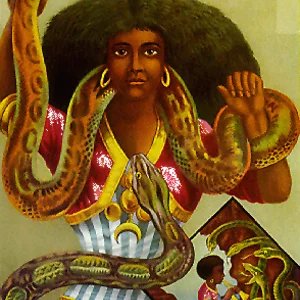

An aquatic deity venerated in West and Central Africa and throughout the African diaspora in the Americas. A water spirit associated with fertility, healing, and prosperity, Mami Wata is a central figure in vodoun worship and many oral traditions. Her origins are pre-colonial, but her iconography was enriched through contact with Atlantic exchange.
Mami Wata
Mami Wata
8 min read
Frequently asked questions
Key Facts
- Mami Wata has been known since pre-colonial times in the cultures of the Gulf of Guinea (Fon, Ewe, Yoruba peoples, among others), through oral traditions passed down from generation to generation.
- Her name is generally interpreted as deriving from an Atlantic creole meaning 'Mother of Waters,' reflecting her role as mistress of rivers, lakes, and seas.
- In the 18th and 19th centuries, Mami Wata's iconography was enriched with visual elements from India and Europe (the serpent-woman motif), spread through trade networks and the Atlantic slave trade.
- The cult of Mami Wata crossed the Atlantic with the African diaspora and is present in Brazil, the Caribbean, and Louisiana in syncretic forms (Yemanjá, the Haitian La Sirène).
- Mami Wata is both feared and venerated: she can bring wealth and healing, but may also drag her devotees into the depths if she is offended — according to oral traditions.
Works & Achievements
A body of songs, prayers, and ritual formulas transmitted orally by vodoun priests and priestesses. These sacred texts form the founding literature of the cult and define the deity's attributes, demands, and benevolence.
A collection of narratives passed down from generation to generation in Fon, Ewe, and Yoruba communities, recounting the apparitions, abductions, and healings performed by Mami Wata. These tales serve a major educational and moral function.
This European commercial image was adopted as the canonical representation of Mami Wata in West Africa. It illustrates how the deity was able to absorb outside influences and become a transnational visual icon.
Hundreds of ritual objects — statuettes, portable altars, beaded necklaces — were produced for the Mami Wata cult. They bear witness to a living artistic tradition, now preserved in museums around the world.
The ceremonies in which Mami Wata 'mounts' her devotees constitute a codified form of ritual performance, with specific costumes, music, and gestures. These practices are embedded in the bodily memory of communities and passed on through initiation.
Anecdotes
In the 1880s, a chromolithograph depicting an Indian snake charmer, printed in Hamburg, spread like wildfire along the West African coast. Local populations immediately recognized in it Mami Wata, their aquatic deity, and adopted this foreign image as a sacred icon. This phenomenon illustrates how Mami Wata has always been able to absorb outside influences into her symbolism — much like water absorbs everything it encounters.
According to oral traditions from Benin and Togo, Mami Wata can draw her chosen ones to the bottom of the waters to initiate them into her mysteries. Those who return — after hours or days of unexplained absence — are often transformed: more beautiful, more charismatic, endowed with healing powers. The community then recognizes them as privileged bearers of divine favor.
During the Atlantic slave trade in the 17th–19th centuries, enslaved Africans deported to the Americas brought the cult of Mami Wata with them. She survived in new forms within Afro-American religions: the Haitian Lasiren, the Brazilian Yemanjá, and Maman de l'eau in Louisiana. This forced journey transformed a local figure into a truly transatlantic deity.
Priests and priestesses consecrated to Mami Wata observe strict dietary prohibitions: they often avoid salt and certain fish — paradoxically linked to the sea. This sacred logic reflects the distinction between fresh and salt water in Vodoun cosmology, as Mami Wata is associated with rivers and lagoons as much as with the ocean.
Primary Sources
The elders say that Mami Wata dwelt in the waters before humans ever populated the earth. She bestows wealth and beauty upon those she favors, but withdraws her gifts from those who disrespect her.
Mami oh, Mami Wata / You come from the deep sea / Watch over us, beautiful lady of the waters / May your hand guide our canoes and our children.
The people of this coast venerate water spirits they call 'Mame,' to whom they offer sacrifices before any sea crossing. These deities are said to be capricious and powerful.
An image widely distributed across West Africa from the 1880s onward, adopted as the canonical depiction of Mami Wata and become a focus of popular devotion throughout the coastal region.
Key Places
The historical heart of Vodun and a former center of the slave trade, Ouidah is one of the most sacred sites for the Mami Wata cult. The Temple of Pythons and the Route of Slaves bear witness to the deep entanglement of spirituality, memory, and the ocean.
Lagos ('the lakes' in Portuguese) is bordered by lagoons where the Mami Wata cult has thrived for centuries. Fishermen and traders perform propitiatory rituals here before setting out to sea.
The Volta is one of West Africa's sacred rivers where Mami Wata is honored by the Ewe and Fon communities living along its banks. Natural shrines mark the points of contact between people and the deity.
In the African diaspora of the Americas, the Haitian Lasiren — a Creole variant of Mami Wata — is venerated as the lwa of the sea in Haitian Vodou. Haiti is perhaps the country where this water tradition has best survived the Atlantic crossing.
The fetish market in Lomé is one of the largest markets for ritual plants and objects in Africa. Mami Wata is omnipresent there in the form of chromolithographs, statuettes, and offerings, reflecting the living vitality of her cult today.
Typical Objects

The mirror is Mami Wata's most iconic attribute: it symbolizes the surface of water, the boundary between the visible world and the invisible one. Priestesses use it to make contact with the deity during possession rituals.

Mami Wata is often depicted combing her long hair at the water's edge. The comb symbolizes beauty, seduction, and the care the deity lavishes on her devotees as well as herself.

The python is Mami Wata's sacred animal: it embodies both her power and her duality, capable of healing or killing. During rituals, the priest sometimes wraps a live snake around his body to channel the divine presence.

These marine shells served as currency across West Africa for centuries and are associated with the fertility and prosperity granted by Mami Wata. They adorn altars and the jewelry worn by initiates.

Water collected from springs or rivers considered sacred is kept in jars on altars. It is used for libations, purifying baths, and healing rituals.

Imported from Europe since the 15th century, beads are incorporated into the ritual adornments of Mami Wata's followers. Their sheen and maritime origins make them a tangible link to the deity of the waters.
School Curriculum
Vocabulary & Tags
Key Vocabulary
Tags
Daily Life
Morning
In coastal sanctuaries, the day begins with libations of fresh water poured before Mami Wata's altar, where white and blue candles burn. Priestesses recite greeting incantations to the deity before anyone approaches the water to fish or wash.
Afternoon
The afternoon is devoted to consultations: worshippers bring their requests — healing, fertility, prosperity — to the sanctuary. The priestess enters a trance and becomes the vessel through which Mami Wata speaks to humans, diagnoses ailments, and prescribes remedies made from plants and sacred water.
Evening
In the evening, during major festivals, possession ceremonies come alive to the sound of drums. Devotees dressed in white and blue dance until the deity descends upon one of them. Night on the water is Mami Wata's sacred time, and fishermen avoid casting their nets without first offering her a prayer.
Food
The foods associated with Mami Wata are those that come from the water: fish, shellfish, rainwater, and juicy tropical fruits such as coconut. Initiates follow strict dietary restrictions — including the prohibition of salt in certain ritual contexts — to maintain their purity and their connection to the deity.
Clothing
In canonical representations, Mami Wata wears lavish adornments: necklaces of cowrie shells and glass beads, gold and silver bracelets, and shimmering fabrics with the iridescent hues of the sea. During ceremonies, initiates wear white and blue, the colors associated with deep waters and spiritual purity.
Housing
Mami Wata's shrines are built as close to the water as possible — on the edge of a lagoon, along a riverbank, or facing the ocean. These sacred spaces combine a hut built from natural materials (earth, thatch, wood) with an open area facing the water, adorned with jars, mirrors, statues, and offerings that are continually renewed.
Historical Timeline
Period Vocabulary
Visual Style
Style mêlant l'art votif vodoun africain et la chromolithographie coloniale : femme-serpent lumineuse émergée des eaux, parures de perles, palette de bleus profonds et d'or.
Sound Ambience
Ambiance nocturne au bord d'une lagune ouest-africaine lors d'une cérémonie vodoun : percussions rituelles, chants féminins et murmure de l'eau se mêlent en une atmosphère envoûtante et sacrée.
Liens externes & ressources
Références
Œuvres
Corpus des chants d'initiation vodoun à Mami Wata
Tradition orale, formes attestées avant le XVe siècle
Cycle de contes oraux 'La Dame des Eaux'
Tradition orale, collecte ethnographique dès le XVIIIe siècle
Chromolithographie 'La charmeuse de serpents' (Hambourg)
vers 1885
Statuaires et autels vodoun consacrés à Mami Wata
XVIIe-XIXe siècles (pièces documentées)
Cérémonies de possession et danses rituelles
Tradition continue