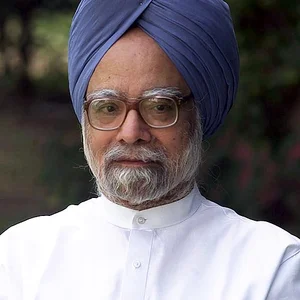

Indian economist and statesman, Manmohan Singh served as Prime Minister of India from 2004 to 2014. Architect of the economic reforms of the 1990s, he profoundly modernized the Indian economy.
Manmohan Singh(1932 — 2024)
Manmohan Singh
Inde, Raj britannique
9 min read
Frequently asked questions
Famous Quotes
« History will be kinder to me than contemporary opinion.»
Key Facts
- Born in 1932 in Punjab (then the British Empire, now Pakistan)
- As Finance Minister in 1991, he launched the major liberalization reforms of the Indian economy
- Prime Minister of India from 2004 to 2014 under the banner of the Indian National Congress
- First Sikh to hold the office of Prime Minister of India
- Passed away in December 2024 in New Delhi
Works & Achievements
A doctoral thesis published by Oxford University Press, in which Singh analyzes the structural barriers to Indian exports and lays the intellectual groundwork for his future economic reforms.
Presented in the midst of a financial crisis, this landmark budget abolished industrial licensing, cut customs duties, devalued the rupee, and opened India to foreign investment — a decisive break with forty years of state socialism.
Enacted under his government, this law guarantees 100 days of paid work per year to every rural household in India. It has reached hundreds of millions of people and remains one of the largest social programs in history.
A landmark democratic reform allowing any Indian citizen to access public administrative records — a powerful tool in the fight against corruption and for government transparency.
Signed after three years of negotiations with the Bush administration, this agreement effectively recognized India as a responsible nuclear power and paved the way for civilian nuclear cooperation with the United States and the international community.
In response to the global financial crisis, Singh steered a targeted economic stimulus package that enabled India to sustain growth above 6%, shielding the economy without compromising fiscal stability.
Anecdotes
In July 1991, during his landmark budget speech, Manmohan Singh quoted the poet Victor Hugo: "No power on earth can stop an idea whose time has come." That single line captured the historical turning point he was engineering for India, opening the country's economy to global markets after decades of state planning.
Born in 1932 in the village of Gah, in what is now Pakistan, Manmohan Singh became a refugee at the age of fifteen during the Partition of 1947. His family fled amid the chaos of intercommunal violence. That formative exile instilled in him a resilience and humility that would shape his entire political career.
A brilliant student, Singh earned a first-class degree in economics from Cambridge University in 1957, followed by a doctorate from Oxford in 1962. His thesis examined trends in Indian exports. He became one of the rare world leaders to have been trained at Britain's most prestigious universities before going on to transform the economy of his own country.
In 2004, Sonia Gandhi, Congress Party president and winner of the general election, stepped aside from the post of Prime Minister to defuse a political crisis surrounding her Italian origins. She nominated Manmohan Singh in her place. He thus became the first Sikh to hold the office, and the first Prime Minister born in the territory of present-day Pakistan.
During the global financial crisis of 2008, while many economies collapsed, India sustained growth of around 6%. Drawing on his expertise as an economist, Manmohan Singh personally steered India's response, combining stimulus packages with careful regulation of the banking system, shielding millions of Indians from the most devastating effects of the crisis.
Primary Sources
« No power on earth can stop an idea whose time has come. I suggest to this august House that the emergence of India as a major economic power in the world happens to be one such idea. »
Singh analyses the structural obstacles to Indian exports and argues for a strategy of gradual opening, laying the intellectual foundations for his future reforms.
« Our government is committed to pursuing policies that will ensure rapid and sustained growth, that will reduce poverty and create employment for all. »
« India and the United States have decided to establish a global strategic partnership founded on democracy, shared values, and the convergence of their interests. »
Singh calls for a reform of international financial institutions to better represent emerging economies, advocating for a fairer multilateral system in the face of the crisis.
Key Places
Manmohan Singh's birthplace, now located in Pakistan. He left at age 15 during the Partition of 1947, never returning but often speaking of this foundational uprooting.
Singh studied economics here and graduated in 1957 with First Class Honours. Cambridge shaped his analytical rigour and opened him to Western economic theory.
Singh completed his doctoral thesis here in 1962, focusing on Indian exports, under the supervision of distinguished British economists.
The colonial building where Singh served as Finance Minister from 1991 to 1996. It was from this office that he orchestrated the most far-reaching economic reforms in post-independence Indian history.
The official residence where Singh lived and worked throughout his ten years in government (2004–2014), receiving heads of state and ministers in this ceremonial setting.
Singh delivered his budget speeches here and defended his reforms against sometimes fierce opposition. He represented India in the Rajya Sabha (upper house) for many years.
Liens externes & ressources
Références
Œuvres
India's Export Trends and Prospects for Self-Sustained Growth
1964
Budget de l'Union indienne 1991-92 (réformes de libéralisation)
24 juillet 1991
Loi MGNREGA (Mahatma Gandhi National Rural Employment Guarantee Act)
2005
Loi RTI (Right to Information Act — Droit à l'information)
2005
Plan de relance anti-crise de 2008-2009
2008-2009