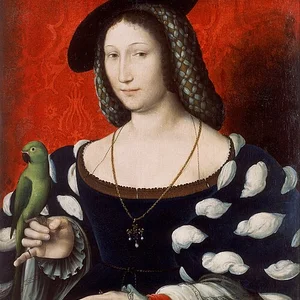

Elder sister of Francis I, Margaret of Navarre was one of the most educated women of the French Renaissance. A patron of humanists and religious reformers, she authored the Heptameron, a collection of tales inspired by Boccaccio's Decameron.
Margaret of Navarre(1492 — 1549)
Margaret of Valois-Angoulême
royaume de France, royaume de Basse-Navarre
7 min read
Frequently asked questions
Famous Quotes
« Love is a hidden fire, a pleasant wound, a sweet poison, a sweet bitterness.»
Key Facts
- Born in 1492 in Angoulême, elder sister of the future king Francis I
- First married in 1509 to Charles IV, Duke of Alençon; second marriage in 1527 to Henry II of Albret, King of Navarre
- Protected Clément Marot, Rabelais, Lefèvre d'Étaples, and other humanists threatened by the Sorbonne
- Published the Heptameron, a collection of 72 framed tales and a major work of French Renaissance prose (published posthumously in 1558)
- Died in 1549 at Odos-en-Bigorre
Works & Achievements
A long mystical poem expressing intense evangelical faith, it was condemned by the Sorbonne. It stands as one of the first works by a woman to be printed in France.
A collection of religious plays written and staged by Marguerite at her court, blending Reformed spirituality with dramatic form. They foreshadow the French humanist theatre tradition.
A collection published during her lifetime gathering poems, plays, and mystical texts. The title plays on her name and the image of the flower, a symbol of both modesty and radiance.
Her masterpiece: 72 prose tales set within a narrative frame inspired by Boccaccio's Decameron. The work explores love, morality, and the condition of women with a remarkable freedom of tone for its time.
A theologically rich exchange of letters with the reforming Bishop of Meaux. These letters reveal the depth of Marguerite's spirituality and her early commitment to evangelical faith.
Anecdotes
Marguerite maintained an intense correspondence with her brother Francis I, even while he was held prisoner by Charles V following the Battle of Pavia in 1525. She traveled to Spain in person to negotiate his release, braving winter roads and foreign courts — a remarkable testament to her sibling devotion.
A great patron of humanist thinkers, Marguerite welcomed reformist minds such as Clément Marot and Lefèvre d'Étaples to her court at Nérac, offering them refuge while the Sorbonne pursued them for heresy. Her court became a unique intellectual sanctuary in France.
She staged religious plays that she had written herself, known as 'spiritual farces' or 'biblical comedies.' Performed before her court, these works blended sincere devotion with theological questioning — earning her the wrath of Parisian theologians.
Marguerite wrote the Heptameron in the final years of her life, dictating some of the tales while traveling by litter through the Pyrenees. The book's fictional framing — travelers stranded by a flood — was inspired by a real mishap she experienced in the mountains of Béarn in 1549.
Despite her sympathies for the Reformation, Marguerite remained Catholic and never officially broke with Rome, skillfully navigating between orthodoxy and evangelism. This ambiguous position allowed her to protect reformers without putting herself at risk of the stake.
Primary Sources
I beg you, therefore, my ladies, that this company be kept secret, and that each one say what he thinks of it, without fear or favor.
Love, who art so strong and so powerful, that thou dost triumph over all hearts, and leavest not one in its freedom.
My lord, the grief I feel at your captivity is so great that, if God does not remedy it in His goodness, I know not how I shall be able to bear it.
O my God, when I look within myself, I find nothing but sin, ignorance, and misery; but when I lift my eyes toward Thy infinite goodness, I hope for salvation.
Key Places
The main residence of the royal couple of Navarre, Nérac became under Marguerite an intellectual and evangelical center. She welcomed humanists and poets there, making it one of the most brilliant courts in France.
Marguerite's birthplace, in 1492. She grew up there alongside her brother Francis in a cultured environment shaped by the influence of their mother Louise of Savoy.
As the king's sister, Marguerite was a frequent presence at the royal court in Paris. It was there that she played her role as political mediator and patron of the arts at the highest level.
Marguerite stayed here in her childhood with her mother; the place left a lasting mark on her intellectual development and religious sensibility from a very young age.
A city in the kingdom of Navarre, of which Marguerite was queen. It is in the Béarnese Pyrenees that the Heptameron is set, and it was at Odos, near Tarbes, that she died in 1549.
Liens externes & ressources
Références
Œuvres
Le Miroir de l'âme pécheresse
1531
Les Comédies bibliques
vers 1535-1545
Les Marguerites de la Marguerite des Princesses
1547
L'Heptaméron
1559 (posthume)
Correspondance avec Guillaume Briçonnet
1521-1524