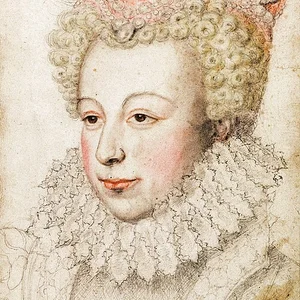

Queen consort of Navarre and later of France, nicknamed 'Queen Margot', she was a central figure in the Wars of Religion. A learned woman of letters, she left behind her Memoirs and was the first wife of Henry IV.
Marguerite de Valois(1553 — 1615)
Marguerite de Valois
France
8 min read
Frequently asked questions
Famous Quotes
« I am quite astonished that something so small as you can contain so great a courage.»
« Kings are the fathers of their peoples.»
Key Facts
- 1553: Born in Saint-Germain-en-Laye, daughter of Henry II and Catherine de' Medici
- 1572: Marriage to Henry of Navarre (future Henry IV) — the wedding is followed by the St. Bartholomew's Day Massacre
- 1589: Her husband Henry of Navarre becomes King of France as Henry IV
- 1599: Her marriage to Henry IV is annulled; she retains the title of queen
- 1628: Posthumous publication of her Memoirs, a major work of literary testimony
Works & Achievements
A masterpiece of French memoir literature, this work recounts life at the Valois court, the St. Bartholomew's Day Massacre, and the years spent at Nérac. It is one of the first major autobiographical texts written by a woman in France.
Her extensive correspondence with Henry IV, Henry III, Catherine de' Medici, and the leading figures of her era constitutes a major historical source on the Wars of Religion and French royal politics.
Marguerite composed poems in both French and Latin in the tradition of the Pléiade. Long overlooked, these texts reveal her command of Renaissance literary forms and her deep attachment to humanist culture.
A political text written to defend her husband Henry of Navarre's interests at court, illustrating her active role in diplomatic negotiations and her skill as a rhetorician.
Anecdotes
On the night of August 23–24, 1572, the St. Bartholomew's Day Massacre broke out in Paris, just days after her marriage to Henri of Navarre. According to her own Memoirs, Marguerite sheltered several terrified Huguenot noblemen in her bedchamber, protecting them from Catholic killers at the risk of her own life.
Her marriage to Henri of Navarre on August 18, 1572 was both a political and religious ordeal: a devout Catholic, Marguerite was opposed to the union. During the ceremony held on the forecourt of Notre-Dame de Paris — the two faiths being unable to wed inside the church — she refused to say 'yes,' and her brother Henri III had to tilt her head forward so that she would nod in consent.
Accused of scandalous behavior and political scheming, Marguerite was exiled by her own brother Henri III as early as 1583. She eventually took refuge at the Château d'Usson in Auvergne, where she remained for nearly eighteen years. Far from being crushed by this captivity, she turned it into a period of intense study, during which she wrote her famous Memoirs.
After her divorce from Henri IV in 1599, Marguerite returned to Paris and settled in a private mansion on the Left Bank of the Seine. There she opened a renowned literary salon, welcoming poets, philosophers, and artists, becoming — well past the age of fifty — one of the great patrons of her era. She even maintained cordial relations with her ex-husband and his new wife, Marie de' Medici.
An exceptionally well-educated woman, Marguerite de Valois was fluent in Latin, Greek, Italian, and Spanish. She shone at the Valois court through her theological and philosophical discussions, to the point that writers such as Brantôme celebrated her in their works, praising her as a princess as beautiful as she was learned.
Primary Sources
I found myself caught up in this bloody tragedy, not knowing whether I myself was the target. Several gentlemen took refuge in my chamber, and I remained torn between fear for them and fear for myself.
I beg you to believe that my devotion to your service is all that you could wish, and that I shall always do whatever may be to your contentment and satisfaction.
She had a most great, beautiful, and refined mind, and an excellent memory… She surpassed in beauty, grace, and wit all the princesses of her time.
The Queen of Navarre, whom I have seen debate theology with the greatest doctors, and poetry with the finest minds, yielded nothing to the men of her century.
Key Places
Marguerite's birthplace in 1553, this royal château was one of the Valois dynasty's favorite residences. It was in this courtly environment that she received her exceptional intellectual and political education.
The main residence of the Valois court, the Louvre was the stage for the defining events of Marguerite's life, including her controversial marriage and the St. Bartholomew's Day Massacre in August 1572.
Capital of the Kingdom of Navarre, Nérac was the court of Marguerite and Henry of Navarre around 1580. She flourished there as an intellectual, drawing poets and artists to what became known as the 'little court of the Muses'.
A fortress in the Auvergne where Marguerite was exiled from 1587 to 1605. During these eighteen years of confinement, she wrote her Memoirs and corresponded with the greatest minds of her time.
After her return to Paris in 1605, Marguerite settled in this townhouse on the banks of the Seine, in what is now the 6th arrondissement. She held a brilliant literary salon there until her death in 1615.
Typical Objects

Margaret possessed an exceptional personal library, rich in illuminated manuscripts and humanist works in Latin, Greek, Italian, and French. Her passion for books was known throughout the court.

An accomplished woman of letters, Margaret wrote her Memoirs, an extensive correspondence, and numerous poems. The quill was her daily tool, used for both literary expression and epistolary diplomacy.

Typical court dress of the French Renaissance: a skirt flared by a rigid framework (the farthingale), a stiff boned bodice, and puffed embroidered sleeves. Margaret wore them in silk or velvet, adorned with pearls and gold thread.

An exceptional luxury item imported from Italy, the Venetian blown-glass mirror was a symbol of prestige at the Valois court. Margaret, renowned for her attention to appearance, kept several in her apartments.

Several portraits of Margaret were produced, some attributed to the school of François Clouet. These official portraits served to assert her rank and circulate her image among the courts of Europe.

A devout Catholic, Margaret wore a rosary and owned precious gem-encrusted reliquaries. These devotional objects accompanied her daily prayers and religious practices.
School Curriculum
Vocabulary & Tags
Key Vocabulary
Daily Life
Morning
Marguerite rose early and attended Mass in the palace chapel — daily prayer was non-negotiable for this devout Catholic. She would then receive her ladies-in-waiting for her morning toilette, a ritual that could last more than an hour given the complexity of court dress at the time.
Afternoon
Afternoons were devoted to court activities: political audiences, walks in the gardens, readings of ancient or contemporary texts, and discussions with the poets and scholars she invited. At Nérac as in Paris, she loved hosting literary and philosophical debates around her.
Evening
Evenings at the Valois court were enlivened by lavish banquets, court ballets, and theatrical performances. During her years of exile at Usson, Marguerite preferred to spend her evenings writing her Memoirs and reading by candlelight in the quiet of her gilded captivity.
Food
The royal table offered multiple courses: roasted meats (venison, pheasant, swan), fish in sauce, meat pies, garden vegetables, fruit, and sweet confections. Meals were accompanied by Bordeaux or Burgundy wines and followed a strict protocol, with each dish presented by household officers according to the rank of the guests.
Clothing
Marguerite wore the fashions dictated by the Valois court: a rigid whalebone bodice, a farthingale widening the skirt, a pleated ruff around the neck, and puffed sleeves adorned with embroidery. Her gowns of silk, velvet, or satin were embellished with gold thread, pearls, and gemstones, reflecting her status as a royal princess.
Housing
Marguerite lived in the greatest châteaux of France: the Louvre, Saint-Germain-en-Laye, Nérac in Gascony, and the Château d'Usson in Auvergne. In the final years of her life, her private mansion on the Left Bank of the Seine in Paris — with its grand library, painting galleries, and formal French gardens — showcased her refined taste and passion for the arts.
Historical Timeline
Period Vocabulary
Visual Style
Le style visuel évoque la cour des Valois dans toute sa splendeur : portraits à la manière de Clouet, robes de velours brodées d'or, fraises de dentelle plissée, fonds sombres rehaussés de lumière de bougie, bijoux de perles et pierres précieuses.
Sound Ambience
L'univers sonore de Marguerite mêle la douceur de la musique de cour — luth, clavecin — au bruissement des soieries, aux cloches des chapelles royales et aux murmures des salons littéraires où philosophes et poètes débattaient à la lueur des chandelles.
Liens externes & ressources
Références
Œuvres
Mémoires
rédigés vers 1594-1600, publiés en 1628
Correspondance (Lettres)
1570-1615
Poésies
fin XVIe siècle
Mémoire justificatif pour Henri de Bourbon
vers 1574