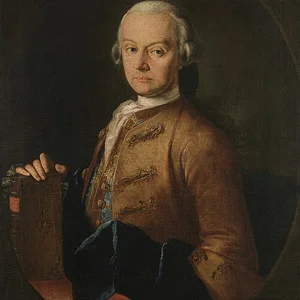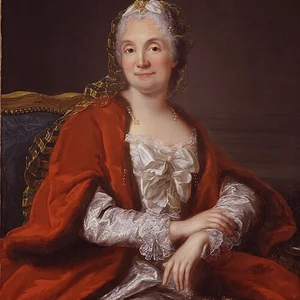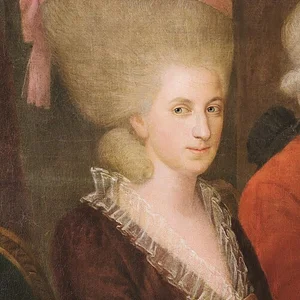

Austrian prodigy pianist and composer of the 18th century, elder sister of Wolfgang Amadeus Mozart. Considered as talented as her brother in childhood, she toured the European courts before her career was cut short in adulthood due to her status as a woman.
Maria Anna Mozart (Nannerl)
Maria Anna Walburga Ignatia Mozart, known as Nannerl
9 min read
Frequently asked questions
Key Facts
- Born on July 30, 1751, in Salzburg into a family of musicians
- Between 1763 and 1766, she toured Europe with her brother Wolfgang and their father Leopold, performing before royal courts
- Regarded by contemporaries as equally gifted as Mozart during their joint tours
- Forced to abandon her concert career around 1769, at marriageable age, on her father's orders
- Nearly all of her composed works have been lost; she died on October 29, 1829, in Salzburg
Works & Achievements
A music notebook compiled by Leopold for Nannerl, containing her first lessons and probably early compositional sketches. This pedagogical document has been preserved and stands as direct evidence of her early musical training.
Leopold Mozart mentioned on several occasions in his letters that Nannerl composed keyboard pieces and showed genuine creative talent. None of these works has been preserved with certainty, lost to the systematic neglect of women's musical creations at the time.
A personal document in which Nannerl recorded her musical activities and daily life. Held in the Salzburg archives, this diary is a major historical source on musical life in Austria at the end of the eighteenth century.
After her performing career came to an end, Nannerl became a respected piano teacher in Salzburg, training many students over several decades. Her work as an educator was recognized by her contemporaries.
Following the deaths of her father and brother, Nannerl carefully preserved the family letters and documents. This effort ensured the survival of an essential epistolary archive for our understanding of musical life in the eighteenth century.
Anecdotes
During the Grand European Tour (1763–1766), twelve-year-old Nannerl performed alongside her brother Wolfgang at the court of Versailles on January 1st, 1764, before Louis XV and Queen Marie Leszczyńska. Leopold Mozart wrote in his letters that his daughter was hailed as an accomplished virtuoso and that the courtiers could not stop praising her mastery of the harpsichord and the fortepiano.
In London in 1764–1765, Nannerl and Wolfgang performed before King George III and Queen Charlotte. The musicologist Charles Burney, present at one of their performances, testified that both children astonished their audience with their precise and expressive playing. Nannerl received praise equal to that of her brother, who was only eight years old at the time.
In 1769, when Nannerl reached the age of eighteen, Leopold decided it was no longer appropriate for a young woman of good family to perform professionally in public. He set off for Italy with Wolfgang alone, leaving Nannerl behind in Salzburg. This decision brought an abrupt end to what had promised to be a brilliant concert career.
Nannerl kept a personal diary between 1775 and 1783, in which she recorded her daily musical activities, the concerts in which she took part, and her life in Salzburg. This personal document, held in the Salzburg archives, is one of the rare first-hand accounts of the life of a female musician in eighteenth-century Central Europe.
Leopold Mozart regularly mentioned in his correspondence that Nannerl had been composing music from a very young age and that she showed genuine creative talent. None of these compositions has survived with certainty, most likely because they were not deemed worthy of preservation — a direct reflection of the low regard given to women's works at the time.
Primary Sources
Leopold Mozart writes from London in 1764: my daughter plays the most difficult pieces with a ease and grace that astonishes all the connoisseurs. The family correspondence, comprising several hundred letters, amply documents Nannerl's talent and the two children's joint tours.
Leopold records during the Paris stay of 1763–1764: Nannerl played before the entire court and received the compliments of the finest musicians present. She acquitted herself with a maturity and precision remarkable for her age.
Nannerl notes in January 1776: lessons in the morning, then rehearsal with Mr. Haydn. In the evening, a concert at the Archbishop's, I played the concerto in D major. Her diary, covering the years 1775 to 1783, documents her intense musical activity in Salzburg following the end of her tours.
Wolfgang writes from Vienna in 1782: dear sister, I eagerly await your judgment on these sonatas. You have always been the best judge of my compositions and your ear is flawless. This letter, among others, attests to the musical respect Wolfgang held for Nannerl throughout his life.
Nissen, who gathered the testimonies of Constanze Mozart, writes: Maria Anna Mozart was in her youth a pianist of the very highest rank, at least equal to her brother in technique and musical sensitivity. Her withdrawal from the public stage was imposed by the circumstances of her condition as a woman.
Key Places
Nannerl was born and spent most of her life in Salzburg, in the family home at 9 Getreidegasse. It was there that she learned music, taught piano to many students, and spent her final years.
On January 1, 1764, Nannerl performed alongside her brother before the court of Louis XV. This performance was one of the most brilliant moments of her career as a child concert artist, earning her the praise of France's finest musicians.
In 1762, Nannerl and Wolfgang performed before Empress Maria Theresa at Schönbrunn Palace. This concert was one of Nannerl's first major public performances, when she was eleven years old.
During the 1764–1765 stay in England, Nannerl performed before King George III. The musicologist Charles Burney heard both children and documented their exceptional performances in his writings on European music.
After her marriage in 1784 to the magistrate von Berchtold zu Sonnenburg, Nannerl lived in Sankt Gilgen, on the shores of the Wolfgangsee. There she raised her own children and those of her husband, while keeping up a limited musical activity.
Typical Objects

A keyboard instrument characteristic of the 18th century and forerunner of the modern piano, on which Nannerl trained and performed from childhood. Leopold owned a quality instrument that the children used for their daily practice and concert tours.

A collection of keyboard pieces compiled by Leopold Mozart from 1759 onward for his daughter's instruction, which also contains early compositions by both children. This notebook bears witness to Leopold's rigorous teaching method and to Nannerl's remarkable precocity.

Between 1775 and 1783, Nannerl recorded her musical activities, concerts, and daily reflections in a notebook. This personal document, preserved in the Salzburg archives, is one of the few direct traces left behind by a professional female musician of the era.

During the European tours, Nannerl wore richly embroidered court gowns to perform before sovereigns. Empress Maria Theresa reportedly gave the Mozart children court attire as a gift during their stay in Vienna in 1762.

The correspondence exchanged between Nannerl, her father Leopold, and her brother Wolfgang forms an essential archive. After the death of her loved ones, Nannerl carefully preserved these letters, ensuring their transmission to the present day.

During long carriage tours, Leopold brought along a portable instrument so that the children could practise at inns and give demonstrations in venues where no instrument was available.
School Curriculum
Vocabulary & Tags
Key Vocabulary
Tags
Daily Life
Morning
Nannerl's day began early with several hours of fortepiano practice — a discipline instilled by Leopold from childhood and maintained throughout her life. During tours, these practice sessions took place in inns or apartments provided by their noble hosts. In Salzburg, she also took on pupils' lessons from the morning onward.
Afternoon
Afternoons were devoted to copying scores, studying new pieces, and — during tours — preparing for the evening concerts. Nannerl helped her father manage correspondence with courts and patrons. After her marriage, she also attended to her household and the education of her own children and stepchildren.
Evening
Tour evenings were filled with concerts in palaces, aristocratic salons, or music rooms, where they might perform prepared pieces and improvisations for several hours at a stretch. In Salzburg, musical evenings at the Archbishop's residence or in bourgeois homes remained frequent, even after Nannerl had stopped touring.
Food
Food during travels came from the inns and noble tables they frequented: roasted meats, broths, Viennese pastries, and local wines that varied from country to country. In Salzburg, the daily fare was that of the Austrian middle class — dark bread, cold cuts, soups, seasonal vegetables, and light beers. Leopold frequently commented in his letters on the culinary differences he observed throughout their tours.
Clothing
For court concerts, Nannerl wore richly embroidered pannier gowns with powdered hair and jewels, in keeping with the strict protocol of royal courts. Empress Maria Theresa reportedly gave the Mozart children court dress during their 1762 Viennese stay. For everyday life in Salzburg, she wore the understated attire of bourgeois women: a skirted dress, apron, and shawl.
Housing
The Mozart family lived at 9 Getreidegasse in Salzburg, a multi-room apartment in a bourgeois building at the heart of the old town — now a museum. During tours, they stayed in quality inns or with aristocratic hosts in sumptuous residences. After her marriage, Nannerl lived in Sankt Gilgen in a comfortable magistrate's house on the shores of the Wolfgangsee.