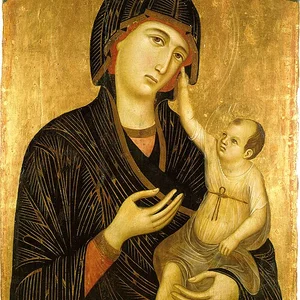

Mother of Jesus of Nazareth, a central figure in Christianity. Venerated as Theotokos (Mother of God) in the Catholic and Orthodox traditions, she holds a major place in the history of monotheistic religions.
Mary (Mother of Jesus)(17 av. J.-C. — 48)
Mary
http://www.wikidata.org/.well-known/genid/4837477512a92ed298b80a13b79187b3
9 min read
Frequently asked questions
Key Facts
- 1st century BCE / 1st century CE: life in Galilee, Roman province of Judea
- Annunciation: according to the Gospel of Luke, the angel Gabriel announces to her that she will be the mother of the Son of God
- Present at the Nativity of Jesus in Bethlehem according to the Gospels of Matthew and Luke
- Present, according to the Gospel of John, at the crucifixion of Jesus (c. 30 CE)
- Marian veneration institutionalized at the Council of Ephesus in 431 CE
Works & Achievements
A hymn of praise spoken by Mary during her visit to Elizabeth, preserved in Luke 1:46–55. This poetic text, inspired by the Canticle of Hannah in the Old Testament, is sung daily in Catholic liturgy during Vespers.
Mary's presence in the Upper Room at Pentecost makes her a founding figure of the nascent Christian community. She is the only person explicitly named in the Acts of the Apostles among the women gathered with the Twelve.
From the earliest centuries of Christianity, Mary was invoked as an intercessor with her son. The oldest known Marian prayer, the *Sub tuum praesidium* (3rd century), bears witness to this practice of intercession, which took root quickly in popular devotion.
Though posthumous, the official proclamation of Mary as *Theotokos* at the Council of Ephesus established her central theological place within Christianity. This title, defended by Cyril of Alexandria against Nestorius, underpins the entire framework of Catholic and Orthodox Mariology.
The earliest depictions of Mary in a posture of prayer — arms raised, palms open — appear in the Roman catacombs as early as the 2nd century. They established an unbroken iconographic tradition that runs throughout the entire history of Western art.
Anecdotes
According to the Gospel of Luke, the angel Gabriel appeared to Mary in Nazareth to announce that she would conceive the Son of God. Mary, troubled, replied simply: “Be it done unto me according to your word.” This moment, called the Annunciation, is one of the most depicted episodes in all of Western art.
While pregnant, Mary hurried to visit her cousin Elizabeth, who was herself miraculously pregnant with John (the future Baptist). According to the Gospel account, the child leapt in Elizabeth's womb upon Mary's arrival, and Mary then spoke the Magnificat, a hymn of joy and faith that has become one of the most recited prayers in Christianity.
At the wedding at Cana in Galilee, Mary noticed that the wine had run out and informed her son Jesus. Despite his initial reluctance (“My hour has not yet come”), he turned water into wine at his mother's request — which the Gospel of John presents as Jesus's first public miracle.
At the moment of the crucifixion, while most of the disciples had fled, Mary stood at the foot of the cross. Jesus then entrusted her with his disciple John: “Woman, behold your son,” then said to John: “Behold your mother.” This gesture established in Christian tradition the idea of Mary as the spiritual mother of all believers.
According to the Acts of the Apostles, Mary was present in the Upper Room in Jerusalem with the apostles at Pentecost, when the Holy Spirit descended upon the nascent community. She is thus considered a founding figure of the early Church, though her role remained discreet and silent in the canonical texts.
Primary Sources
The angel said to her: “Do not be afraid, Mary, for you have found favor with God. And behold, you will conceive in your womb and bear a son, and you shall call his name Jesus.” And Mary said: “My soul magnifies the Lord, and my spirit rejoices in God my Savior.”
The mother of Jesus said to him: “They have no wine.” Jesus said to her: “Woman, what does this have to do with me? My hour has not yet come.” His mother said to the servants: “Do whatever he tells you.”
An angel of the Lord appeared to Joseph in a dream and said: “Rise, take the child and his mother, and flee to Egypt, and remain there until I tell you, for Herod is about to search for the child, to destroy him.”
Joachim and Anne, long childless, received an angel's announcement that a daughter would be born to them, who would be blessed among all women. Mary was presented at the Temple at the age of three, where she lived consecrated to God.
All these with one accord were devoting themselves to prayer, together with the women and Mary the mother of Jesus, and his brothers.
Key Places
Mary's hometown and the place where she lived with Joseph and Jesus. According to the Gospel of Luke, the Annunciation took place here, making this modest town in Galilee the birthplace of Christianity.
The city where Mary gave birth to Jesus during the census ordered by Augustus, in a stable because there was no room at the inns. The Church of the Nativity, built in the 4th century, marks the traditional site of the birth.
Mary was present in the Upper Room at the Last Supper and at Pentecost, and likely lived there afterward with the nascent apostolic community. It was also in Jerusalem that she witnessed the crucifixion on Golgotha.
The site of the wedding where Jesus performed his first miracle at Mary's request: turning water into wine. This village in Galilee is identified by tradition with Kafr Kanna, north of Nazareth.
According to an ancient tradition, Mary spent her final years in Ephesus, entrusted to the care of the apostle John. A house on Mount Koressos has been venerated since the 19th century as the "House of the Virgin" (*Meryem Ana Evi*).
Typical Objects

A symbol of purity and virginity, the lily has been the iconographic attribute most closely associated with Mary since the Middle Ages. The angel Gabriel typically carries one in depictions of the Annunciation.

Blue became the quintessential Marian color in Christian art, symbolizing the heavens and the divine. Mary's blue mantle often shelters the faithful beneath it in representations of the Virgin of Mercy.

This devotional object — a string of beads used to count prayers — has been intimately linked to Marian devotion since the Middle Ages. According to tradition, Mary herself taught this practice to Saint Dominic in the 13th century.

The stable and manger where Jesus was born, depicted in Nativity scenes, place Mary at the center of a humble yet sacred space. Popularized by Francis of Assisi in the 13th century, the nativity scene has become a universal symbol of Christmas.

Rooted in the title Stella Maris ("Star of the Sea"), the golden star frequently adorns Mary's mantle in iconography. It symbolizes her guidance for believers and her role as mediator between heaven and earth.

According to the Protevangelium of James, Mary was spinning purple wool for the Temple veil when the angel Gabriel appeared to her. This domestic object grounds the Marian figure in the everyday reality of a 1st-century Jewish woman, devoted to work and prayer.
School Curriculum
Vocabulary & Tags
Key Vocabulary
Tags
Daily Life
Morning
In a stone or wattle-and-daub house in Nazareth, Mary rose at dawn for the Shema Israel prayer. She would then light the hearth, draw water from the village spring, and prepare bread by kneading barley or wheat dough — a daily task for Jewish women in Galilee in the 1st century.
Afternoon
Afternoons were devoted to spinning, weaving, and sewing — central activities of women's domestic life in the ancient Mediterranean world. Mary might also tend the vegetable garden, gather olives or figs depending on the season, and oversee household tasks.
Evening
In the evening, the family gathered for the main meal, taken after the sunset prayer. Torah texts were sometimes recited or discussed together; the Sabbath and Jewish festivals (Passover, Sukkot, Shavuot) marked the rhythm of the annual calendar and called for careful ritual preparations.
Food
Mary's diet followed the rules of kashrut (Jewish dietary laws): barley or wheat bread, olive oil, pulses (lentils, chickpeas), fish from the Sea of Galilee, figs, and dates. Meat, being costly, was reserved for festive meals. Wine diluted with water was the common drink.
Clothing
Mary wore a long tunic (chiton) of wool or linen, belted at the waist, covered by a shawl or cloak (himation) when going out. A veil covered her head, following Jewish women's custom. Colors were natural or dyed with indigo and saffron; embroidery was reserved for festive garments.
Housing
The Nazarene home was a modest structure of local limestone or mud brick, with one or two shared rooms where the whole family lived. The floor was packed earth; the flat wooden-and-clay roof served as a terrace for drying food or sleeping in summer. Domestic animals might share the lower level.
Historical Timeline
Period Vocabulary
Liens externes & ressources
Références
Œuvres
Le Magnificat (cantique de Marie)
vers 30 apr. J.-C. (transmission écrite vers 80)
La co-fondation de l'Église primitive
vers 33 apr. J.-C.
Tradition de l'intercession mariale
Ier–IIe siècle (premières attestations)
Le titre de Theotokos (Mère de Dieu)
Concile d'Éphèse, 431
L'iconographie mariale — la Vierge Orans
IIe–IIIe siècle (catacombes de Rome)