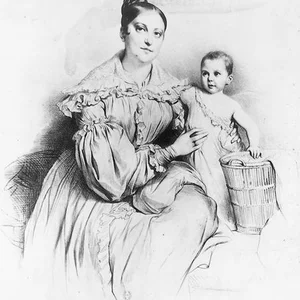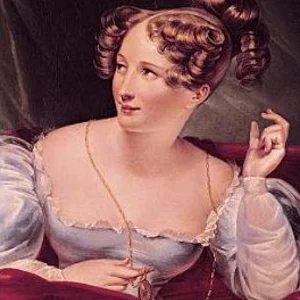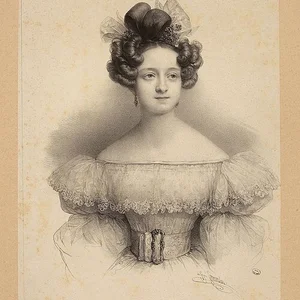

A 19th-century Italian prima ballerina, Marie Taglioni revolutionized Romantic ballet by popularizing dancing on pointe. Her performance in *La Sylphide* (1832) defined the airy, ethereal aesthetic of Romantic ballet for generations to come.
Marie Taglioni(1804 — 1884)
Marie Taglioni
royaume d'Italie
9 min read
Frequently asked questions
Key Facts
- 1804: Born in Stockholm to Italian parents; her father Filippo Taglioni was a choreographer
- 1832: Premiere of *La Sylphide* at the Paris Opéra, choreographed by her father — a founding work of Romantic ballet
- She popularized dancing on pointe as an expressive technique, symbolizing lightness and the supernatural
- Adored throughout Europe, she became the definitive model of the Romantic ballerina
- 1884: Died in Marseille, leaving a lasting influence on the aesthetics of classical ballet
Works & Achievements
A romantic ballet in two acts choreographed by Filippo Taglioni for his daughter, based on a libretto by Adolphe Nourrit inspired by a tale by Charles Nodier, with music by Jean-Madeleine Schneitzhoeffer. Considered the first great romantic ballet, it defined the aesthetic of the genre for generations: lightness, the supernatural, and ethereal femininity.
A romantic ballet in two acts choreographed by Filippo Taglioni, featuring undines and aquatic creatures. It confirmed the triumph of the airy, poetic style that was Taglioni's hallmark and was performed to great success in Paris and Saint Petersburg.
A ballet created in Saint Petersburg for Marie Taglioni, allowing her to explore a more earthbound and dramatic register than her usual sylph roles. It revealed the full range of her talent as a performer beyond the purely fantastical.
A ballet in three acts created in Saint Petersburg, in which Marie Taglioni portrayed the ghost of a young woman who had died. The work once again demonstrated her unique ability to give form to the intangible and move audiences through the sheer grace of her movement.
The only ballet choreographed by Taglioni herself, at the Paris Opéra, created for the young Emma Livry whom she had taken under her wing. The sole testament to her career as a choreographer, it reflects her determination to pass on the art of romantic ballet to the next generation.
Anecdotes
In Saint Petersburg, enthusiasm for Taglioni reached unimaginable heights: wealthy admirers purchased her worn ballet slippers after a performance, had them cooked in a sauce, and savored them at a banquet, claiming they wished to absorb some of her genius. This anecdote, reported by chroniclers of the time, attests to the quasi-religious fervor the ballerina inspired in Imperial Russia.
Her father, choreographer Filippo Taglioni, subjected her from childhood to an extremely rigorous training regime, aware that his daughter did not possess the proportions considered ideal for ballet. He corrected her figure through years of grueling exercises, turning her supposed flaws into unique qualities. This relentless work paid off: Marie Taglioni became the most admired dancer of her time.
On March 12, 1832, at the premiere of *La Sylphide* at the Paris Opéra, audiences were left speechless by Taglioni's ethereal lightness. She seemed to truly fly, lifted by her pointe work and theatrical machinery that made her appear suspended in mid-air. The role was created especially for her by her father, based on a libretto inspired by a fantastical tale by Charles Nodier.
In Saint Petersburg, devoted admirers unhitched the horses from her carriage to pull it themselves through the streets, to the cheers of the crowd. This gesture, usually reserved for sovereigns and war heroes, attests to the exceptional status the dancer had acquired in Russia, where she performed regularly between 1837 and 1842.
After her retirement from the stage in 1847, Marie Taglioni faced financial difficulties, due in part to an unhappy marriage to the Count de Voisins. She became a teacher of deportment and dance for young London aristocrats, passing on to English high society the secrets of an elegance she had spent decades perfecting.
Primary Sources
There is in this dancing something aerial and fantastical that belongs to the realm of vision. Mademoiselle Taglioni does not touch the earth, or if she does, it is like a bird that brushes the surface of the water with its wing before vanishing into the clouds.
Taglioni is the virgin of the northern glaciers, the dweller of cloud-capped mountains, the fairy of springs and waterfalls. She is as white and transparent as crystal, and her arms stir about her like two wings poised for flight.
Taglioni dances with her soul as much as with her feet; her movements are like a silent prayer, and when she rises into the air one could believe one was watching an aspiration ascending toward heaven.
A sylph, an ethereal and elusive creature, visits the young James in a dream and inspires in him an irresistible love that draws him away from his earthly fiancée Effie; smitten with this being of the air, he rushes toward his own ruin in his desire to hold her upon the earth.
This young dancer has brought to the Opéra a new poetry, a way of hovering rather than walking, that leaves in the hall an impression of waking dream long after the curtain has fallen.
Key Places
Birthplace of Marie Taglioni, born on 23 April 1804 to an Italian choreographer father and a Swedish mother. She left Stockholm at a very young age to follow her father's itinerant career across the major European capitals.
Paris's principal opera house, located on rue Le Peletier, where Taglioni made her debut in 1827 and triumphed on 12 March 1832 with *La Sylphide*. It was the birthplace of Romantic ballet, before the theatre was destroyed by fire in 1873.
The Russian imperial capital where Taglioni performed regularly between 1837 and 1842 before the court of Nicholas I, becoming the undisputed idol of Russian ballet enthusiasts. Her triumphs there took on an almost mythological dimension.
The city where Taglioni launched her professional career in 1822 under her father's guidance, at a time when Vienna was one of Europe's great capitals of music and dance.
The city where Taglioni performed on several occasions at Her Majesty's Theatre, and where she settled after her retirement to teach dancing and deportment to young English aristocrats.
The city where Marie Taglioni passed away on 22 April 1884, on the eve of her eightieth birthday, having withdrawn to the south of France in the final years of her life.
Typical Objects

Reinforced-toe dance shoes that allow a dancer to balance on the tips of her toes. Taglioni refined and popularized this technique, which gave her dancing a supernatural lightness and made pointe work the defining symbol of classical ballet.

A long, calf-length skirt made of sheer gauze that gave dancers an ethereal, ghostly appearance. Associated with the role of La Sylphide, this white costume became the iconic image of Romantic ballet.

Delicate gauze wings attached to the back of the costume to embody the supernatural creatures of Romantic ballet. On stage, invisible wires and theatrical machinery helped Taglioni appear to float above the ground.

A horizontal bar fixed to the wall of the rehearsal room, essential for daily warm-up and muscle-strengthening exercises. Taglioni trained for several hours each morning at the barre under her father's demanding guidance.

A floral headdress worn on stage for the role of La Sylphide, symbolizing purity and the enchanted world of air spirits. It enhanced the virginal, fleeting quality of the character.

A printed booklet distributed to the audience at each performance, describing the ballet's plot and listing the names of the dancers. Programs bearing Taglioni's name became prized collector's items during her own lifetime, such was the draw of her name.
School Curriculum
Vocabulary & Tags
Key Vocabulary
Daily Life
Morning
Each morning, Taglioni rose at dawn to begin her barre exercises, often under her father's supervision. These training sessions could last several hours, stringing together pliés, battements, and pointework to maintain the extraordinary flexibility and muscular strength her art demanded.
Afternoon
The afternoon was devoted to collective rehearsals at the Opéra, where she worked with the other corps de ballet dancers and refined her roles with her father as choreographer. Costume fittings and technical adjustments preceded the evening performances, which were sometimes accompanied by full dress rehearsals with the orchestra.
Evening
On performance nights, Taglioni performed before packed houses in an electric atmosphere. After the show, she received compliments from privileged subscribers — those wealthy patrons with backstage access — and sometimes joined fashionable suppers in the great Parisian salons or at embassies.
Food
Taglioni followed a light, controlled diet to preserve the effortless quality her technique demanded. She favored broths, lean meats, and fruits, avoiding heavy dishes before performances, in keeping with the habits of Opéra dancers who were expected to maintain an impeccable figure.
Clothing
On stage, Taglioni wore the Romantic tutu: a long translucent white gauze skirt falling to the calf, a fitted bodice, pointe shoes, and, depending on the role, gauze wings or a crown of flowers. In everyday life, she dressed in the bourgeois Romantic fashion of her era: dresses with puffed sleeves, a defined waist, shawls, and ribbon-trimmed hats.
Housing
During her Parisian career, Taglioni lived in comfortable apartments in the Opéra district with her family, her father managing her career and engagements. The family moved regularly according to contracts across European capitals — Paris, London, Saint Petersburg, Vienna — staying in fine hotels or apartments rented for the season.
Historical Timeline
Period Vocabulary
Liens externes & ressources
Références
Œuvres
La Sylphide
12 mars 1832
La Fille du Danube
1836
La Gitana
1838