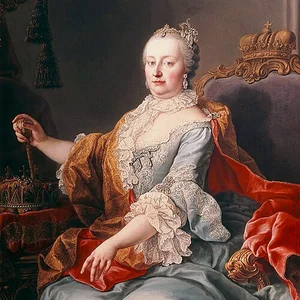

Archduchess of Austria and Queen of Hungary and Bohemia (1717–1780), she defended her inheritance against the major European powers and profoundly modernized the Habsburg state. The only woman to have ruled over Habsburg territories, she stands as one of the great reforming monarchs of the 18th century.
Maria Theresa of Austria(1717 — 1780)
Maria Theresa of Austria
Monarchie de Habsbourg
8 min read
Frequently asked questions
Famous Quotes
« I have no counselors but my own heart and my reason.»
Key Facts
- 1717: born in Vienna, only daughter of Emperor Charles VI
- 1740: death of Charles VI — Maria Theresa inherits the Habsburg territories by virtue of the Pragmatic Sanction
- 1740–1748: War of the Austrian Succession against Frederick II of Prussia and his allies
- 1756: Diplomatic Revolution — she allies with France against Prussia (Seven Years' War)
- 1740–1780: sweeping administrative, fiscal, judicial, and educational reforms
Works & Achievements
Facing a coalition of Prussia, France, Bavaria, and Spain, Maria Theresa defended her inheritance for eight years during the War of the Austrian Succession. She retained the bulk of her territories, asserting the legitimacy of a female sovereign.
Creation of a unified central administration (the Directorium) for Austria and Bohemia, reorganization of finances, and modernization of the army. This reform laid the foundations of the modern Austrian bureaucratic state.
Maria Theresa enacted a major penal reform (the Constitutio Criminalis Theresiana in 1768) and then abolished torture in 1776, placing Austria firmly within the humanist movement of the Enlightenment championed notably by Beccaria.
Introduction of compulsory primary schooling for all children aged 6 to 12 across the Austrian states, the creation of thousands of schools, and the training of teachers. One of the first national education policies in Europe.
By allying with France — the traditional enemy of the Habsburgs — Maria Theresa revolutionized the European balance of power. This diplomatic turning point, engineered by her chancellor Kaunitz, redefined international politics for several decades.
Maria Theresa unified internal tariffs, promoted trade and industry, and curtailed the fiscal privileges of the nobility to modernize state finances. These reforms stimulated the economy across the Habsburg territories.
Anecdotes
In 1741, at just 23 years old and pregnant, Maria Theresa appeared alone before the Hungarian Diet at Pressburg to appeal to the nobles for help against the Prussian invasion. Her speech in Latin, delivered with tears in her eyes, provoked an ovation: the Hungarian magnates rose to their feet and cried “Moriamur pro rege nostro Maria Theresia!” (Let us die for our king Maria Theresa!). This decisive support allowed her to resist Frederick II of Prussia.
Maria Theresa had sixteen children with Emperor Francis I, and used their marriages as diplomatic instruments across Europe. She earned the nickname “mother-in-law of Europe.” One of her daughters, Marie Antoinette, married the future Louis XVI of France; this union sealed the Franco-Austrian alliance born of the “Diplomatic Revolution” of 1756.
In 1767, Maria Theresa herself contracted smallpox, which had already claimed her daughter-in-law and her own daughter Maria Josepha. Marked by the epidemic, she became a fervent advocate of variolation and ordered the inoculation of several of her children. This courageous decision, controversial at the time, reflects her pragmatism in embracing the scientific advances of the Enlightenment.
In 1774, Maria Theresa promulgated the Allgemeine Schulordnung, a reform establishing compulsory primary education throughout her states for all children aged 6 to 12, boys and girls alike. Thousands of schools were created, and the state took control of education that had previously been in the hands of the Church. It stands as one of the earliest mass public education policies in Europe.
Maria Theresa was renowned for her remarkable work ethic: she rose at five in the morning, dealt with her correspondence before breakfast, and personally presided over government councils. Even during her sixteen pregnancies, she carried out her duties without interruption — earning the admiration, and sometimes the astonishment, of her contemporaries.
Primary Sources
I have known far too many ministers who, instead of advising me according to their conscience, sought only to please my favor. The prince must govern himself and inform himself of all things.
I found myself without money, without credit, without an army, without experience, without knowledge, and finally without any counsel, because everyone wanted first to see how things would turn out.
Never forget that you are German; do not let yourself be swept along by French fashions; keep your principles and your piety, and remember your mother who loves you.
The instruction of youth is one of the foremost duties of government. Every child, without distinction of sex or social station, must attend school from the age of six until the completion of their twelfth year.
The matter is not to preserve the old form of government, but to improve it in all its parts, for that is the only way to restore to the monarchy the strength and respect that are its due.
Key Places
Maria Theresa's principal residence, which she had enlarged and decorated in the Baroque and Rococo style. It was the heart of her family life and government for the greater part of her reign.
The imperial palace at the center of Vienna and the official seat of Habsburg power. Maria Theresa held her councils of state there and received ambassadors from the European powers.
The historic capital of the Kingdom of Hungary, where in 1741 Maria Theresa delivered the defining speech of her reign before the Hungarian Diet, securing decisive military support.
Capital of the Kingdom of Bohemia, of which Maria Theresa was queen. The city was briefly occupied by the Bavarians and French in 1741–1742, before being reconquered by her armies.
The traditional burial place of the Habsburgs, where Maria Theresa rests alongside her husband Francis I. Their imposing double Baroque sarcophagus makes it one of the most visited funerary monuments in Vienna.
Typical Objects

The sacred crown of the kings of Hungary, symbol of royal legitimacy over that territory. Maria Theresa was crowned Queen of Hungary in 1741 with this crown — a crucial gesture to secure the support of the Magyar nobles.

Maria Theresa was a tireless letter-writer: every morning she composed a voluminous diplomatic, family, and governmental correspondence, writing in Latin, French, and German.

Depicted in armour in several state portraits, Maria Theresa asserted her role as military commander and sovereign in her own right, in a political world that was the exclusive preserve of men.

A deeply devout woman, Maria Theresa began and ended each day with prayers. Her Catholic faith guided her reforms — she remained consistently hostile to the atheism of the Enlightenment philosophers.

An instrument of day-to-day government, the seal validated decrees, treaties, and ordinances. Maria Theresa personally signed thousands of administrative acts throughout her forty-year reign.

Following the smallpox epidemic of 1767, Maria Theresa actively promoted variolation (the forerunner of vaccination) and had several of her children inoculated, embodying her openness to the medical advances of her era.
School Curriculum
Vocabulary & Tags
Key Vocabulary
Daily Life
Morning
Maria Theresa rose around five in the morning and began her day with a private Mass in her chapel. She then worked through her correspondence — often several dozen letters — before the Court had even stirred, dictating her replies to her secretaries and reviewing reports from her ministers.
Afternoon
The afternoon was devoted to audiences, to the Council of State which she chaired herself, and to working sessions with her leading ministers such as Kaunitz. She examined files in detail, asked pointed questions, and made the final decisions, refusing to let her advisers govern in her place.
Evening
Evenings at Schönbrunn were family affairs: Maria Theresa made a point of dining with her many children, overseeing their education and organizing concerts or short theatrical performances. She herself played the harpsichord with considerable skill. Grand Court receptions were reserved for official occasions.
Food
The imperial table was generous without being extravagant: roasted meats, game, freshwater fish, vegetables from the Schönbrunn gardens, Viennese pastries, and wines from the Austrian vineyards. Maria Theresa favored traditional Austrian cuisine and had little taste for the elaborate French sauces fashionable at other courts.
Clothing
Maria Theresa wore court gowns in embroidered silks — often white or grey after the death of Francis I in 1765 — adorned with Brussels lace and crown jewels. In official portraits she was sometimes depicted in armor, a symbol of her military authority. She enforced a strict dress code throughout her Court.
Housing
Maria Theresa resided mainly at Schönbrunn, which she had transformed into a prestigious residence of 1,441 rooms following the plans of architect Nikolaus Pacassi. The imperial apartments blended baroque splendor with family comfort, combining grand state rooms for official receptions with more intimate spaces for the family life of her sixteen children.
Historical Timeline
Period Vocabulary
Liens externes & ressources
Références
Œuvres
Défense de la Pragmatique Sanction et préservation des États Habsbourg
1740-1748
Grande réforme administrative des États Habsbourg
1749
Réforme judiciaire : Codex Theresianus et abolition de la torture
1768-1776
Allgemeine Schulordnung — réforme de l'instruction publique
1774
Renversement des alliances et système diplomatique de Kaunitz
1756
Réformes économiques et douanières
1750-1775