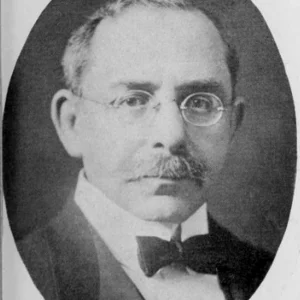

Maurice Henry (1907-1984) was a French cartoonist, poet, and humorist, a key figure of the Surrealist movement. Famous for his humorous drawings published in the press, he was also a painter and sculptor, blending the absurd with poetry.
Maurice Henry(1907 — 1984)
Maurice Henry
France
5 min read
Frequently asked questions
Key Facts
- Born in 1907 in Cambrai and died in 1984 in Milan
- Joined the Surrealist movement in the early 1930s and associated with André Breton
- Co-founded the Octobre group in 1932 with artists close to Jacques Prévert
- Published a great many humorous drawings in the French press (Le Nouvel Observateur, Marianne, etc.)
- Continued a body of work as a Surrealist painter and sculptor until his final years
Works & Achievements
A collection of surrealist poems that reflects his dual activity as both poet and draughtsman.
A surrealist object (a mummified violin) that became one of the movement's most iconic images.
Thousands of drawings published in Le Rire, Marianne, and France-Soir, establishing him as a master of absurd humour.
A collection of drawings bringing together his dreamlike, poetic graphic universe.
Visual works that extend his surrealist imagination into colour and volume.
Anecdotes
Born in Cambrai in 1907, Maurice Henry joined André Breton's Surrealist group in Paris at the end of the 1920s. Alongside René Char and André Breton, he took part in the movement's collective games, such as the famous “exquisite corpse,” in which each person draws or writes a part without seeing what the others have done.
In 1936, Maurice Henry exhibited at the Surrealist Exhibition of Objects at the Galerie Charles Ratton in Paris. There he presented an object that became famous: a violin entirely wrapped in strips of cloth, like a mummy, titled “Homage to Paganini,” which turned a musical instrument into a poetic riddle.
To earn a living, Maurice Henry published thousands of humorous drawings in newspapers and magazines such as *Le Rire*, *Marianne*, and later *France-Soir*. His absurd and poetic humor, in which impossible situations seem perfectly natural, left a deep mark on French post-war press cartooning.
A film enthusiast, Maurice Henry began writing film reviews in the 1930s and took an interest in American slapstick. He particularly admired comedians like the Marx Brothers, whose absurdity chimed with the Surrealist spirit he championed.
At the end of his life, settled in Italy near Milan, Maurice Henry devoted himself more to painting and sculpture. He continued to explore the world of dreams and incongruity until his death in Milan in 1984.
Primary Sources
Collection of surrealist poems by Maurice Henry, a testament to his literary activity within the movement.
A violin wrapped in bandages, presented at the Surrealist Exhibition of Objects, Galerie Charles Ratton, Paris.
A collection of humorous drawings in which Maurice Henry unfurls his absurd, dreamlike world.
Drawings that appeared in Le Rire, Marianne, and France-Soir, illustrating the shift of surrealism toward newspaper humor.
Key Places
Town in northern France where Maurice Henry was born in 1907.
Capital where he joined the Surrealist group and developed his career as a cartoonist and poet.
Site of the 1936 Surrealist Exhibition of Objects where he presented his Hommage à Paganini.
City in Italy where he settled in the latter part of his life and where he died in 1984.
Typical Objects

The cartoonist's basic instrument, used to draw the fine-line humorous drawings intended for the press. India ink offered deep blacks that reproduced well in printing.

An emblematic surrealist object: a mummified violin that turns a musical instrument into a poetic riddle. It embodies the spirit of the surrealist object, in which the usual function is abolished.

A vehicle for spreading humorous drawings, such as Le Rire or Marianne. These popular publications introduced his work to a wide audience.

A painter's tools that he used mainly in the second half of his life. They accompanied his shift from press cartooning to dreamlike painting.

A small notebook where the cartoonist jotted down ideas and sketches from day to day. It served as a reservoir of absurd and poetic inventions.
School Curriculum
Vocabulary & Tags
Key Vocabulary
Daily Life
Morning
In the morning, Maurice Henry often worked at home, at his drawing table, sketching ideas that came to him upon waking or born from his dreams. Surrealism placed great importance on the images of sleep and the unconscious.
Afternoon
The afternoon might be spent taking his drawings to newspaper editorial offices, or meeting the other Surrealists in a Parisian café. These cafés were the true headquarters of the movement.
Evening
In the evening, he took part in the lively discussions of the Surrealist group, played collective games like the exquisite corpse, or went to the cinema, his great passion.
Food
Like the Parisians of his time, he shared simple meals in the neighborhood brasseries and cafés. These places were spaces of conviviality as much as of intellectual creation.
Clothing
He wore the urban attire of the 20th-century artist and intellectual: a jacket, shirt, and tie, in the understated style of the Parisian bohemia of the interwar years.
Housing
He lived in Parisian apartments, then, in the second half of his life, settled in Italy near Milan, where he had a studio for painting and sculpting.
Historical Timeline
Period Vocabulary
Liens externes & ressources
Références
Œuvres
Les Paupières de verre
1936
Hommage à Paganini
1936
Dessins d'humour pour la presse
années 1930-1970
Les Métamorphoses du vide
1955
Peintures et sculptures
à partir des années 1950