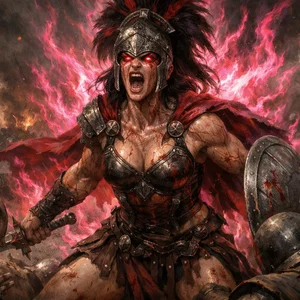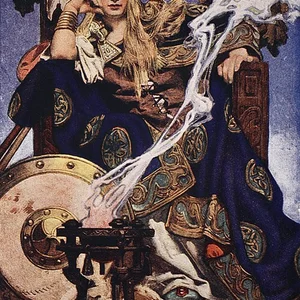

Legendary queen of Connacht in Irish mythology. A central figure of the Ulster Cycle, she leads the great cattle raid of the Táin Bó Cúailnge to seize the Brown Bull of Cooley. She embodies sovereignty, war, and fertility in the Celtic tradition.
Medb
Medb
8 min read
Frequently asked questions
Key Facts
- Medb is queen of Connacht and a central figure of the Ulster Cycle, the great body of Irish epic literature
- She triggers the war of the Táin Bó Cúailnge in order to seize the Brown Bull of Cooley
- She faces the hero Cúchulainn, the only defender of Ulster capable of standing against her army
- Personification of Irish sovereignty: legitimate kings had to symbolically unite with her to rule
- The manuscripts featuring her (the Book of the Dun Cow) date from the 11th century but reflect much older oral traditions
Works & Achievements
The great Irish epic in which Medb is the primary driving force. She organizes and leads the coalition of the four provinces of Ireland against Ulster to seize the Brown Bull of Cooley, triggering a conflict that shapes the entire Ulster Cycle.
Medb embodies and perpetuates the ancient rite by which no king may rule without her consent. By offering the mead cup to the claimant, she legitimizes royal power and stands as the permanent source of political authority in Connacht.
Before launching the war, Medb attempts to obtain the Bull through diplomacy: she offers land, a chariot, her own friendship, and her daughter in exchange. The failure of this negotiation reveals her political skill as much as her unyielding determination.
Medb achieves the remarkable feat of uniting warriors from Munster, Leinster, Connacht, and the Ulster exiles under a single command, demonstrating exceptional leadership in a politically fragmented world.
Medb imposes single combats at the fords to slow Cú Chulainn and allow her forces to advance toward Cooley. This tactic reveals her military intelligence, even if she ultimately cannot defeat the Ulster hero.
Anecdotes
The Pillow Talk: it all begins one night when Medb and her husband Ailill compare their wealth. Each owns as much as the other… except for one exceptional bull, the White-Horned Bull of Connacht, which refused to belong to a woman and joined Ailill's herd. To restore equality — and prove her superiority — Medb decides to seize the only animal that could rival it: the Brown Bull of Cooley, in the kingdom of Ulster.
Medb was said to run faster than Irish warhorses. This supernatural ability made her a living embodiment of sovereignty: the queen did not flee from her enemies — she outpaced them. In some versions of the myth, merely gazing upon an enemy warrior was enough to strip him of two-thirds of his valor.
The sacred marriage: to be a legitimate king of Connacht, every ruler had to obtain Medb's consent and be united with her. She thus had several successive husbands, including Ailill mac Máta and Eochaid Dála. This tradition reveals her role as a goddess of sovereignty: it was she, not men, who held the right to rule over the land of Ireland.
Medb's death is as remarkable as her life. Furbaide, son of the King of Ulster, would watch her every morning as she bathed in the lake of Inchcleraun. He killed her with a sling shot using a piece of hard cheese — a laughable weapon for so formidable a warrior. Her death symbolizes the reversal of fate: the great queen falls victim to personal vengeance rather than an epic battle.
During the Táin Bó Cúailnge, Medb faces Ulster's army almost single-handedly: the goddess Macha had cursed all Ulster warriors, leaving them as weak as a woman in labor at the moment of greatest danger. Only one man was immune: Cú Chulainn, the teenage hero who alone defended the fords of Ulster, slowing the advance of Medb's army until the Ulstermen could recover their strength.
Primary Sources
"There was never a king over this land," said Medb, "save a man taken by my hand. For my father had given me a singular gift: the province of Connacht. And I never granted my bed without there being beside me a man without fear, without greed, and without jealousy."
"Ailill said: 'It is true, happy is the woman who is wife to the king of a flourishing province.' 'Why do you say that?' asked Medb. 'Because you were better off before you met me than you are now.'"
"Medb gathered the four great provinces of Ireland, and she herself led the Connacht troops. It is said she wore two golden birds upon her shoulders, and that her very presence was enough to strike terror into the enemy ranks."
"Medb of Connacht sat at the king's right hand, and no warrior took his seat before she had taken hers, for the land itself belonged to her."
Key Places
The mythological and historical capital of Connacht, seat of Medb's palace. Rathcroghan is today a major archaeological complex in County Roscommon, comprising more than 240 Iron Age monuments.
The destination of the great expedition in the Táin, where the coveted Brown Bull grazed. This peninsula in County Louth is the flashpoint of the conflict between Connacht and Ulster.
A hilltop overlooking Sligo Bay, crowned by a vast megalithic cairn known as Misgán Médhbh (Medb's butter churn). Irish folk tradition holds it to be the tomb of the legendary queen, buried upright and facing her enemies.
A lake island on Lough Ree where Medb was said to bathe every morning. According to the mythological tradition of the Ulster Cycle, it was here that she was slain by Furbaide.
The legendary capital of the kingdom of Ulster and seat of King Conchobar mac Nessa, Medb's chief adversary. Archaeological excavations have confirmed the site's significance during the Iron Age; throughout the Táin, Medb seeks its destruction.
Typical Objects

Medb travels and fights from a two-wheeled chariot pulled by horses, a symbol of royal and warrior status in Irish Celtic society. Her chariot is described in the Táin as richly decorated, driven by her own charioteer.

A rigid collar made of precious metal, the torque is the distinctive mark of royal rank and divine power among the Celts. Medb wears one as a visible sign of her sovereignty over Connacht.

Her very name means 'she who intoxicates' in Old Irish. The queen's cup is the instrument of the sovereignty ritual: she offers drink to the future king, thereby binding the claimant to the land of Connacht.

Medb is an active warrior who takes part in battles. Her spear symbolizes her dual nature as queen and fighter, breaking down the traditional opposition between femininity and martial violence.

The central object of the great saga, this exceptional bull is the cause of the entire expedition. It represents wealth, virility, and territorial power — and Medb is ready to start a war to seize it.

A large open circular clasp used to fasten the royal cloak, characteristic of Irish Celtic aristocratic dress. On Medb's garment, it is made of gold or richly decorated bronze adorned with La Tène spiral motifs.
School Curriculum
Vocabulary & Tags
Key Vocabulary
Tags
Daily Life
Morning
Medb rises before dawn in her great hall at Cruachan. She bathes in the nearby lake — a habit that will prove fatal, according to myth. Her handmaidens dress her: a gold torc, a bronze fibula, a dyed wool tunic. She consults her druids on omens before making any important decision.
Afternoon
The afternoon is devoted to the affairs of the kingdom: audiences with warriors and clan chiefs, negotiating alliances, inspecting the royal herds. During the Táin campaign, she oversees the advance of her army from her chariot, personally directing military strategy.
Evening
In the evening, Medb presides over feasts in the great wooden hall of Cruachan. The bard recounts the day's martial exploits. She distributes rewards and lands to valiant warriors, affirming her generosity — one of the cardinal virtues of a Celtic ruler. At night, she receives ambassadors in private.
Food
The aristocratic Irish diet of the Iron Age: roasted beef and pork as the centrepiece of royal feasts, game, fish from lakes and rivers, barley bread, cheese and butter. Mead — a fermented honey drink — holds a central place, both as an everyday beverage and as a ritual instrument of sovereignty.
Clothing
A long, finely dyed wool tunic (saffron, crimson, madder purple), cinched with a leather belt fitted with bronze clasps. A heavy double-layered wool cloak fastened by a gold penannular brooch. A solid gold torc at the neck, spiral rings on the arms. Soft leather shoes. Vivid colours and precious metals signal royal rank and divine favour.
Housing
Medb resides in the palace of Cruachan, the political and symbolic heart of Connacht. Built in heavy timber: a great central hall with an open hearth on the floor, decorated beams, and wattle-and-daub partition walls. Outbuildings house warriors, craftsmen, and druids. The site is defended by earthen ramparts and palisades. The great hall serves at once as a court of justice, a feasting hall, and a place of worship.
Historical Timeline
Period Vocabulary
Visual Style
Style illustration épique celtique : Medb en reine guerrière à la chevelure flamboyante, torque d'or, manteau cramoisi, devant les collines brumeuses du Connacht avec motifs entrelacés de La Tène.
Sound Ambience
Les sons du Connacht mythologique : chars de guerre dans la brume irlandaise, troupeaux de bœufs, carnyx résonnant sur les collines, barde récitant le Táin dans la grande salle de Cruachan.
Liens externes & ressources
Références
Œuvres
Le Táin Bó Cúailnge (Le Raid des Vaches de Cooley)
Composition orale ~Ier-IIIe s. ; mise par écrit ~700-1100
Institution du rite de la souveraineté du Connacht
Mythologie irlandaise préhistorique
Négociation diplomatique avec Dáire mac Fiachna
Récit du Táin
Alliance des quatre provinces d'Irlande
Récit du Táin
Stratégie des duels singuliers aux gués contre Cú Chulainn
Récit du Táin