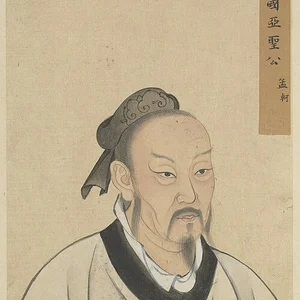

Mencius was a Chinese philosopher of the 4th century BCE, considered the second great sage of Confucianism after Confucius. He developed the idea that human nature is fundamentally good and that a legitimate ruler must govern with benevolence. His work, the Mengzi, is one of the Four Books of the Confucian canon.
Mencius(371 av. J.-C. — 288 av. J.-C.)
Mencius
État Zou
8 min read
Frequently asked questions
Famous Quotes
« Man's nature is naturally good, just as water naturally flows downward.»
« The people are the most important element in a nation; the spirits of the land and grain come next; the sovereign counts the least.»
Key Facts
- Born around 371 BCE in the state of Zou (present-day Shandong province, China)
- A follower of Confucian thought, transmitted through the school of Zisi (Confucius's grandson)
- Traveled from court to court advising rulers on the art of governing with virtue
- Championed the theory of the innate goodness of human nature (xing shan)
- Died around 288 BCE; his conversations were compiled in the Mengzi, ranked among the Four Books of Confucianism
Works & Achievements
A collection of dialogues between Mencius, his disciples, and various rulers, organized into seven books. It is the foundational work of classical Confucianism, incorporated into the canon of the Four Books by Zhu Xi in the 12th century.
The first book of the Mengzi, devoted to exchanges with the king of Wei on benevolence, righteousness, and good governance. It illustrates Mencius's central political vision: the legitimate ruler governs for the benefit of the people.
A major theoretical development on the innate goodness of human nature, articulated around four natural dispositions: compassion, shame, modesty, and moral discernment. This is a foundational text of Confucian anthropology.
A passage in which Mencius asserts that a tyrannical ruler forfeits his heavenly mandate and may legitimately be overthrown. This bold idea profoundly influenced Chinese political philosophy for two millennia.
Anecdotes
Mencius's mother is famous for having moved three times in search of the best environment for her son's education. She finally settled near a school, believing that proximity to learning was essential to the formation of character. This story, known as 'Mencius's mother moves three times,' has remained a model of education in China.
Mencius once refused a sum of gold offered by the King of Qi in gratitude for his teachings. He explained that accepting a gift without legitimate cause would be a form of corruption of the soul. This episode illustrates his commitment to moral integrity above any material consideration.
During an audience with King Hui of Liang, the king asked Mencius how to enrich his kingdom. Mencius replied that a king should not think about profit, but about benevolence and justice. This bold answer shocked the ruler, yet it sums up the entire political philosophy of Mencius.
Mencius once compared a man who neglects the cultivation of his mind to a farmer who yanks his young seedlings upward to make them grow faster — and kills them in doing so. This metaphor emphasized that virtue must develop naturally, without forcing or rushing.
Mencius traveled from court to court for years, trying to persuade rulers to govern with humanity (ren). None truly listened, and he eventually withdrew to teach and compile his dialogues with his disciples. His journey echoes that of Confucius, his primary spiritual reference.
Primary Sources
King Hui of Liang said: 'Old man, you have not considered the distance too great to come here. You surely bring something profitable for my kingdom?' Mencius replied: 'Why speak of profit? What matters is benevolence and righteousness.'
Mencius said: 'Human nature is good, just as water naturally flows downward. There is no man who is not good, just as there is no water that does not flow downward.'
Mencius said: 'I have heard that a man named Zhou (the last Shang king) was killed. I have not heard that a king was killed.' A ruler who betrays benevolence and righteousness is no longer a king but merely a common man.
Mencius said: 'Compassion is the sprout of benevolence; shame is the sprout of righteousness; modesty is the sprout of propriety; the sense of right and wrong is the sprout of wisdom. Every man possesses these four sprouts within himself.'
Key Places
Mencius's birthplace, a small vassal principality of Lu where he was born and spent his childhood. It was here that his celebrated mother watched over his education, moving several times to shield him from bad influences.
Capital of the state of Wei, where Mencius stayed and engaged in his first major political dialogues recorded in the Mengzi. It was here that he formulated his celebrated response on benevolence versus profit.
Capital of the state of Qi, one of the most powerful kingdoms of the era, where Mencius held the greatest hope of finding a ruler receptive to his ideas of humane governance. He resided there for several years.
An exceptional intellectual center founded by the kingdom of Qi, where thinkers from the Hundred Schools of Thought gathered. Mencius debated his Confucian ideas there against the arguments of Legalists, Mohists, and Taoists.
A commemorative complex built in honor of Mencius as early as the Han dynasty and expanded under the Song and Ming dynasties. It remains a major historical site today and stands as a testament to the status of 'Second Sage' bestowed upon Mencius.
Typical Objects

The primary writing medium of the era, bamboo tablets were bound together with cords to form scrolls. The Mengzi was most likely composed and transmitted on this medium before being transcribed onto silk and later paper.

Essential tools of the Confucian scholar, a brush dipped in black ink was used to calligraph philosophical and administrative texts. Mastery of writing was a mark of culture and virtue for a gentleman (junzi).

A long, loose garment made of silk or linen, characteristic of Confucian scholars, embodying in its very appearance the ideals of dignity and moral rectitude. Mencius placed great importance on outward dress as a reflection of inner virtue.

A foundational divinatory and philosophical text that Mencius and his contemporaries knew and commented upon. It represented the ancestral wisdom of the Zhou dynasty to which Confucians constantly referred.

The mode of transport Mencius used during his journeys from court to court. He traveled with a retinue of disciples, just as Confucius had done before him, to spread his ideas among the rulers of the day.

A symbol of political legitimacy and ancestral piety, present in every court of the Warring States period. For Mencius, the ancestral rites embodied by these objects were inseparable from good governance.
School Curriculum
Vocabulary & Tags
Key Vocabulary
Daily Life
Morning
Mencius rose at dawn to perform ancestral offering rites, a central practice of Confucian piety. He then devoted himself to reading and meditating on the classical texts, particularly the Book of Odes and the Book of Documents. The morning was reserved for personal study before receiving his disciples.
Afternoon
The afternoon was dedicated to oral teaching: Mencius answered his students' questions, commented on ancient texts, and discussed the political and moral issues of the day. During his stays at court, he granted audiences to royal advisors or waited to be received by the ruler in order to present his views.
Evening
In the evening, Mencius dined simply with his closest disciples and extended philosophical discussions in an informal setting. He might dictate reflections to his students, who recorded them on bamboo tablets. As night fell, the closing rites of the day — ablutions and prayers — marked the end of all activity.
Food
Mencius's diet followed Confucian precepts of moderation: rice, millet, vegetables, soybean tofu, and occasionally fish or meat at ritual banquets. Out of compassion (ren), he refused to eat the flesh of any animal whose dying cries he had heard. Tea was not yet widespread; people drank broths made from fermented grains instead.
Clothing
Mencius wore the long scholar's robe (ru fu), consisting of a loose gown in linen or silk depending on the season, fastened with a leather belt adorned with jade. The color and quality of the fabric varied by occasion: plain and simple for teaching, more formal for royal audiences. A ceremonial cap completed the outfit during rites.
Housing
During his years of travel, Mencius lodged in residences provided by the courts he visited — sometimes luxurious lacquered wood pavilions with curved roofs. Back in his home state of Zou, he lived in a modest dwelling of wood and fired earth, surrounded by a garden where his disciples gathered to study. The interior was furnished with low woven mats, a lacquered table, and shelves holding bamboo scrolls.
Historical Timeline
Period Vocabulary
Visual Style
Style peinture à l'encre de Chine, inspiré des représentations Han : érudit en robes cérémonieuses dans un pavillon ouvert sur un paysage de montagne brumeuse, palette sobre de noirs, verts jade et terres chaudes.
Sound Ambience
Ambiance sonore d'une cour royale chinoise au IVe siècle av. J.-C. : cloches rituelles en bronze, bruissement de soie, récitation des classiques par les étudiants et rumeurs lointaines des armées en campagne.
Liens externes & ressources
Références
Œuvres
Mengzi (孟子)
vers 300 av. J.-C.
Dialogues avec le roi Hui de Liang (Livre I)
vers 320 av. J.-C.
Théorie des quatre germes (Livre II)
vers 310 av. J.-C.
Doctrine du Mandat du Ciel et du droit de révolte (Livre I B)
vers 310 av. J.-C.
See also
Related Characters
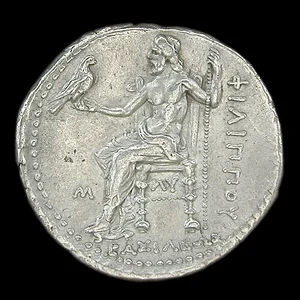
Alexander II of Macedon
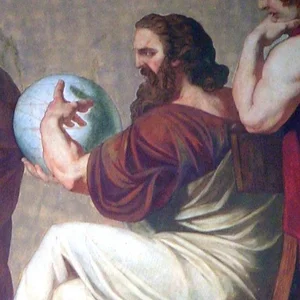
Anaxagoras of Clazomenae
499 av. J.-C. — 427 av. J.-C.
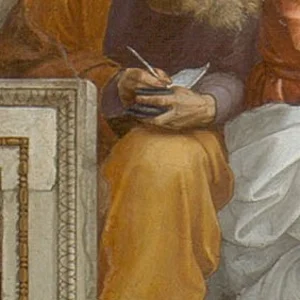
Anaximander
609 av. J.-C. — 545 av. J.-C.
Aspasia
469 av. J.-C. — 399 av. J.-C.
Catiline
107 av. J.-C. — 61 av. J.-C.
Confucius
550 av. J.-C. — 478 av. J.-C.