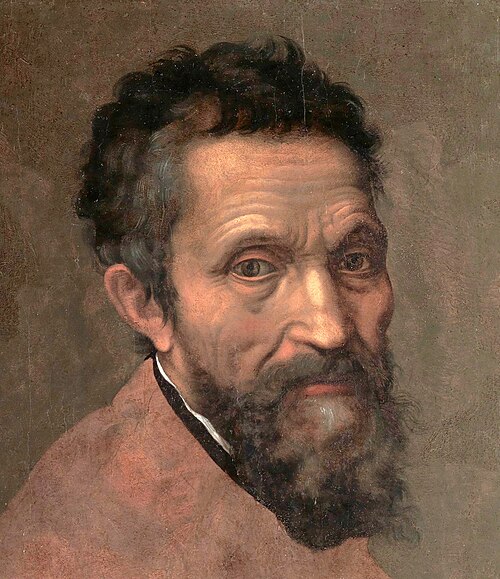
Michelangelo Buonarroti
Michelangelo Buonarroti
1475 — 1564
République florentine
Michelangelo Buonarroti (1475–1564) was a Florentine Renaissance artist, considered one of the greatest geniuses in the history of art. Painter, sculptor, architect, and poet, he created masterpieces such as the Sistine Chapel ceiling and the statue of David.
Famous Quotes
« Sculpture is the art of taking away, removing everything that is superfluous. »
« I saw the angel in the marble and carved until I set him free. »
Key Facts
- 1475: Born in Caprese, near Arezzo, in Tuscany
- 1501–1504: Created the statue of David for the city of Florence
- 1508–1512: Painted the ceiling of the Sistine Chapel in Rome for Pope Julius II
- 1536–1541: Painted The Last Judgment on the altar wall of the Sistine Chapel
- 1564: Died in Rome at the age of 88
Works & Achievements
A marble sculptural group depicting the Virgin Mary holding the body of Christ. A prodigious early work and the only sculpture Michelangelo ever signed, carving his name on Mary's sash.
A 17-foot marble colossus depicting the biblical hero before his battle. A symbol of Florentine freedom and the absolute standard of male beauty in the Renaissance.
A monumental fresco spanning over 500 square meters depicting scenes from Genesis, including the celebrated Creation of Adam. The pinnacle of fresco painting, executed by Michelangelo almost entirely alone.
A marble sculpture of extraordinary expressive power, embodying the concept of terribilità so characteristic of Michelangelo. Stendhal wrote of being struck by an overwhelming aesthetic shock upon seeing it.
A monumental fresco on the altar wall of the Sistine Chapel depicting the resurrection of the dead and the final judgment. A mature work in a more tormented style, considered a forerunner of Mannerism.
Michelangelo designed the drum and dome of the largest basilica in Christendom. The dome was completed after his death but faithfully followed his plans.
A collection of sonnets and madrigals reflecting a profound Neoplatonic vision of love, beauty, and death. A testament to Michelangelo's recognition as a major poet of the Renaissance.
Anecdotes
Michelangelo long refused the commission for the Sistine Chapel, insisting he was a sculptor, not a painter. Pope Julius II pressed so firmly that the artist finally relented. Working alone, lying on scaffolding for four years (1508–1512), he endured chronic neck and eye pain, yet produced one of the greatest frescoes in history.
The statue of David (1501–1504) was carved from a block of marble that other sculptors had already begun and abandoned, deeming it unusable. Michelangelo accepted the challenge and delivered a 5.17-meter masterpiece regarded as the symbol of human perfection. The Florentines were so awestruck that they debated for weeks over where to place it.
Michelangelo lived to the age of 88 — an exceptional lifespan for his era. He was still working on the Rondanini Pietà just days before his death in 1564. He led a frugal life, sleeping little and eating sparingly, devoting the bulk of his energy to his art.
At the age of 13, Michelangelo entered the workshop of the painter Ghirlandaio, where his talent scandalized his fellow students: he would touch up his masters' drawings and improve them. Lorenzo de' Medici, known as the Magnificent, recognized his genius so quickly that he invited him to live in his palace and study alongside the greatest intellectuals of Florence.
Primary Sources
Michelangelo Buonarroti, a Florentine, was endowed by Divine Providence with a universal genius superior to anything seen before. He excelled in sculpture, painting, and architecture, surpassing not only the moderns but the Ancients as well.
Non ha l'ottimo artista alcun concetto / ch'un marmo solo in sé non circonscriva / col suo superchio, e solo a quello arriva / la man che ubbidisce all'intelletto. (The best artist has no conception that a single block of marble does not already contain within itself; only the hand that obeys the intellect can release it.)
I live here in great distress and with extreme physical exhaustion, without a friend or any comfort of any kind, and I do not wish to have any. I do not even have time to eat what I need.
Michelangelo declared that good painting is nothing other than a copy of the perfections of God and a reflection of His painting; it is ultimately a music and a melody that only the intellect can understand.
Key Places
It was in this garden that the young Michelangelo was discovered by Lorenzo de' Medici and introduced to ancient sculpture. This place was the cradle of his artistic training.
Michelangelo painted the famous ceiling (1508–1512) and later The Last Judgment (1536–1541) here. This is the place that best embodies the full expression of his genius.
It is home to the original David (1501–1504), a masterpiece of Renaissance sculpture and a symbol of the Florentine Republic.
Michelangelo served as its chief architect from 1546 and designed the monumental dome that still dominates the Rome skyline today.
Michelangelo sculpted the Medici tombs here and designed the architecture of the funerary chapel — a space where sculpture, architecture, and philosophy merge into one.
Gallery

Michelangelo Buonarroti (1475–1564) title QS:P1476,en:"Michelangelo Buonarroti (1475–1564) "label QS:Len,"Michelangelo Buonarroti (1475–1564) "label QS:Lit,"Michelangelo Buonarroti"label QS:Lde,"Mich
Wikimedia Commons, CC0 — Attributed to Daniele da Volterra

Michelangelo Buonarroti (1475–1564) title QS:P1476,en:"Michelangelo Buonarroti (1475–1564) "label QS:Len,"Michelangelo Buonarroti (1475–1564) "label QS:Lit,"Michelangelo Buonarroti"label QS:Lde,"Mich
Wikimedia Commons, Public domain — Attributed to Daniele da Volterra

“I’ ho già fatto un gozzo” (“I’ve Grown a Goitre”) – Michelangelo
Wikimedia Commons, Public domain — Michelangelo Buonarroti

Michelangelo Sculpting the Statue of 'Night'
Wikimedia Commons, Public domain — Joseph Noel Paton

Michelangelo Buonarroti
Wikimedia Commons, Public domain — Stefano Ussi

Plaster cast of the Pieta of Michelangelo, Museo dell'Opera del Duomo, Florence, 223886
Wikimedia Commons, CC BY-SA 4.0 — Zde

Plaster cast of the Pieta of Michelangelo, Museo dell'Opera del Duomo, Florence, 223887
Wikimedia Commons, CC BY-SA 4.0 — Zde

Plaster cast of the Pieta of Michelangelo, Museo dell'Opera del Duomo, Florence, 223889
Wikimedia Commons, CC BY-SA 4.0 — Zde

Escultura de yeso de Moisés
Wikimedia Commons, CC BY-SA 4.0 — Geyuvaan

Michelangelo being Shown the Belvedere Torsolabel QS:Len,"Michelangelo being Shown the Belvedere Torso"label QS:Leu,"Michelangelo bere tailerrean"label QS:Lfr,"Michel-Ange dans son atelier"
Wikimedia Commons, Public domain — Jean-Léon Gérôme