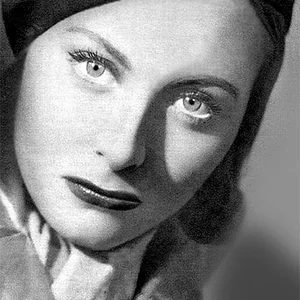

French actress born in 1920, Michèle Morgan is one of the greatest stars of French cinema. Discovered by Marcel Carné in Port of Shadows (1938), she won the Best Actress award at Cannes in 1946 for Pastoral Symphony.
Michèle Morgan(1920 — 2016)
Michèle Morgan
France
9 min read
Frequently asked questions
Famous Quotes
« I have beautiful eyes, you know.»
Key Facts
- Born on February 29, 1920, in Neuilly-sur-Seine
- Breakthrough role in Marcel Carné's Port of Shadows (1938)
- First Best Actress award at Cannes in 1946 for Pastoral Symphony
- International career in Hollywood during World War II
- Died on December 20, 2016, at the age of 96
Works & Achievements
Marcel Carné's film starring Jean Gabin, considered the masterpiece of French poetic realism. Michèle Morgan plays Nelly, a mysterious young woman, in an atmosphere of fatalism and melancholy that became iconic of 1930s cinema.
Jean Grémillon's film begun in 1939 but released in 1941 due to the war, in which Michèle Morgan stars opposite Jean Gabin in a poignant maritime drama. Considered one of the major French films of the Occupation period.
Michèle Morgan's first major Hollywood role for RKO Pictures, in which she plays a French woman helping Allied airmen during the Occupation. The film opened the doors of the international market to her during her American exile.
Jean Delannoy's adaptation of André Gide's novel, in which Michèle Morgan plays a blind girl taken in by a Protestant pastor. The role earned her the first Best Actress award in the history of the Cannes Film Festival.
René Clair's film in which Michèle Morgan plays a provincial milliner opposite a military seducer played by Gérard Philipe. One of the greatest box-office successes of her career, praised for the subtlety of her performance.
An autobiography in which Michèle Morgan recounts her early career in film, her American exile, and her vision of the acting profession. A valuable document on the golden age of French cinema and the inner workings of Hollywood in the 1940s.
Anecdotes
On the set of Port of Shadows (1938), Jean Gabin improvised opposite Michèle Morgan the line that would become iconic: “You've got beautiful eyes, you know.” This phrase did not appear in Jacques Prévert's original screenplay — it arose naturally between the two actors. It encapsulates on its own the alchemy of French poetic realism and remains one of the most famous quotes in the entire history of cinema.
In 1940, sensing the danger of the German Occupation, Michèle Morgan left France for the United States. She would be one of the few major French stars to continue her career in Hollywood, appearing notably in Joan of Paris (1942). Her absence from occupied France earned her some criticism at the Liberation, but she had flatly refused to work under Nazi control.
In September 1946, the very first Cannes Film Festival awarded a Best Actress prize for the first time. Michèle Morgan received it for her role in Pastoral Symphony by Jean Delannoy, becoming the first woman officially crowned at Cannes — a historic distinction in the history of world cinema.
Her real name is Simone Roussel. It was a producer who suggested she adopt a more “cinematic” stage name for her debut in the 1930s. She chose Michèle Morgan, a name she would carry throughout her life and which would become synonymous with elegance, mystery, and melancholy in the French collective imagination.
Toward the end of her career, Michèle Morgan also devoted herself to painting and exhibited her canvases in Parisian galleries. She declared that she found in this art “a freedom that cinema does not always give” — revealing an unsuspected creative side to the star, beyond the film set.
Primary Sources
I never really chose to become an actress. It was cinema that chose me, almost in spite of myself, one day when I was fifteen and walking near the studios.
Michèle Morgan receives the Best Actress award for La Symphonie pastorale, to the applause of an audience won over by the subtlety and restraint of her performance.
Port of Shadows is my youth. Jean Gabin was extraordinarily generous on set. That line about the beautiful eyes? It just came out naturally, between us.
Cinema gave me everything. But it is the French public that has always carried me, even when I was on the other side of the world.
Key Places
A affluent suburb on the western edge of Paris where Michèle Morgan was born on February 29, 1920, and where she died on December 20, 2016. She spent much of her life there, in a comfortable, bourgeois setting just outside the capital.
A legendary center of French cinema from the 1930s to the 1960s, these studios hosted the filming of *Port of Shadows* and many other golden-age classics. Michèle Morgan worked alongside Marcel Carné, Jean Gabin, and the greatest names in French cinema here.
During World War II (1940–1949), Michèle Morgan went into exile in Hollywood, where she appeared in several American films. This period brought her international recognition while allowing her to escape Nazi censorship and propaganda.
It was in Cannes, in September 1946, at the very first International Film Festival, that Michèle Morgan received the festival's inaugural Best Actress award for *Pastoral Symphony* — a historic moment for world cinema.
Michèle Morgan was a familiar face in the postwar intellectual and artistic scene of Saint-Germain-des-Prés, moving among existentialists, filmmakers, and cultural figures whose work gave Paris its international reputation.
Typical Objects
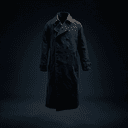
In *Port of Shadows* (1938), Michèle Morgan wears a trench coat that became one of the most iconic costumes in French cinema. This garment symbolizes at once the modernity, vulnerability, and mystery of the female character in poetic realism.

An indispensable tool on golden-age film sets, the clapperboard synchronizes image and sound in the era of talking pictures, which emerged in 1927. It embodies the technical rigor of the productions from the 1930s to 1960s in which Michèle Morgan appeared.

Studios in the 1930s–1950s used heavy, bulky 35mm cameras requiring several technicians. These devices captured the greatest scenes of classic French and Hollywood cinema in which Michèle Morgan performed.

Screenplays in classic cinema were typed on typewriters and annotated by hand by actors and directors. Michèle Morgan worked with the greatest writers — Jacques Prévert, Jean Aurenche — whose scripts are today considered precious literary documents.

In 1946, the first Best Actress award at the Cannes Film Festival, received by Michèle Morgan, represented the consecration of European auteur cinema. This trophy symbolizes the French cultural renaissance after the Second World War.
Classic black-and-white film makeup followed precise technical constraints, adapted to panchromatic film stock. Actresses worked with professional makeup artists so that skin tones would appear natural on screen.
School Curriculum
Vocabulary & Tags
Key Vocabulary
Daily Life
Morning
On film sets, Michèle Morgan arrived at the studio at dawn for hair and makeup sessions that could last several hours. Black-and-white cinema makeup required rigorous technical precision, handled by professional makeup artists. Rehearsals with the director took place in the early morning before the first takes.
Afternoon
Afternoons were devoted to the actual shooting, often repeated many times until the desired shot was achieved. Actors had to remain available between scenes, in their dressing rooms, ready to return to the set at any moment. Long waits and unexpected technical issues were an integral part of daily life for a classic-era film star.
Evening
Away from the set, Michèle Morgan frequented society dinners, film premieres, and the social gatherings of postwar Parisian artistic circles. She maintained warm friendships with leading figures of French culture after the Liberation. During her Hollywood years, her evenings brought her into contact with American stars at villas in Beverly Hills.
Food
Like many actresses mindful of their figure for the demands of cinema, Michèle Morgan followed a light, balanced diet. Traditional French cuisine — bourgeois family meals, Parisian cafés — shaped her life off set. During her California exile, she discovered American gastronomy and the eating habits of Hollywood stars.
Clothing
In everyday life, Michèle Morgan wore the elegant outfits typical of Parisian fashion from the 1940s to the 1960s: fitted suits, structured dresses, and classically cut coats. Her film costumes, carefully designed by the leading couturiers of the era, helped forge her image as a timeless style icon.
Housing
Michèle Morgan lived mainly in Neuilly-sur-Seine and Paris, in the comfortable apartments typical of the French cultural bourgeoisie. During her Hollywood years, she resided in the sought-after residential neighborhoods favored by American film stars in Beverly Hills, far from the occupied Paris she had been forced to leave.
Historical Timeline
Period Vocabulary
Liens externes & ressources
Références
Œuvres
La Symphonie pastorale
1946