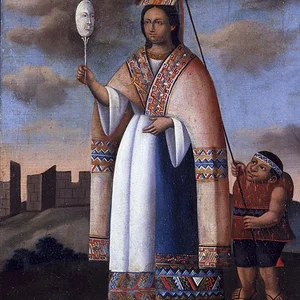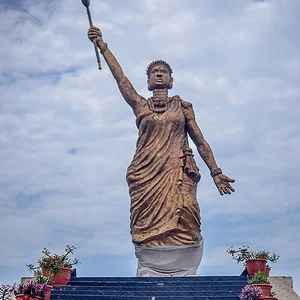

Legendary heroine of the Yoruba people of Ilé-Ifè (present-day Nigeria), a figure of African oral tradition. According to legend, she sacrificed herself to infiltrate the ranks of Ifè's enemies and liberate her people through cunning and courage.
Moremi Ajasoro
Moremi Ajasoro
Nigeria
9 min read
Frequently asked questions
Famous Quotes
« "It is for my children and for my people that I give what I hold most dear." (words attributed by Yoruba oral tradition at the time of her son Oluorogbo's sacrifice)»
Key Facts
- According to Yoruba oral tradition, Moremi lived in Ilé-Ifè, the sacred city considered the cradle of the Yoruba people, most likely between the 11th and 13th centuries
- She is said to have allowed herself to be captured by the Igbo invaders (referring here to an enemy group in the tradition of Ifè) in order to discover the secret of their military power
- She discovered that the invaders' terrifying costumes were made of raffia and dried grass, making them vulnerable to fire, and passed this information on to her people
- In exchange for her mission, she had promised a great sacrifice to the river goddess Esinmirin; she sacrificed her only son Oluorogbo to keep her word
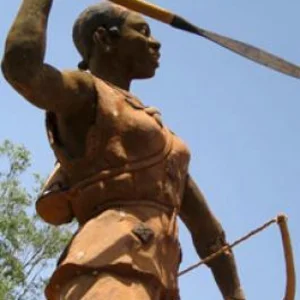
- She is celebrated every year during the Edi festival in Ilé-Ifè (Nigeria); a monumental statue in her honor stands on the campus of Obafemi Awolowo University
Works & Achievements
Moremi's founding act: by infiltrating the enemy camp and revealing the vulnerability of the Igbo warriors, she enabled her people to free themselves once and for all from a threat that had terrorized them for generations.
The annual Edi festival, created in honor of Moremi, is a living celebration that keeps her memory alive in Ilé-Ifè to this day, weaving together rituals, songs, and commemoration of her sacrifice.
A founding moral act of the Yoruba tradition of Ifè: by sacrificing her only son to honor her promise to the deities, Moremi embodies the value of keeping one's word and the primacy of the common good over personal love.
By revealing the technique of using torches against the enemy's fiber costumes, Moremi pioneered a form of military intelligence based on espionage and observation — a tactical as much as a heroic legacy.
Passed down from generation to generation by Yoruba griots and priests, the epic of Moremi is a major work of oral literary heritage, teaching courage, wisdom, and self-sacrifice for the community.
Anecdotes
Moremi Ajasoro lived in Ilé-Ifè at a time when the city was regularly devastated by mysterious raiders known as the Igbo (or Ugbo), whose warriors wore costumes made of plant fibers and seemed invincible. The people of Ifè took them for forest spirits, and no soldier dared confront them for fear of their supernatural appearance.
Desperate to end her people's suffering, Moremi went to the Esimirin River and made a solemn vow to the water goddess: if she granted her the strength and fortune to uncover the enemy's secrets, she would offer her most precious possession in return. The river accepted the pact. Moremi deliberately allowed herself to be captured during a raid and was taken to the enemy camp as a prisoner.
Inside the Igbo camp, Moremi managed to win the favor of their chief, who made her his wife. She patiently observed their fighting techniques and discovered their weakness: their terrifying costumes of dry leaves and raffia would instantly catch fire when exposed to flames. Returning to Ifè, she shared this secret with her people. The warriors of Ifè, armed with torches, drove the invaders away for good.
When the time came to honor her vow to the Esimirin River, Moremi realized with heartbreak that her most precious possession was her only son, Oluorogbo. According to tradition, she kept her word nonetheless and sacrificed the child. This tragic act is regarded as the ultimate expression of her heroism: giving everything — even her most beloved — for the salvation of her community.
In memory of Moremi, the city of Ilé-Ifè established the Edi festival, an annual celebration during which the people commemorate her courage and sacrifice. A monumental statue of Moremi Ajasoro, unveiled in 2017, now stands at the heart of Ile-Ife, depicting the goddess holding a torch and her son — symbols of her twofold offering to the Yoruba people.
Primary Sources
The babalawo of Ilé-Ifè preserve within the Ifá corpus odù (oral chapters) that describe Moremi as a woman of virtue and sacrifice, sent by the gods to save Ifè from its enemies.
During the Edi festival, liturgical chants recount Moremi's sacrifice and her pact with the Esimirin river. These chants are passed down by priests and elder women of the sacred city.
Samuel Johnson records Yoruba traditions relating to Moremi Ajasoro, portraying her as a founding heroine whose sacrifice lies at the heart of Ilé-Ifè's identity.
The akéwì, Yoruba poets and griots, carry Moremi's epic through their public performances, highlighting her intelligence, cunning, and devotion to her community above even maternal love.
Key Places
Sacred city considered the cradle of the Yoruba people, and the heart of Moremi Ajasoro's life and deeds. This is where the enemy raids took place, where Moremi returned in triumph, and where the Edi festival is held in her memory.
A sacred river near Ilé-Ifè where Moremi made her vow to the water goddess before setting out on her mission. This site is regarded as a point of contact between the human world and the realm of the divine spirits (orisa).
An iconic sacred forest embodying Yoruba spirituality, inscribed on the UNESCO World Heritage List, illustrating the type of sacred forest environment where rituals and sacrifices took place during Moremi's era.
The residence of the Ooni (sacred king) of Ilé-Ifè, the seat of power and decision-making for the Yoruba people. It was before the Ooni that Moremi revealed her plan and her secret, changing the fate of the city forever.
Typical Objects

The central symbol of Moremi's victory: it was through her knowledge of the enemies' flammable costumes that the warriors of Ife were able to use fire as a weapon. The torch represents the intelligence and the light Moremi brought to her people.

A ritual terracotta vessel used to place offerings at the sacred Esimirin River. It was there that Moremi went to make her solemn vow before her infiltration mission.

A plant-based armor worn by the enemies of Ife to mimic the appearance of forest spirits. Moremi uncovered its secret, turning this symbol of terror into an exploitable vulnerability.

Coral and bead ornaments worn by high-ranking women in Ile-Ife. As the wife of an enemy chief and later a celebrated heroine, Moremi is depicted adorned with these marks of dignity.

A staple of everyday Yoruba life, central to the preparation of pounded yam (iyan), a dietary staple. It symbolizes the domestic and communal life that Moremi chose to defend at the cost of her own son.

A Yoruba percussion instrument used during ceremonies and festivals to convey messages and stories. The Edi festival held in honor of Moremi is accompanied by ritual drumming.
School Curriculum
Vocabulary & Tags
Key Vocabulary
Tags
Daily Life
Morning
Moremi rose at dawn in her compound (agbo-ile), a sprawling cluster of mud-walled, thatched-roof dwellings housing the extended family. She would begin with devotions to the orisa (Yoruba deities), pouring a libation of water or palm wine onto the ground while reciting prayers. She then joined in communal chores: drawing water from the well or river, and preparing the morning meal of maize porridge (ogi) or yam.
Afternoon
Afternoons were devoted to city affairs and trading at the market, the central hub of social life in Yoruba culture. As a woman of high standing, Moremi took part in community matters and collective decision-making. Afternoons might also be spent preparing slow-cooked stews — egusi, efo riro — made from vegetables, seeds, and dried meat simmering over a wood fire.
Evening
Evenings brought the extended family together around the fire in the compound's central courtyard. This was the time for oral storytelling, when elders and griots passed down history, myths, and proverbs to younger generations. Nighttime protection rites were performed, including offerings to ancestral spirits (egúngún). On festival nights, dundún drums would ring out, bringing the community together for dancing and celebration.
Food
Medieval Yoruba cooking centered on pounded yam (iyan) and maize flour (ogi), served alongside thick soups — egusi made with melon seeds, efo with leafy greens, and banga with palm oil. Game meat, dried fish, and legumes provided protein. Palm oil and okra were staples throughout, and everything was seasoned with Guinea pepper and local spices.
Clothing
Moremi wore woven cotton wraps dyed in indigo, a color of nobility in Yoruba tradition, draped around the body according to the codes of her rank. She adorned herself with coral bead necklaces — a mark of dignity and connection to the divine — along with bronze and ivory bracelets. An aso-oke (handwoven prestige cloth) might drape her shoulders during ceremonies. Her hair was carefully styled in braids or rolls following Yoruba aesthetic traditions.
Housing
The Yoruba compound (agbo-ile) was a grouping of rectangular or round mud-brick (banco) structures with roofs of straw or raffia leaves, arranged around a shared central courtyard. Walls might be decorated with incised geometric patterns or natural pigments such as ochre and kaolin white. The interior space included a food storage area, an open-air cooking area, and a dedicated space for ancestral and orisa shrines.
Historical Timeline
Period Vocabulary
Visual Style
Esthétique inspirée des bronzes et terres cuites d'Ifè : tons ocre, terre de Sienne et vert forêt, parures de corail, lumière de torche sur des architectures en banco, gravité et noblesse d'une héroïne yoruba.
Sound Ambience
Ambiance sonore d'Ilé-Ifè médiévale : percussions rituelles yoruba, pilonnage de l'igname, fleuve sacré et forêt tropicale dense, chants cérémoniels et crépitement du feu nocturne.
Liens externes & ressources
Références
Œuvres
Libération d'Ilé-Ifè des raiders Igbo
vers XIe–XIIIe siècle
Institution du festival Edi (Ìdí)
vers XIIe–XIIIe siècle
Sacrifice d'Oluorogbo au fleuve Esimirin
vers XIIe–XIIIe siècle
Transmission du savoir stratégique aux guerriers d'Ifè
vers XIIe–XIIIe siècle
Épopée orale de Moremi Ajasoro
Tradition orale, depuis le XIIe–XIIIe siècle