
The nine Muses are the daughters of Zeus and Mnemosyne in Greek mythology. Goddesses of the arts and sciences, they inspire poets, musicians, and scholars. Calliope, Clio, Erato, Euterpe, Melpomene, Polyhymnia, Terpsichore, Thalia, and Urania each preside over an artistic or intellectual domain.
Muses
Muses
9 min read
Frequently asked questions
Key Facts
- Nine Muses born of Zeus and Mnemosyne (goddess of Memory)
- Hesiod names them and describes their attributes in the *Theogony* (c. 700 BCE)
- Homer invokes the Muse in the opening lines of the *Iliad* and the *Odyssey*
- The word “music” derives directly from their name
- Associated with Mount Helicon and the Hippocrene spring in Boeotia
Works & Achievements
The first text to establish the names and domains of the nine Muses in Greek literature. Hesiod recounts his encounter with them on Mount Helicon and their gift of inspiration, establishing the model of poetic invocation that would carry through all of ancient literature.
Masterpiece of Greek epic poetry, opening with the invocation "Sing, O goddess, the wrath of Achilles." This formula of calling upon the Muse would become the obligatory model for every epic in Greco-Roman and later European literature.
A collection of poems in honor of the Greek gods, several of which directly celebrate the Muses and their patron Apollo. These hymns describe the dancing and singing of the Muses on Olympus and their role as inspirers of sacred poetry.
A set of lyric poems celebrating victories at the Pythian Games at Delphi, in which Pindar regularly invokes the Muses to affirm the excellence of his own art and the legitimacy of the victors he glorifies.
In these philosophical dialogues, Plato develops his theory of poetic frenzy: poets do not create through their own genius but are possessed by the Muses who speak through them — a view that shaped the whole of Western aesthetic thought.
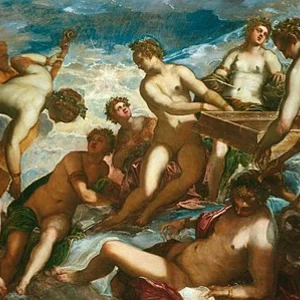
The story of the famous singing contest between the Muses and the nine Pierides who dared to challenge them. Calliope sings the glory of Ceres, and the defeated Pierides are transformed into magpies — a celebrated allegory of hollow imitation in the face of genuine inspiration.
Anecdotes
Zeus united with Mnemosyne, goddess of Memory, for nine consecutive nights, and from this union were born nine daughters: the Muses. Their number symbolically reflects the nine nights of their conception, and their divine origin signifies that all art and science spring from the human capacity to remember and pass knowledge down to future generations.
Hesiod, a Boeotian poet of the 8th century BCE, recounts in his Theogony that he encountered the Muses on the slopes of Mount Helicon while tending his flocks. They offered him a laurel branch and breathed into him the gift of poetry, revealing to him “the things that shall be and those that were.” This scene is one of the earliest depictions of poetic inspiration in all of Western literature.
In Ovid's Metamorphoses, nine mortal women from Macedonia known as the Pierides dared to challenge the Muses to a singing contest. Defeated by Calliope, the arrogant challengers were transformed into chattering magpies, condemned to emit nothing but noise — a symbolic punishment for those who had confused vulgar imitation with true talent inspired by the gods.
In the 3rd century BCE, Ptolemy I Soter founded in Alexandria the Mouseion, a vast research center placed under the protection of the Muses. This institution, connected to the famous Library of Alexandria, brought together scholars from across the world to study mathematics, astronomy, medicine, and literature. It is directly from this Mouseion that our modern word “museum” derives.
The Muse Calliope, whose name means “beautiful voice,” was regarded as the most eminent of the nine sisters, for she presided over epic poetry, the most prestigious literary genre of Antiquity. According to certain mythological traditions, she was the mother of Orpheus, the legendary musician capable of enchanting stones and animals with his lyre, illustrating the idea that supreme artistic genius is of divine origin.
Primary Sources
From the Heliconian Muses let us begin to sing, who hold the great and holy mount of Helicon, and dance on soft feet about the deep-blue spring and the altar of the almighty son of Cronos.
Sing, O goddess, the anger of Achilles son of Peleus, that brought countless ills upon the Achaeans. Many a brave soul did it send hurrying down to Hades, and many a hero did it yield a prey to dogs and vultures.
Tell me, O Muse, of that ingenious hero who travelled far and wide after he had sacked the famous town of Troy. Many cities did he visit, and many were the nations with whose manners and customs he was acquainted.
Muses of Pieria who give glory through song, come hither, tell of Zeus your father and chant his praise. Through him mortal men are famed or un-famed, sung or unsung alike, as great Zeus wills.
The golden Muses have sent me the finest of rewards, the glory of song, which shines upon nations and illuminates those who are victorious.
Key Places
Sacred mountain in Boeotia considered the main dwelling place of the nine Muses. On its slopes sprang the Hippocrene fountain, born according to legend from a kick of the winged horse Pegasus, whose waters were said to inspire the poets who drank from them.
The other home of the Muses, which they shared with Apollo, god of the arts and prophecy. Delphi housed the most important oracular sanctuary in the Greek world, a meeting place between divine inspiration and human knowledge.
A region in northern Greece considered by several ancient authors to be the birthplace of the Muses, hence their epithet the Pierides. The cult of the Muses is said to have originated here before spreading throughout the Hellenic world.
Founded around 295 BCE by Ptolemy I, this intellectual center dedicated to the Muses brought together hundreds of Greek and Eastern scholars. Attached to the great Library of Alexandria, it represents the concrete embodiment of the Muses' ideal: gathering and transmitting all human knowledge.
The first stone theatre in the Western world, built on the slopes of the Acropolis in Athens. It was here that the great tragedies of Aeschylus, Sophocles, and Euripides were performed — works placed under the dual protection of Dionysus and the Muses Melpomene and Thalia.
Typical Objects

The quintessential stringed instrument of ancient Greece, the lyre is the primary attribute of Apollo and several Muses. Erato and Terpsichore play it to accompany lyric poetry and dance during ceremonies and banquets.

The primary writing medium of ancient Greece and Rome, the papyrus scroll is the attribute of Calliope and Clio, Muses of epic poetry and history. It symbolizes the transmission of knowledge and the collective memory that the Muses are entrusted to preserve.

The tragic mask is the attribute of Melpomene, Muse of tragedy, while the comic mask belongs to Thalia, Muse of comedy. These masks allowed Greek actors to embody different characters and to project their voices across the vast open-air theaters.

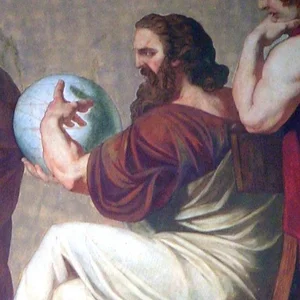
An astronomical instrument representing the celestial spheres, the armillary sphere is the attribute of Urania, Muse of astronomy. It symbolizes knowledge of the cosmos and the movements of the stars — a science considered divine in ancient Greece.

Woven from branches of laurel sacred to Apollo, this wreath adorned the heads of poets, musicians, and scholars who triumphed in artistic competitions. The Muses would symbolically bestow it upon those they had chosen to inspire.

A wind instrument made of two pipes played simultaneously, the aulos is the attribute of Euterpe, Muse of music. Its powerful sound accompanied religious rituals, military combat, and funeral ceremonies in ancient Greece.

Common writing tools of the ancient world, used to record poems, formulas, or observations. Associated with Polyhymnia, Muse of sacred hymn, they serve as a reminder that every artistic creation is a gift from the Muses, given form through human effort.
School Curriculum
Vocabulary & Tags
Key Vocabulary
Daily Life
Morning
At sunrise, the Muses leave their home on Mount Helicon to join Olympus, where they sing in honor of Zeus and the other gods during the divine feast. Their harmonious voices accompany the dawn and set the sacred rhythm for the celestial day.
Afternoon
During the day, the Muses descend to places frequented by mortals — sanctuaries, poetry contests, theaters — to breathe inspiration into artists worthy of their favor. They observe poets, musicians, and philosophers at work, and choose those they will possess with their divine breath.
Evening
In the evening, the Muses gather around the Hippocrene spring to dance and sing together, forming a chorus under the direction of Apollo. These nocturnal festivities on Helicon are the moment when their creative power is at its peak, and when human poets receive their most beautiful inspirations in dreams.
Food
As divinities, the Muses feed on ambrosia and nectar, the immortal foods reserved for the gods of Olympus. This celestial diet, described by Homer and Hesiod, grants them their eternal beauty and their incomparable voice — quite unlike mortal food, which weighs down body and mind.
Clothing
The Muses are depicted in Greek art wearing long draped robes — the wool peplos or the linen chiton — in vivid colors: pure white, saffron, purple, or navy blue. Their flowing hair is adorned with crowns of laurel or ivy according to their domain, and their bare feet tread the sacred stones of Mount Helicon.
Housing
The Muses dwell on Mount Helicon in Boeotia and Mount Parnassus near Delphi, two sacred places between heaven and earth where the boundary between the divine world and the human world is thinnest. Their dwellings are not buildings but natural places — caves, springs, and sacred groves — at once removed from the profane world and accessible to poets in search of inspiration.
Historical Timeline
Period Vocabulary
Visual Style
Neuf femmes gracieuses en robes drapées blanc et safran sur fond de montagne grecque baignée de lumière dorée, chacune tenant son attribut symbolique dans une composition harmonieuse.
Sound Ambience
Atmosphère apaisante d'un sanctuaire grec de montagne : source sacrée, brise sur les lauriers, lyre distante et chœur de voix féminines harmonieuses.
Liens externes & ressources
Références
Œuvres
Théogonie — Hésode
vers 700 av. J.-C.
Iliade — Homère
vers 750 av. J.-C.
Hymnes homériques
VIIe-VIe siècles av. J.-C.
Odes pythiques — Pindare
vers 498-446 av. J.-C.
Phèdre et Ion — Platon
vers 390-380 av. J.-C.
Métamorphoses, livre V — Ovide
vers 8 ap. J.-C.