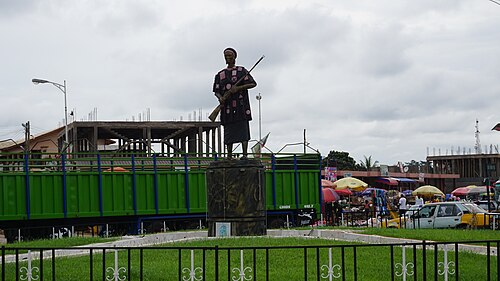
Nana Yaa Asantewaa
Yaa Asantewaa
1832 — 1921
Côte-de-l’Or
Queen Mother of the Ashanti kingdom (present-day Ghana), she led the resistance against British occupation in 1900 during the War of the Golden Stool. A major figure in Akan oral tradition, she embodies the struggle for African sovereignty against colonization.
Famous Quotes
« "If you, the Ashanti men, will not go forward, then we will. We, the women, will fight until the last of us falls on the battlefield." (words attributed by oral tradition at the 1900 war council) »
Key Facts
- Born around 1840 in Besease, in the Ashanti Empire (present-day Ghana) — date based on oral tradition, not confirmed by written records
- In 1896, the British exiled Asantehene Prempeh I to the Seychelles, weakening Ashanti authority
- In March 1900, British Governor Frederick Hodgson demanded the surrender of the sacred Golden Stool, symbol of the soul of the Ashanti nation — triggering the uprising
- She led the Ashanti forces during the War of the Golden Stool (March–September 1900), holding the British at bay for several months
- Captured in 1900, she was exiled to the Seychelles where she died in 1921 — never returning to her homeland
Works & Achievements
The last major Ashanti armed uprising against British colonization, personally led by Yaa Asantewaa. This war stands as one of the most iconic examples of female resistance to colonization in Africa.
A months-long military operation that paralyzed the British garrison at Kumasi, forcing London to send massive reinforcements from several colonies. Strategically bold, this action demonstrated the military capabilities of the Ashanti forces.
An oral address delivered before the hesitant chiefs of the Ashanti council, passed down ever since through Akan oral tradition. This speech is regarded as one of the great texts of African resistance to colonization.
By organizing the resistance, Yaa Asantewaa indirectly ensured that the Golden Stool was hidden and never fell into British hands. The sacred stool remains to this day the central symbol of Ashanti identity and is kept in Kumasi.
Yaa Asantewaa has become one of the most celebrated female figures in African collective memory, featured in dozens of Akan songs, tales, and proverbs passed down orally from generation to generation.
Anecdotes
In March 1900, British Governor Frederick Hodgson summoned the Ashanti chiefs to demand the surrender of the Golden Stool, the sacred symbol of the Ashanti nation's soul. Faced with the men's hesitation, Yaa Asantewaa stood up and declared: 'If you, the men of Ashanti, will not go forward, then we, the women, will.' This legendary speech, passed down through oral tradition, marked the beginning of the last great Ashanti resistance against the British.
Yaa Asantewaa was appointed Queen Mother of Ejisu by her brother Afrane Panin, the territory's chief. The title was far from ceremonial: in Akan society, the Queen Mother held a central political role — advising chiefs, participating in war councils, and even having the power to depose a king deemed unworthy. It was by virtue of this authority that she led the 1900 uprising.
During the siege of the British fort at Kumasi in 1900, Yaa Asantewaa personally oversaw military operations. Under her command, Ashanti forces held several thousand British soldiers at bay for months, forcing London to send massive reinforcements from other African colonies. The siege was one of the most intense military confrontations in the entire history of African resistance to colonization.
Captured in September 1900 following the final Ashanti defeat, Yaa Asantewaa was exiled to the Seychelles along with other chiefs, joining Asantehene Prempeh I, who had already been exiled there since 1896. She died in exile in 1921, a few years before Prempeh I was allowed to return to Ghana. Her remains were later repatriated to Ashanti lands, in accordance with Akan beliefs about the necessity of resting on ancestral soil.
The Golden Stool (Sika Dwa Kofi) that the British sought to seize was no mere royal seat: according to Akan tradition, it held the sunsum — the collective soul — of the entire Ashanti people. Guardians watched over it day and night, and it was never allowed to touch the ground. In attempting to take it, the British failed to understand that they were threatening the very spiritual identity of the nation. The stool was hidden and never surrendered to the colonizers.
Primary Sources
If you, the men of Ashanti, will not go forward to fight for the Golden Stool of your king, then we, the women, will. I shall see if a man of Ashanti will carry a bow and arrows.
The Ashantis have taken up arms under the leadership of a woman named Yaa Asantewaa, Queen Mother of Ejisu. The resistance is organized and determined. Reinforcements are indispensable to restore His Majesty's authority.
Yaa Asantewaa, the warrior who fights with musket and sword. Yaa Asantewaa, the woman who holds the nation together. The Golden Stool shall not fall as long as she watches over it.
She told us that our shame was great for having let the White men take our king without resistance. She picked up the musket herself to show us the way.
The Ashanti war of 1900 was instigated and led by the Queen Mother of Ejisu, Yaa Asantewaa. Her influence over the chiefs was paramount and her military direction of the siege of Kumasi demonstrated a considerable strategic ability.
Key Places
The town where Yaa Asantewaa served as queen mother, located about twenty kilometers from Kumasi. It was in Ejisu that she delivered her historic speech before the Ashanti chiefs and was appointed war leader.
Capital of the Ashanti Kingdom and the political and spiritual heart of the Confederacy. The British fort at Kumasi was besieged by Yaa Asantewaa's forces for several months in 1900.
A fortress built by the British following the annexation of 1896, and a symbol of colonial occupation. Its siege by Ashanti troops under Yaa Asantewaa's leadership is the central military episode of the War of 1900.
The main island of the Seychelles archipelago, where Yaa Asantewaa was exiled after her capture in 1900. She spent her final years there alongside other exiled Ashanti chiefs, including Asantehene Prempeh I.
Seat of the British colonial government of the Gold Coast. It was from Accra that the decisions to exile Prempeh I and later Yaa Asantewaa were made, and from where the military operations of suppression were coordinated.
Gallery

Ejisu Roundabout
Wikimedia Commons, CC BY-SA 4.0 — Noahalorwu

Yaa Asantewaa Museum (4)
Wikimedia Commons, CC BY-SA 4.0 — Noahalorwu

Yaa Asantewaa's Family House
Wikimedia Commons, CC BY-SA 4.0 — Noahalorwu

O17 Rita Mae and Yaa
Wikimedia Commons, CC BY-SA 3.0 — Victuallers

Sergeant John Mackenzie VC, Seaforth Highlanders
Wikimedia Commons, Public domain — Taddy & Co