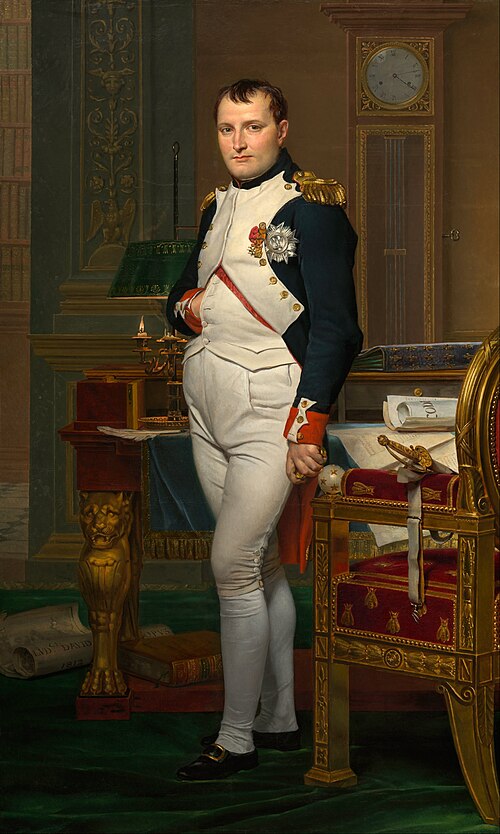
Napoleon I
Napoleon I
1769 — 1821
France
A Corsican general who rose to become First Consul and then Emperor of the French, Napoleon I profoundly reshaped Europe through his military conquests and domestic reforms. His reign (1804–1815) left a lasting legacy: the Civil Code, the Legion of Honor, and a centralized system of government.
Famous Quotes
« Impossible is a word found only in the dictionary of fools. »
« Every soldier carries a marshal's baton in his pack. »
« Glory is fleeting, but obscurity is forever. »
Key Facts
- 1799: Coup of 18 Brumaire — Napoleon becomes First Consul and brings the Directory to an end
- 1804: Coronation at Notre-Dame de Paris — proclamation of the French Empire
- 1804: Promulgation of the Civil Code (Code Napoléon), whose main provisions remain in force to this day
- 1812: Disastrous Russian campaign — the beginning of the Empire's decline
- 1815: Defeat at Waterloo and permanent exile to Saint Helena, where he died in 1821
Works & Achievements
A landmark piece of legislation that unified French civil law, guaranteeing equality before the law, private property rights, and individual freedoms. Still in force in France today, it has influenced the civil codes of many countries around the world.
An agreement between Napoleon and Pope Pius VII that reorganized the Catholic Church in France following the upheavals of the Revolution. It recognized Catholicism as the 'religion of the great majority of the French' while preserving freedom of worship.
A national order recognizing civil and military merit, regardless of birth or social rank. Still awarded today, the Legion of Honor is France's highest distinction.
Napoleon established the lycée as a public secondary school, then created the baccalaureate in 1808 as France's first formal secondary school diploma. Both institutions continue to shape the French education system to this day.
A financial institution tasked with managing currency and credit, stabilizing the French economy after the crises of the Revolutionary period. It played a key role in financing the Napoleonic Wars.
A colossal monument commissioned by Napoleon to celebrate his victories, most notably Austerlitz. Completed after his death, it is today one of the most iconic landmarks in Paris.
A monumental 23-volume encyclopedia published following Napoleon's Egyptian expedition of 1798–1801, compiling the work of the scholars he brought with him. It laid the foundations of modern Egyptology.
Anecdotes
Napoleon stood around 5'6" (1.68 m), a perfectly average height for his time. The legend of his short stature arose from a mix-up between French and English inches: the British, who mockingly called him 'the little corporal,' miscalculated the conversion, and the caricature spread across all of Europe.
A voracious reader since his childhood in Corsica, Napoleon always brought a travelling library on his military campaigns. He sometimes read for several hours a night, devouring works on history, geography, and philosophy, filling the margins with his own notes.
During the Egyptian campaign of 1798, Napoleon brought with him nearly 167 scholars, engineers, and artists. This scientific expedition led to the discovery of the Rosetta Stone, which became the key to deciphering Egyptian hieroglyphics — a feat achieved by Champollion twenty years later.
Napoleon slept very little, rarely more than six hours a night, and practiced what he himself called the 'warrior's nap': short twenty-minute breaks during the day, even in the middle of a military campaign, to restore his energy.
An enthusiastic chess player, Napoleon played regularly but was not particularly skilled. Several games played at Saint Helena have been reconstructed and preserved; he reportedly confided to his companions in exile that chess allowed him to 'think without tiring himself out.'
Primary Sources
I closed the abyss of anarchy and cleared the chaos. I uncovered the eyes of corruption, developed the strength of nations, and gave them new life.
Not a day goes by without my loving you; not a night passes without my holding you in my arms; I never drink a cup of tea without cursing the glory and ambition that keep me away from the soul of my life.
Soldiers, you are naked and poorly fed; the government owes you much but can give you nothing. The patience and courage you show among these rocks are admirable, but they bring you no glory.
There shall be a Civil Code of the French. Civil laws are made to protect the property, family, and individual freedom of citizens.
I wish my ashes to rest on the banks of the Seine, in the midst of the French people whom I have loved so dearly.
Key Places
Napoleon Bonaparte's birthplace, where he was born on August 15, 1769, into a family of minor Corsican nobility. The Bonaparte family home is today a national museum.
The official residence of Napoleon as First Consul and later as Emperor, at the heart of Paris. It was from this palace that he governed France and commanded his armies; the palace was burned down in 1871.
The site of Napoleon's most celebrated victory, on December 2, 1805, against the Russian and Austrian armies. This battle is still studied in military academies around the world.
The royal château where Napoleon abdicated for the first time on April 6, 1814. It was here that he bade farewell to his Imperial Guard in a speech that has since become famous: 'Farewell, my children!'
A village near Brussels where Napoleon suffered his final defeat on June 18, 1815, at the hands of the allied armies of Wellington and Blücher. This battle brought the Empire to a definitive end.
A remote British island in the middle of the Atlantic Ocean where Napoleon was exiled from 1815 until his death in 1821. There he dictated his memoirs, crafting the Napoleonic legend for posterity.
Gallery

German: Napoleon I. Bonaparte (1769-1821) als König von Italien Napoleon I of Francetitle QS:P1476,de:"Napoleon I. Bonaparte (1769-1821) als König von Italien "label QS:Lde,"Napoleon I. Bonaparte (1
Wikimedia Commons, Public domain — Andrea Appiani

Napoléon Bonaparte Premier Consul label QS:Lfr,"Portrait de Bonaparte, Premier Consul"label QS:Len,"Portrait of Bonaparte, First Consul"label QS:Lde,"Porträt des Bonaparte, Premier Consul"
Wikimedia Commons, Public domain — François Gérard

The Emperor Napoleon in His Study at the Tuileries label QS:Len,"The Emperor Napoleon in His Study at the Tuileries"label QS:Lar,"الإمبراطور ناپُليُون في مكتبه بِقصر التويليري"title QS:P1476,en:"The
Wikimedia Commons, Public domain — Jacques-Louis David

French: Portrait de femme. title QS:P1476,fr:"Portrait de femme. "label QS:Lfr,"Portrait de femme. "
Wikimedia Commons, Public domain — Unidentified painter

Monsiau - Portrait de Napoléon
Wikimedia Commons, Public domain — Nicolas-André Monsiau

Napoleon statue - tomb of Napoleon II
Wikimedia Commons, CC BY-SA 3.0 — BrokenSphere

Napoleon sculpture (Borodinskaya panorama)
Wikimedia Commons, CC BY-SA 3.0 — shakko

Napoleon Lemot Louvre MR3458-02a
Wikimedia Commons, CC BY 2.0 — edwin.11

Caricature gillray plumpudding
Wikimedia Commons, Public domain — James Gillray

Précis d'histoire de la Guadeloupe
Wikimedia Commons, Public domain — Maurice Martin