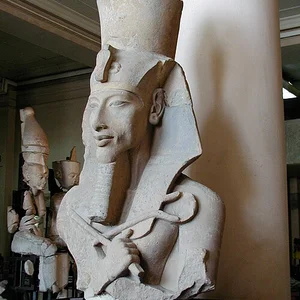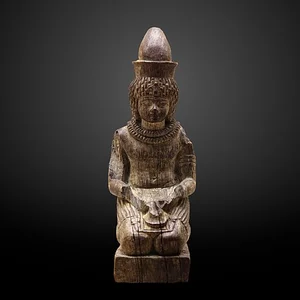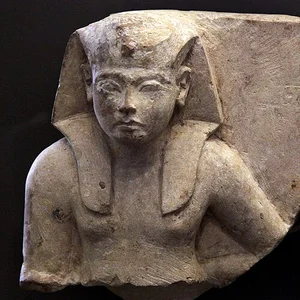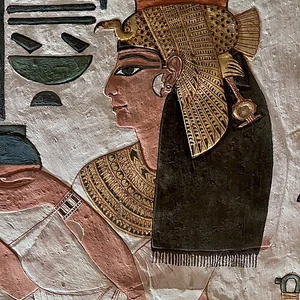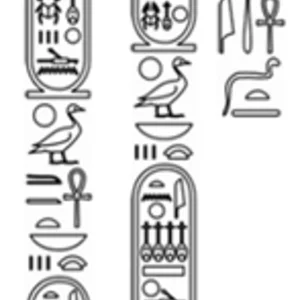

Neferneferuaten was a queen of Egypt from the 18th Dynasty, probably co-regent or direct successor to Akhenaten around 1335 BCE. Her exact identity remains debated: she may be Nefertiti under a new name, or a daughter of Akhenaten.
Neferneferuaten(1400 av. J.-C. — 1400 av. J.-C.)
Neferneferuaten
Égypte antique
8 min read
Frequently asked questions
Key Facts
- Around 1335 BCE: Neferneferuaten held power in Egypt, probably after or alongside Akhenaten
- Her royal cartouche has been found on several monuments and objects from the Amarna period
- She is associated with the cult of Aten, the sole sun god promoted by Akhenaten
- Her identity remains uncertain: some Egyptologists identify her with Nefertiti, others with Meritaten
- She directly preceded Tutankhamun on the throne of Egypt
Works & Achievements
Neferneferuaten most likely served as co-regent with Akhenaten in the final years of his reign, taking charge of a portion of state affairs. Her coronation name appears on official monuments, attesting to a fully recognized royal role.
After Akhenaten's death, Neferneferuaten ruled alone, becoming one of the very rare examples of a female pharaoh in Egyptian history, alongside Hatshepsut and Twosret. Her brief but attested reign represents the political pinnacle achieved by a woman within the pharaonic system.
As co-officiant of religious ceremonies, Neferneferuaten played a central role in the Atenist cult, embodying the divine feminine principle alongside the pharaoh. As the only intermediaries permitted to communicate directly with Aten, they presided daily over the rituals of the sunrise.
The large rock-cut stelae marking the boundaries of the sacred city of Amarna mention the Amarna royal family and their vows to Aten. These monumental inscriptions are among the rare documents in which the royal couple is depicted together before the solar deity.
Anecdotes
Neferneferuaten remains one of the most mysterious figures of ancient Egypt: her exact identity has never been established with certainty. Egyptologists still debate whether she was Nefertiti who adopted a new regnal name, or one of Akhenaten's daughters, perhaps Meritaten. This enigma — born from the fact that her successors systematically erased all traces of the Amarna period — makes her an almost legendary figure.
During her reign or co-regency, Aten's religious revolution was in full swing: all temples to traditional gods such as Amun had been closed, and only the solar disk Aten was worshipped. Neferneferuaten took part in sacred rituals alongside Akhenaten as the sole intermediaries between Aten and humanity — a position of spiritual power unprecedented for a woman in Egypt.
Her regnal name, Ankhkheperure Neferneferuaten, means 'Beautiful are the beauties of Aten' — a poetic evocation of the sun god that Akhenaten had imposed upon all of Egypt. She also bore the epithet 'Beneficial for her husband,' which has led some scholars to believe she may have succeeded Akhenaten as pharaoh in her own right after his death, making her one of the very few attested female pharaohs.
After Akhenaten's death around 1334 BCE, Neferneferuaten vanishes from the historical record as though she never existed. Her successor Tutankhamun restored the cult of Amun and ordered the erasure of all traces of the Amarna period — a damnatio memoriae that condemned Neferneferuaten's memory to oblivion for more than three thousand years, until the rediscovery of Amarna by archaeologists in the 19th century.
Primary Sources
You appear beautifully on the horizon of heaven, O living Aten, you who were the first to exist! When you rise on the eastern horizon, you fill every land with your beauty. You are beautiful, great, dazzling, and you are high above every land.
Diplomatic letters discovered at Tell el-Amarna shed light on the activity of the royal court during the Amarna period, featuring exchanges with the kings of Babylon, Mitanni, and Syria, attesting to an active diplomacy conducted from the new capital.
The rock-carved scenes in the tomb depict the Amarna royal family in worship before the Aten, with the queen taking part in the ritual alongside the pharaoh, attesting to the central role of the royal woman in the practice of the solar cult.
The pharaoh had his vows to the Aten carved at the boundaries of the sacred city: 'I shall build Akhetaten for the Aten my father in this place.' The stelae mention the royal family united in worship of the solar disk.
Key Places
The holy city founded by Akhenaten on a virgin site, dedicated exclusively to the worship of Aten. It was here that Neferneferuaten lived, reigned, and took part in great solar rituals held in open-air temples — roofless by design, so that Aten's rays could reach the worshippers directly.
The ancient religious capital of Egypt and seat of the powerful Amun priesthood, whose temples Akhenaten had closed. It was from Thebes that the theological backlash against Atenism was organized after Akhenaten's death, ultimately leading to the erasure of Neferneferuaten from the historical record.
The royal necropolis where the pharaohs of the 18th Dynasty were buried. No tomb has been formally identified as belonging to Neferneferuaten, though some Egyptologists believe that certain objects found in Tutankhamun's tomb (KV62) may have originally belonged to her.
A major administrative and religious city in northern Egypt and the traditional seat of pharaonic power. After the abandonment of Amarna under Tutankhamun, the royal court relocated to Memphis, where the memory of Neferneferuaten was gradually expunged from the official records.
Typical Objects

The central symbol of the Amarna religious revolution, the solar disk extends its rays toward the royal family, whose hands hold out ankh symbols (crosses of life). Neferneferuaten took part in this ritual as the sole designated intermediary between the god and humanity.

A royal headdress combining the white crown of Upper Egypt and the red crown of Lower Egypt, worn by pharaohs during official ceremonies. As a pharaoh in her own right, Neferneferuaten was entitled to wear it, marking her exceptional rank.

Royal insignia of power, held crossed over the chest in official depictions of pharaohs. These attributes — symbolizing temporal authority and sacred might — would have been carried by Neferneferuaten during major state ceremonies.

An oval loop of knotted rope encircling the pharaoh's throne name, believed to offer magical protection. The cartouche of Ankhkheperure has been found on stele fragments at Amarna, sometimes bearing scrape marks that reveal later attempts at erasure.

A hieroglyph meaning 'life', frequently shown being extended by Aten's rays toward the nostrils of the royal family to breathe eternal life into them. Neferneferuaten is often depicted holding it aloft in cultic scenes.

A ritual percussion instrument associated with the goddess Hathor, used during religious ceremonies to appease divine forces. Queens of the Amarna period held it during solar rites at the great open-air temple of Aten.
School Curriculum
Vocabulary & Tags
Key Vocabulary
Tags
Daily Life
Morning
At dawn, Neferneferuaten took part in the solar adoration ritual in the great open-air temple of Aten — roofless, unlike the dark enclosed temples of tradition. She officiated alongside the pharaoh, arms raised toward the disk of Aten rising over the eastern horizon of Amarna, in a silence broken only by the chants of the officiants and the sound of the sistrum.
Afternoon
The afternoon was devoted to affairs of state: audiences at the palace's 'Window of Appearances,' where the royal couple received reports from high officials and bestowed golden collars on deserving officers. As co-regent or pharaoh, Neferneferuaten also oversaw construction progress on the tombs and temples being built throughout the new city.
Evening
In the evening, the court gathered in gardens adorned with pools and friezes of faience ducks. Musicians played harp, lute, and flute while dancers performed. The royal family retired to apartments whose walls were painted with vivid scenes from nature — birds, fish, and Nile reeds — unique in all of Egyptian art.
Food
The royal table featured emmer wheat bread, lentils, fava beans, onions, dates, and figs. Meats reserved for the elite — beef, poultry, and Nile fish — were plentiful, accompanied by barley beer and palm wine. At state banquets, alabaster and gold vessels filled with wine imported from the Nile Delta were passed among the guests.
Clothing
Like the queens of the Eighteenth Dynasty, Neferneferuaten wore fine pleated white linen robes, often sheer, held in place by ornate sashes. Her court wig was topped with the double-plumed crown or the royal nemes headdress. She wore broad usekh collar necklaces in faience, gold, and lapis lazuli, along with bracelets at her wrists and ankles.
Housing
The great palace of Amarna (Hwt-Aten) stretched several hundred meters along the Nile, with gardens, pools, and artisans' workshops. The royal apartments featured floors and walls painted with marsh scenes — birds and fish rendered in trompe-l'œil — the only naturalistic mural paintings known from all of ancient Egypt. The bright white limestone gave the entire complex the appearance of a city of light.
Historical Timeline
Period Vocabulary
Visual Style
Le style amarnien : représentations naturalistes aux corps allongés et fluides, baignés d'or solaire, avec les tons caractéristiques de l'ocre, du lapis-lazuli et du blanc calcaire lumineux de la cité d'Aton.
Sound Ambience
Une atmosphère de palais solaire baigné de lumière dorée : le murmure du Nil, les sistres rythmant les hymnes à Aton à l'aube, et le vent chaud du désert sur les colonnes de calcaire blanc d'Amarna.
Liens externes & ressources
Références
Œuvres
Corégence avec Akhenaton
vers 1336-1334 av. J.-C.
Règne comme pharaon sous le nom Ankhetkheperourê
vers 1334-1332 av. J.-C.
Officiation au grand temple d'Aton à Amarna
vers 1346-1332 av. J.-C.
Administration des stèles frontières d'Akhetaton
vers 1346 av. J.-C.