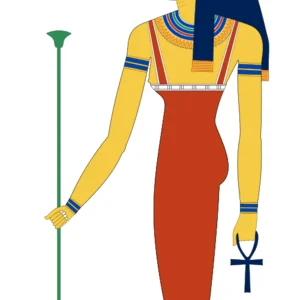

An ancient Egyptian goddess, Nephthys is the protector of the dead and the deceased. Sister of Isis, Osiris, and Set, she plays a fundamental role in Egyptian funerary rites. Her tradition is passed down through the Pyramid Texts and the Coffin Texts.
Nephthys
Nephthys
9 min read
Frequently asked questions
Famous Quotes
« "I am your sister Nephthys, I weep for you, I search for you." (funerary lament attributed to Nephthys in Osirian rituals, according to Egyptian tradition)»
Key Facts
- Nephthys is first mentioned in the Pyramid Texts, around 2400 BCE
- She is part of the Ennead of Heliopolis, the group of nine great deities in Egyptian cosmogony
- Together with Isis, she watches over the body of Osiris after his murder by Set, according to the Osirian myth
- She is the wife of Set yet nonetheless helps Isis resurrect Osiris, illustrating the complexity of Egyptian myths
- Her Egyptian name, Nebet-Hout, means "Mistress of the (divine) House"
Works & Achievements
The earliest written religious corpus in human history, carved inside the pyramids of the Old Kingdom. Nephthys is invoked as protector of the deceased king in hundreds of spells, marking her first major written attestation.
A collection of funerary spells derived from the Pyramid Texts, made accessible for private individuals. Nephthys serves as a protective goddess alongside Isis, guiding every deceased person toward resurrection.
A guide for the deceased in the afterlife, copied onto papyrus and placed in tombs. Nephthys appears in numerous chapters, notably during the judgment scene, and embodies one of the great protective powers of the underworld.
A liturgical text in Demotic script depicting the dialogue between the two sisters mourning Osiris. This document distills a very ancient oral tradition and bears witness to the vitality of the Osirian cult during the Hellenistic period.
Inscriptions carved on the walls of the Temple of Philae celebrating Nephthys as "Lady of Heaven" and guardian of funerary mysteries. These hymns represent one of the latest and most elaborate expressions of her cult.
Anecdotes
Nephthys is often depicted with a hieroglyph on her head that forms her name: a basket resting on the floor plan of a house. This sign literally means "Lady of the Castle" or "Mistress of the House," reflecting her role as guardian of the threshold between the world of the living and the realm of the dead.
In the myth of Osiris, Nephthys mourns her murdered brother alongside Isis. The two goddesses are so frequently paired in funerary lamentations that they form an inseparable duo — the priestesses who recited these laments at burial rites were sometimes called "the two Ises" or "the two mourners."
Although she was the wife of Seth, the god of chaos, Nephthys sided with Osiris during the mythological conflict. This ambivalence fascinated the Egyptians: she embodies the in-between, standing at the border of order and disorder, of day and night.
Nephthys is one of the four protective deities of the canopic jars — the containers that preserved the organs of mummies. She watched over the liver alongside Hapy, one of the four Sons of Horus, ensuring the body's integrity for resurrection in the afterlife.
In the Pyramid Texts, among the oldest religious writings in the world, Nephthys is invoked in the very first magical spells designed to protect the deceased pharaoh. Her presence in these inscriptions, carved around 2400 BCE, speaks to her great antiquity and her central importance in Egyptian cosmology.
Primary Sources
"O Nephthys, come to him, wrap your arms around him, protect him, let nothing evil befall him." The spells invoking Nephthys as protector of the dead pharaoh are among the earliest attested references to the goddess.
Nephthys is described as the one who "reassembles the scattered limbs" and who, together with Isis, restores breath to the deceased. These spells extended funerary protection beyond the pharaoh to all people.
"Isis and Nephthys, the two divine sisters, have gathered your limbs, they have put an end to your suffering." Chapter 17 is one of the most frequently copied chapters of the Book of the Dead and contains several invocations to Nephthys.
This liturgical text, recited during Osirian festivals, depicts the two goddesses mourning Osiris: "Come to your home, come to your home… Your enemy has fallen, you are no longer among us, beautiful bull."
The inscriptions at the Temple of Philae celebrate Nephthys as "lady of the sky, mistress of all divine dwellings, eye of Ra shining in all things."
Key Places
The Pyramid Texts carved in the burial chamber of Unas (c. 2375 BCE) are the oldest written sources to mention Nephthys. This site is therefore the textual birthplace of the goddess.
The holy city of Osiris and a major center of Osirian mysteries, Abydos is where the rituals uniting Isis, Nephthys, and Osiris were celebrated with the greatest splendor, particularly under Seti I and Ramesses II.
This Ptolemaic and Roman temple, dedicated primarily to Isis, contains numerous inscriptions and reliefs depicting Nephthys. It is one of the last sanctuaries where ancient Egyptian religious practices survived into the 6th century CE.
A major theological center of ancient Egypt and the birthplace of the Ennead — the circle of nine gods to which Nephthys belongs alongside Osiris, Isis, Seth, Geb, Nut, Atum, Shu, and Tefnut. The Heliopolitan cosmogony establishes Nephthys's role in the divine order.
The royal tombs of the New Kingdom, cut into this Theban valley, are decorated with scenes from the Book of the Dead and the Amduat in which Nephthys appears among the guardians of the gates of the afterlife. The tomb of Tutankhamun yielded amulets bearing her image.
Typical Objects

Nephthys's distinctive headdress is formed by a basket (neb) placed atop a house plan (hwt) — it is her very name, visible at the top of her head in all her representations. This sign functioned both as an iconographic identifier and as a protective talisman.

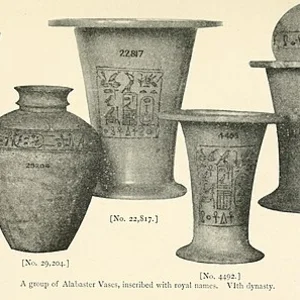
Nephthys was the designated protector of the canopic jar containing the deceased's lungs, placed under the guardianship of Hapy, one of the Sons of Horus with the head of a baboon. These jars were arranged in the burial chamber to ensure the body's integrity in preparation for resurrection.

Small figurines in blue or green faience depicting Nephthys kneeling with arms outstretched in a gesture of protection were slipped among the mummy's wrappings. They were meant to protect the deceased during their journey into the afterlife.

It was common practice to paint Isis at the foot and Nephthys at the head of the sarcophagus, or vice versa. This arrangement symbolized their eternal vigil around the deceased, re-enacting the mythic scene of their funeral watch over Osiris.

Illustrated funerary papyrus scrolls frequently depict Nephthys in vignette form, particularly in the scene of the Weighing of the Heart (psychostasia). Her presence ensured the magical protection of the inscribed spells.

A percussion instrument used in funerary ceremonies and Osirian rituals, the sistrum was shaken by priestesses embodying Nephthys during ritual lamentations. Its sound was believed to drive away evil spirits and appease the gods.
School Curriculum
Vocabulary & Tags
Key Vocabulary
Tags
Daily Life
Morning
In Egyptian cosmology, Nephthys's day begins at dawn — a moment she is closely associated with, as the goddess of twilight and transitions: she watches over the boundary between night and day. Priestesses who embodied her in the temples would purify themselves in the cold waters of the Nile before donning their white ceremonial robes and reciting the first morning invocations.
Afternoon
The Osirian rites in which Nephthys mythically took part often unfolded in broad daylight within the sanctuaries: offerings of bread, beer, and incense were laid before her image. During the great festivals of Osiris at Abydos, priestesses playing the role of Nephthys would walk in procession through the temple courtyards, shaking their sistrums.
Evening
Evening is Nephthys's domain above all others — she is the goddess of the nocturnal threshold. Funerary laments were recited at dusk around the body of the deceased. The overnight vigil, during which women portraying Isis and Nephthys mourned the dead, was intended to rekindle the vital breath of the deceased before embalming.
Food
As a deity, Nephthys did not eat in any human sense, but received daily food offerings in her temples: breads of various shapes, dried meats, figs, pomegranates, barley beer, and palm wine. These offerings were then redistributed to the priests after the ceremony, in keeping with the practice known as the 'reversion of offerings.'
Clothing
Nephthys is always depicted wearing a white or blood-red sheath dress — red being the color of resurrection — fitted tightly at the ankles. She wears a broad usekh collar of gold and turquoise, bracelets at her wrists and ankles, and her characteristic hieroglyphic headdress. In some later representations, her arms transform into the outstretched wings of a kite or vulture, spread wide in a gesture of protection.
Housing
Unlike Isis or Ptah, Nephthys had no great temple of her own. She was venerated in places sacred to Osiris — notably at Abydos and Philae — in chapels or halls dedicated to her within larger temple complexes. In mythological terms, her dwelling is the edge of the western horizon, where the sun sets and the souls of the dead begin their journey.
Historical Timeline
Period Vocabulary
Visual Style
Style égyptien canonique : silhouette hiératique en profil et face simultanés, coiffe distinctive à hiéroglyphe, palette de sable, lapis-lazuli et or sur fond calcaire, dans l'esthétique des peintures de tombeaux.
Sound Ambience
L'atmosphère sonore de Nephtys évoque une cérémonie funèbre égyptienne : lamentations rythmées des prêtresses, cliquetis de sistres, crépitement d'encens dans une salle à colonnes baignée de lumière de torches.
Liens externes & ressources
Références
Œuvres
Textes des Pyramides
Vers 2400-2300 avant notre ère
Textes des Sarcophages
Vers 2100-1650 avant notre ère
Livre des Morts (Pert em Heru)
Vers 1550 avant notre ère — Ier siècle de notre ère
Lamentations d'Isis et de Nephtys
Vers 50 avant notre ère (papyrus ptolémaïque)
Hymnes à Nephtys du temple de Philae
IIIe siècle avant notre ère — Ier siècle de notre ère