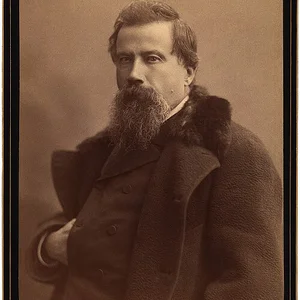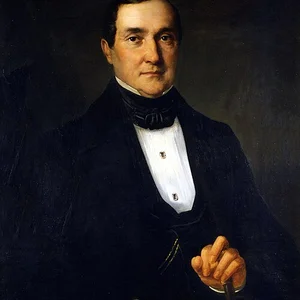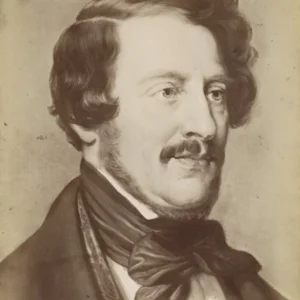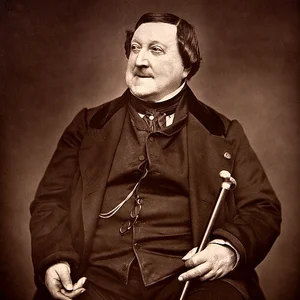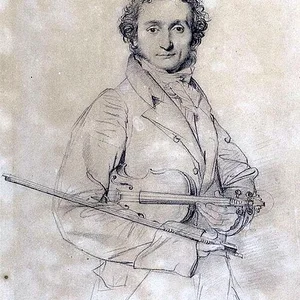

Niccolò Paganini (1782–1840) was an Italian violinist and composer, considered the greatest virtuoso of his era. His revolutionary technique and stage charisma earned him extraordinary fame across Europe, fuelling a dark and mysterious legend.
Niccolò Paganini(1782 — 1840)
Niccolò Paganini
république de Gênes
7 min read
Frequently asked questions
Famous Quotes
« I suffer no one else to touch my violin.»
Key Facts
- Born 27 October 1782 in Genoa, died 27 May 1840 in Nice
- Composed the 24 Caprices for solo violin (op. 1), published in 1820 — the definitive benchmark of violin virtuosity
- Toured across Europe from 1828 onwards, inspiring an unprecedented wave of public fervour
- His reputation as a supernatural virtuoso gave rise to the legend that he had made a pact with the devil
- His works inspired Liszt, Schumann, and Brahms, who created celebrated transcriptions and variations based on them
Works & Achievements
Published in Milan, these twenty-four pieces revolutionized violin technique worldwide and remain to this day a pinnacle of the solo violin repertoire.
Paganini's first major concerto, blending technical brilliance with Romantic lyricism; it was long performed in E-flat to make the soloist's part easier to play.
The finale of this concerto, known as “La Campanella,” directly inspired Liszt, who made it into a celebrated piano transcription, ensuring the theme's enduring fame.
Virtuoso variations on an aria by Paisiello, showcasing Paganini's ability to transform a popular theme into a dazzling technical showpiece.
A bravura piece in which Paganini played entirely on the violin's single G string — its lowest — producing a sound of striking depth and resonance.
A set of some fifteen quartets demonstrating Paganini's mastery of the guitar, an instrument he played as an accomplished amateur throughout his Italian years.
Anecdotes
Paganini's diabolical reputation was so widespread that his contemporaries suspected him of having sold his soul to the devil in exchange for his prodigious technique. His spectral silhouette, his long curved fingers, and his hypnotic gaze all fed this legend. When he died in Nice in 1840, the local bishop refused to grant him burial in consecrated ground for several years, so persistent was the rumor of his demonic pact.
Paganini owned a 1742 Guarneri del Gesù violin he nicknamed 'Il Cannone' (The Cannon) on account of its extraordinary sonic power. He was so attached to it that he bequeathed it by will to the city of Genoa, his hometown. This violin is still kept at the Palazzo Tursi in Genoa and is lent on exceptional occasions to great soloists for special concerts.
A verified anecdote tells that after losing his violin in a gambling game, Paganini had to borrow the instrument of a French music lover, M. Livron, to honor a concert in Livorno. His performance was so dazzling that Livron offered him the violin at the end of the concert, declaring that he could never play on an instrument that the maestro's fingers had touched.
In 1831, the young Franz Liszt, aged nineteen, attended a Paganini concert in Paris. He was so profoundly moved by what he heard that he resolved to become 'the Paganini of the piano,' shutting himself away to practice with a new intensity. This revelation deeply transformed his style and made him the greatest virtuoso pianist of his century.
Paganini suffered from chronic health problems throughout his life: he was extremely thin, had unusually flexible joints, and fingers of remarkable length. Some modern physicians have put forward the hypothesis that he suffered from Marfan syndrome, a genetic connective tissue disorder that may partly explain his extraordinary technical abilities.
Primary Sources
Autograph letters in which Paganini describes his tours, his state of health, and his negotiations with venue directors across Europe.
He was tall and thin, dressed in black; his cheeks were hollow like two caverns, and in those caverns gleamed two dark eyes that seemed to gaze upon an invisible world.
Nothing like it has ever been heard from a violin. Paganini seems to have pushed the limits of the instrument beyond anything previously thought possible.
I bequeath my favourite violin, the Guarneri del Gesù I have named *Il Cannone*, to the city of Genoa, so that it may be preserved and no one else may ever play it.
The audience at the King's Theatre had never heard anything comparable. The sounds he draws from his instrument defy all description and all comparison with any violinist known until now.
Key Places
Paganini's birthplace, where he received his first violin lessons and made his debut. His violin 'Il Cannone' is still kept there at the Palazzo Tursi.
It was at La Scala that Paganini achieved his first great national triumph in 1813, establishing himself as the foremost violinist in Italy.
Paganini's 1828 Viennese tour marked the beginning of his conquest of Europe, with the imperial capital greeting him with tremendous enthusiasm.
His Parisian concerts of 1831–1832 had a lasting effect on the European musical scene, directly inspiring Liszt, Chopin, and Berlioz.
The city where Paganini died on 27 May 1840, at a time when Nice still belonged to the Kingdom of Sardinia. He is buried there in the Château cemetery.
Paganini served as director of music at the court of Marie Louise of Austria from 1816 to 1827, and owned the Villa Gaione in the surrounding countryside.
Typical Objects

A 1742 instrument and Paganini's absolute favourite for its extraordinary sonic power. He bequeathed it to the city of Genoa, where it is still kept today.

Paganini used ivory-tipped bows, suited to his spectacular playing style, which included extreme bowing techniques never seen before.

Paganini jealously guarded his handwritten scores, refusing to publish them during his lifetime so that no one could reproduce his technical effects.

During his European tours, Paganini covered thousands of kilometres by stagecoach, enduring gruelling journeys that worsened his already fragile health.

Paganini was also an accomplished guitarist and composer for the instrument; he wrote more than 200 pieces for solo guitar or ensemble.

His concert attire — severe black clothing and a white collar — reinforced his ghostly image and contributed to the mysterious atmosphere that surrounded his performances.
School Curriculum
Vocabulary & Tags
Key Vocabulary
Daily Life
Morning
Paganini rose late, often after ten o'clock, his fragile health and evening concerts leaving him deeply exhausted. He would begin by slowly warming up his fingers, sometimes still in bed, before sitting down to review his scores or write the many business letters his career demanded.
Afternoon
The afternoon was devoted to rehearsal and finalizing the evening's program. He sometimes received journalists, admirers, or musicians eager to submit their compositions for his opinion. While on tour, he also had to handle the practical details of each concert — negotiating fees and reaching agreements with venue directors.
Evening
Concert evenings saw Paganini transform: dressed in black, he would take the stage with a calculated theatrical intensity. His performances often lasted more than two hours and included improvisations. After the concert, he sometimes supped with patrons or fellow artists, but generally returned home early due to his poor health.
Food
Paganini was renowned for his extreme thinness and ate very little. He suffered from numerous digestive ailments and frequently followed strict diets. He was known to have a taste for simple Italian pasta dishes and light soups; his doctors forbade him from any dietary excess.
Clothing
On stage, he invariably wore a severe black coat with a white collar, which accentuated his pallor and spectral silhouette. In daily life, he dressed carefully but soberly, as befitted an artist travelling from city to city who wished to command respect.
Housing
On tour, Paganini stayed at the finest hotels in whichever city he visited — a necessity both for his reputation and his delicate health. He owned the Villa Gaione near Parma, where he rested between tours. In his final years, he lived in Nice in more modest lodgings, his fortune having been eroded by ill-fated investments.