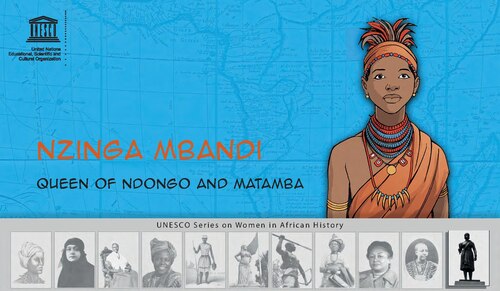
Njinga
Njinga
Queen of Ndongo and Matamba (Mbundu people, present-day Angola), Njinga is a towering figure of African resistance against Portuguese colonization in the 17th century. A skilled diplomat and feared warrior, she negotiated with the Portuguese as an equal and fought her entire life against the slave trade. Her memory is preserved through the oral traditions of the Mbundu people.
Famous Quotes
« "I am a queen, not a slave." (attributed to her by oral tradition during her negotiation with the Portuguese governor of Luanda, around 1622) »
Key Facts
- Born around 1583 in the kingdom of Ndongo (present-day Angola), among the Mbundu people — according to both Portuguese written sources and oral tradition.
- Around 1622: she served as ambassador for her brother, King Ngola Mbandi, to Portuguese governor João Correia de Sousa in Luanda — a famous episode in which she refused to sit on the floor and had a servant kneel down to serve as her seat.
- 1624: she seized power in Ndongo following her brother's death and ruled as sovereign queen.
- From the 1630s onward: she conquered the neighboring kingdom of Matamba, turning it into her base of resistance against the Portuguese and their allies.
- Died around 1663, having negotiated a peace treaty with Portugal — she governed until the very end of her life, at nearly 80 years of age by most estimates.
Works & Achievements
A diplomatic agreement recognizing Njinga's sovereignty over Matamba. The first treaty signed on equal terms between an African kingdom and the Portuguese Crown in Central Africa.
Njinga built a coalition of Mbundu peoples, Imbangala warriors, and Dutch allies, demonstrating exceptional diplomatic genius in uniting disparate forces against a colonial power.
By conquering and organizing the kingdom of Matamba, Njinga established a royal city and political center that resisted the Portuguese and outlasted her death by more than 80 years.
A series of political letters addressed to Portuguese authorities and the Vatican, in which Njinga asserts her sovereignty, requests priests, and negotiates the terms of peace.
Njinga incorporated guerrilla tactics, trained units of women warriors, and adapted Mbundu military strategy to warfare against Portuguese muskets, pioneering new approaches in African military art.
Anecdotes
During her first meeting with Portuguese governor João Correia de Sousa in Luanda in 1622, he refused to offer her a seat, attempting to humiliate her by forcing her to stand. Njinga immediately ordered one of her servants to kneel and serve as her human throne. With this single gesture, she boldly asserted her diplomatic equality with the Portuguese.
Baptized as a Christian in 1622 under the name Ana de Sousa, Njinga chose the governor's wife as her godmother. For her, the baptism was a purely diplomatic act aimed at securing concessions — she never abandoned her traditional Mbundu religious practices or her political ambitions.
To escape Portuguese domination, Njinga allied herself with the Dutch, enemies of Lisbon, in the 1640s. This alliance provided her with weapons and military support, and she fought alongside Dutch troops at the Battle of Ngoleme in 1647, inflicting a heavy defeat on Portuguese forces.
Throughout her life, Njinga refused to use the title of queen, preferring instead to be called king — a deliberate political statement of her full and absolute sovereignty over her kingdoms. She sometimes dressed in male warrior attire and personally commanded her armies, which made a profound impression on European witnesses of the time.
At over 70 years old, Njinga negotiated a final peace with the Portuguese in 1657. She secured recognition of her kingdom of Matamba and the release of some captives. She spent her final years rebuilding her kingdom, promoting trade and welcoming Capuchin missionaries, while maintaining her sovereign authority.
Primary Sources
Queen Njinga, a woman of extraordinary intelligence and resolve, governed her people with absolute authority and fought the Portuguese with a steadfastness that few sovereigns could have matched.
I am the queen of Ndongo and Matamba. I ask that my ambassadors be received and that the agreements made between our kingdoms be honored, in accordance with the word given.
This woman governed her kingdom with such vigor and prudence that she held the armies of the king of Portugal at bay for many years, rallying many neighboring nations to her cause.
Njinga is not dead — she lives in the memory of her people. Women sing her name during rites of passage to invoke her strength and wisdom against the enemies of the people.
Queen Ana de Sousa Njinga received the Capuchin Fathers with goodwill and permitted the construction of a church in her capital, while maintaining her ancestral practices within her court.
Key Places
Portuguese colonial capital where Njinga negotiated her famous diplomatic meeting in 1622. This is where the symbolic power struggle over the refused seat took place.
Njinga's kingdom of origin, homeland of the Mbundu people whom she defended against Portuguese expansion. The ruins of her successive capitals lie in this region.
Kingdom conquered by Njinga in 1631 that became her base of resistance for thirty years. It is here that she died and where her memory remains most alive.
Site of Njinga's victory alongside her Dutch allies over the Portuguese in 1647, one of the greatest battles of her armed resistance.
Main residence of the kings of Ndongo, a city Njinga was forced to abandon under Portuguese pressure but whose sovereignty she spent her entire life trying to reclaim.
Gallery

Nzinga Mbandi Queen of Ndongo and Matamba English
Wikimedia Commons, CC BY-SA 3.0 igo — UNESCO

Nzinga Mbandi Queen of Ndongo and Matamba SEQ 01 Ecran 1
Wikimedia Commons, CC BY-SA 3.0 — UNESCO

Medan Bahasa 1956
Wikimedia Commons, Public domain — Bagian BAHASA

Ann Zingha
Wikimedia Commons, Public domain — Achille Devéria

Ann Zingha, queen of Matamba
Wikimedia Commons, Public domain — François Villain (litographer)

Nzinga regina, funerale
Wikimedia Commons, Public domain — Giovanni Antonio Cavazzi

Christening of Njinga
Wikimedia Commons, Public domain — Giovanni Anatonio Cavazzi

Nzinga regina, funerale (cropped)
Wikimedia Commons, Public domain — Giovanni Antonio Cavazzi

Queen Nzinga 1657
Wikimedia Commons, Public domain — Inconnu

Nzinga Mbandi Queen of Ndongo and Matamba Portuguese
Wikimedia Commons, CC BY-SA 2.5 — UNESCO, Masioni, Pat; Serbin, Sylvia; Joubeaud, Edouard; Balducci, Adriana