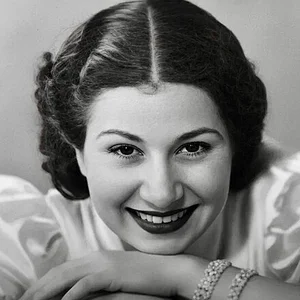

Umm Kulthum was an Egyptian singer and actress, one of the greatest voices of the Arab world in the 20th century. Nicknamed “the Star of the East,” she shaped generations through her radio-broadcast concerts and a repertoire blending love, patriotism, and classical poetry.
Oum Kalthoum(1898 — 1975)
Oum Kalthoum
royaume d'Égypte, République d'Égypte, Égypte, République arabe unie
8 min read
Frequently asked questions
Key Facts
- Oum Kalthoum naît vers 1898 dans un village du delta du Nil, en Égypte, et apprend le Coran avec son père, imam, ce qui forge sa technique vocale.
- Elle s'impose au Caire dans les années 1920-1930 comme la voix la plus célèbre du monde arabe, enregistrant pour la radio égyptienne dès 1934.
- Ses concerts mensuels du premier jeudi de chaque mois, diffusés en direct à la radio, paralysent littéralement les rues du monde arabe de 1937 aux années 1970.
- Après la défaite arabe de 1967 (guerre des Six Jours), elle donne des concerts de soutien dont les recettes sont reversées à l'État égyptien pour la reconstruction de l'armée.
- À sa mort en février 1975, ses funérailles au Caire rassemblent plusieurs millions de personnes, l'un des rassemblements populaires les plus importants du XXe siècle.
Works & Achievements
A masterpiece born from the collaboration with Mohammed Abdel Wahab, this song of over an hour is considered one of the greatest compositions in 20th-century Arabic music. It symbolizes the fusion between classical tradition and musical modernity.
A poem set to music by Riad Al Sunbati, Al Atlal is a meditation on lost love and melancholy. This title is regularly cited as the absolute pinnacle of Oum Kalthoum's art, her ability to modulate every syllable making it a unique work with each performance.
Inspired by the tales of One Thousand and One Nights, this song embodies Oum Kalthoum's ability to tell stories through song. It became one of her most popular signatures throughout the Arabic-speaking world.
Oum Kalthoum appeared in six feature films in classic Egyptian cinema, including Wedad (1936) and Salama (1945). These films allowed her to broaden her audience and establish herself as a national figure beyond music.
Following the defeat of 1967, Oum Kalthoum organized a series of concerts across the Arab world and in Europe, donating the proceeds to Egypt. This patriotic act reinforced her status as a political and cultural symbol beyond her artistic dimension.
Anecdotes
Every first Thursday of the month, all of Egypt came to a standstill: streets emptied, cafés filled up in front of radios to listen to Oum Kalthoum's concert broadcast live. It was said that even criminals ceased their activities that evening. This collective ritual lasted for decades and made her far more than a singer: a living national symbol.
In 1967, after Egypt's military defeat against Israel during the Six-Day War, Oum Kalthoum organized a concert tour across the Arab world and Europe to raise funds. She donated the entirety of the proceeds to the Egyptian state, contributing significantly to the reconstruction of the army. Her popularity transcended borders: she was a unifying figure for the entire Arab world.
Oum Kalthoum was renowned for her exceptionally long concerts: a single song could last three to five hours, as she repeated verses while improvising new melodic variations, responding to the audience's cries of enthusiasm. This technique, inherited from the tradition of tarab (Arab musical ecstasy), allowed her to draw listeners into a state of collective trance.
The daughter of a village imam in the Egyptian countryside, she memorized the Quran before she ever sang. Her father, upon discovering her extraordinary voice, disguised her as a boy so she could perform at religious ceremonies without causing scandal. It was thus, hidden beneath a turban, that Oum Kalthoum took her first steps on stage.
Upon her death in February 1975, four million people took to the streets of Cairo to accompany her funeral procession — one of the largest crowd gatherings in Egyptian history, comparable to the funeral of President Nasser in 1970. Embassies around the world reported that Arab nationals were openly weeping in the streets of Paris, London, and New York.
Primary Sources
"My voice is a gift from God, but it is daily labor that makes it an instrument. I repeat each musical phrase until it becomes as natural as my breathing."
"I sing for Egypt, for its soldiers, for its honor. As long as I have a voice, it will be in the service of this homeland."
"I ask you to compose for me a melody that speaks of love for one's homeland as much as of love for a man. These two feelings are, for me, inseparable."
"The French told me they do not understand the words, but that they feel the emotion. That is what universal music is."
Key Places
Oum Kalthoum's birthplace in the Dakahlia region. It was here that she learned the Quran from her imam father and that her musical vocation was born, nurtured by religious chanting and rural ceremonies.
The cultural capital where Oum Kalthoum settled in 1924 and built her entire career. Cairo was the stage for her greatest concerts, her collaborations with the finest Arab composers, and her monthly radio broadcasts.
One of the iconic venues where Oum Kalthoum performed before thousands of spectators. Her concerts there would sometimes last until dawn, the audience refusing to let her leave the stage.
In November 1967, Oum Kalthoum performed at the Olympia during her solidarity tour following the Six-Day War. The concert was an unexpected triumph: thousands of European and Arab diaspora spectators were overwhelmed by her voice.
The site of her wedding and her state funeral in 1975. Millions of Cairenes gathered there to pay their final respects, making the event one of the largest gatherings in modern Egyptian history.